Lal Kitab software
The chart is cast from the ascendant, the fixed numbers 1 to 12 go over the houses, and the nine debt patterns of the 1952 table and the sleeping planets and houses are checked for you. Every rule carries a label that says how far it has been checked, so you always know what you are reading.
Included in the Vedic plan, Rs 3,001 a month. No card needed. Sign in with Google to start.
Who it is for
You give Lal Kitab readings beside the Vedic chart, and you want the debts, the permanent houses and the sleeping planets worked out for each client in a minute. The Lal Kitab Home holds the whole reading of one kundli on a single page, so you can talk through it with the person in front of you.
It suits a careful reader. Lal Kitab rules are copied and changed from book to book, so this tool does not hide that. A rule, or a part of one, that even the later accounts do not settle says Not confirmed beside it, and the remedies keep our own gentle suggestions apart from the traditional upay.
What you can do with it
The Lal Kitab chart
- The chart is counted from the rising sign, with the fixed numbers 1 to 12 written over the houses.
- A ring marks a planet in its own permanent house (pakka ghar), and a grey house is a sleeping house. Both can be switched off.
- Sight lines from each planet to the houses it looks at, off, on hover or always.
- Point at a house to see the planets in it, who sees it and whose permanent house it is. Click to keep it open.
- A planet table with house, permanent house and state. Sleeping, Awake, or Awake in its own house.
- Click a planet row to open the planet panel.
- With no birth time, the houses are counted from the Moon's sign and the page says so.
The nine debts (rin)
- Nine patterns checked yes or no, as the table of debts in the Lal Kitab of 1952 gives them: pitri, matru, stree and swa rin, the relatives' debt, the daughter's or sister's debt, and daiviya, ajanma and nirdayi rin.
- Debts found come first. Each opens in place with its pattern, the planets in it and the reason in plain words.
- The reason names the houses, for example which planet is in which house.
- Move the mouse over a debt and its planets light up on the chart.
- The Rin page writes out every rule in a table, with a Found column, the reason and the planets.
- A note under each debt gives the 1952 table's own words for it and any second condition a later account adds, which never changes the answer.
Sleeping planets and houses
- A count of sleeping planets and houses at the top of the page.
- For each sleeping planet, the reason. It is not in its permanent house, and it looks at no house in the sight table, or at houses where no planet stands.
- For each sleeping house, the planet linked with it and where that planet stands now.
- One gentle habit beside each sleeping planet and house.
- The Planet States page gives the houses each planet sees, the planets it sees and the planets that see it.
- A grey note appears when a planet in houses 9 to 12 counts as sleeping only because the sight table stops at house 8.
Planet in house readings
- What later accounts of the Lal Kitab say about each planet in its house, in short summaries in our own words.
- 78 of the 108 planet and house pairs have a summary. The others say so and wait for the book check.
- These stay apart from the Vedic reading of the same planet, and they are worded as tendencies.
- The Planets and Houses page lists all nine planets and all twelve houses with sign, permanent house, state and who sees each house.
- More options adds the exalted and debilitated houses of the Sun and Saturn, the two planets with values so far.
Remedies
- For each debt found, three gentle suggestions, one each for service, charity and behaviour. These are our own, in plain words.
- One gentle habit for each planet.
- The Remedies page is ready to print, and can also show the suggestions for the debts not found.
- A switch under More options on the Lal Kitab Home adds the traditional upay as later accounts give them, 32 lines in all, by debt and by planet. It is off to start with.
- Each traditional line carries its label, and the tool asks for a full reading before anyone follows one.
- Acts that put an item in water or the ground carry a note to use a clean natural item and keep the water clean.
See it in the tool
Real screens from the tool, made with sample charts. Select a screen to see it larger.
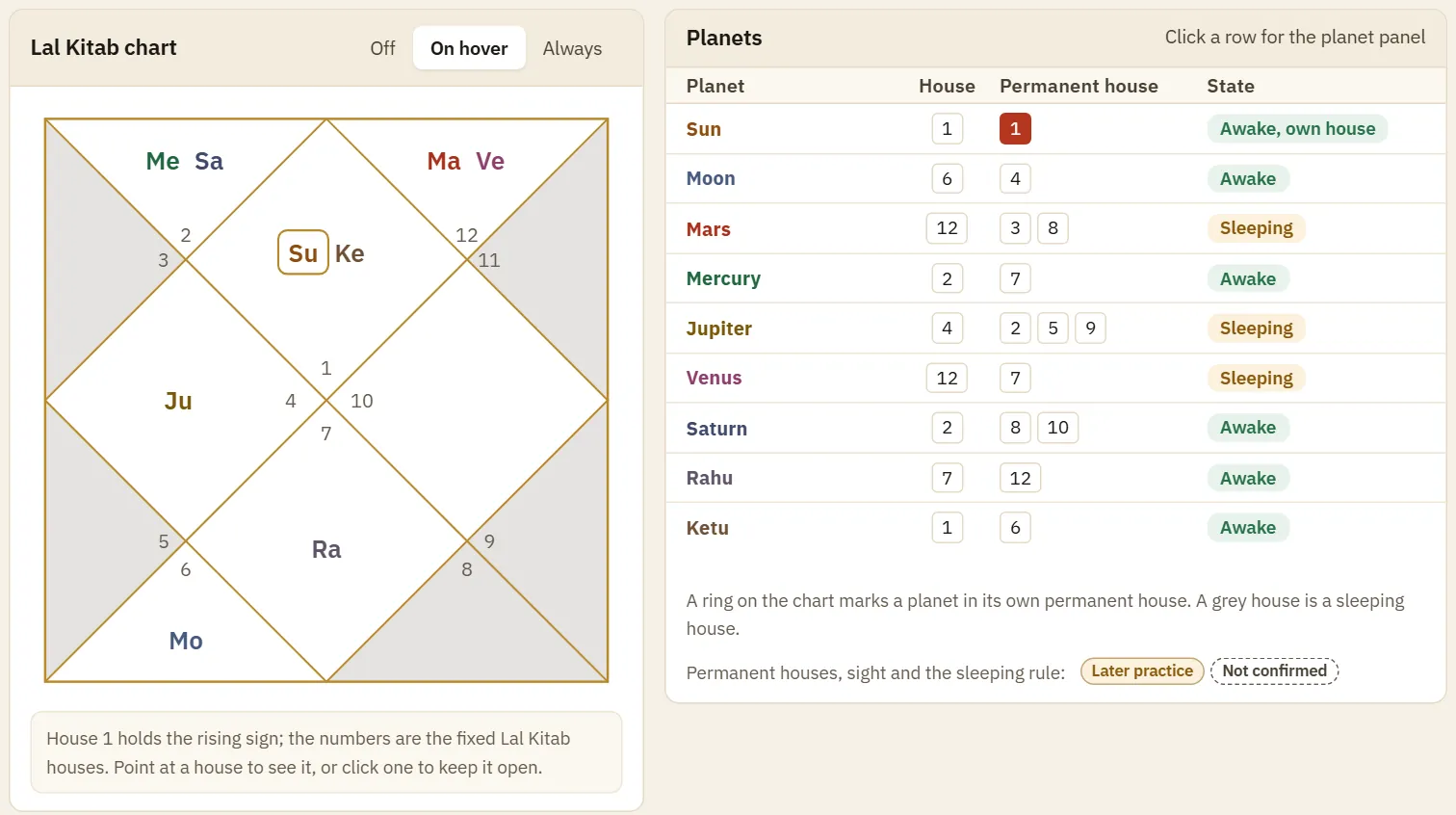
The Lal Kitab chart and the planets
House 1 holds the rising sign and the numbers are the fixed Lal Kitab houses. The table gives each planet's house, permanent house and state.
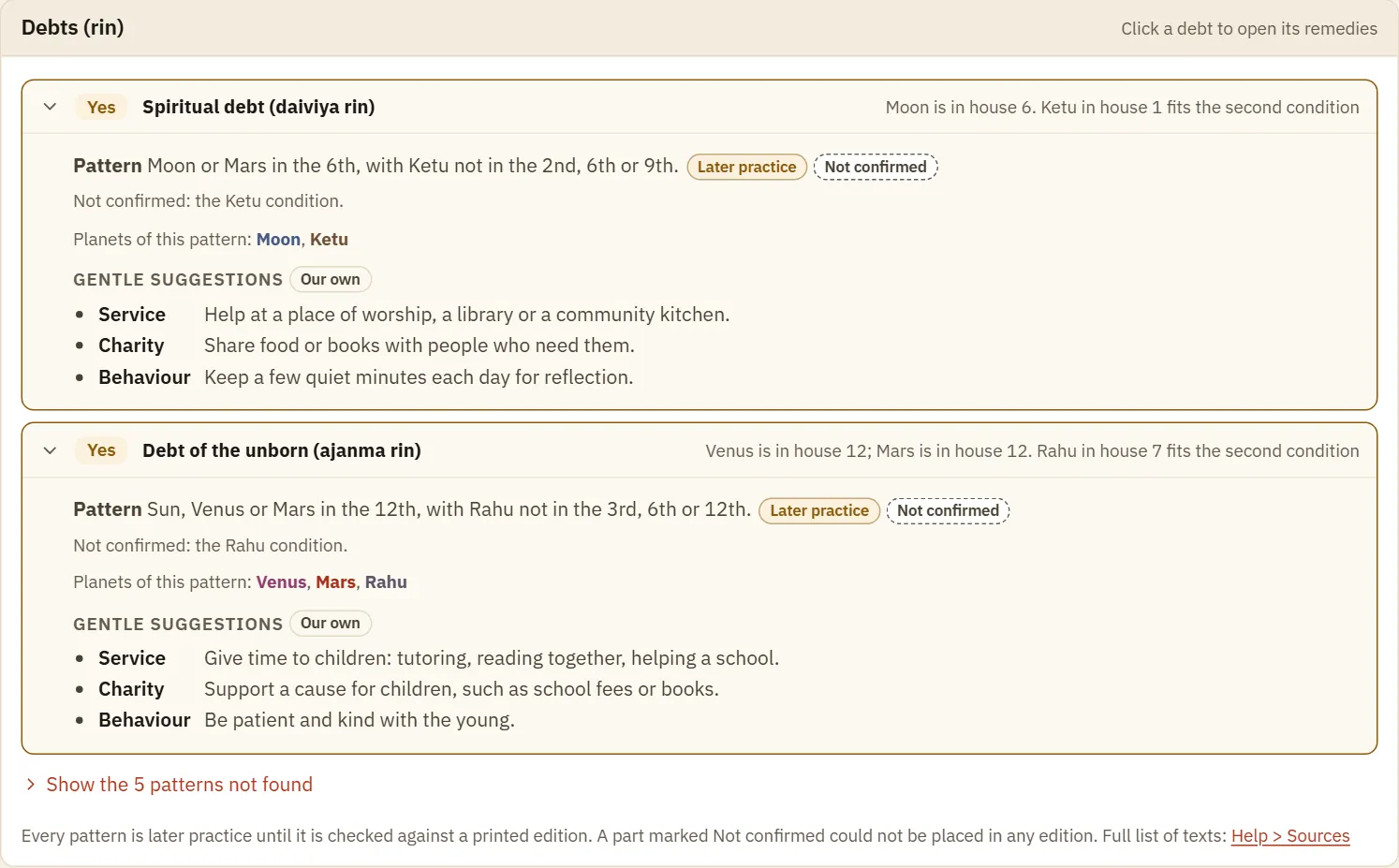
The debts, opened in place
A debt found opens with its pattern, its labels, the reason and three gentle suggestions. The patterns not found are one click away.
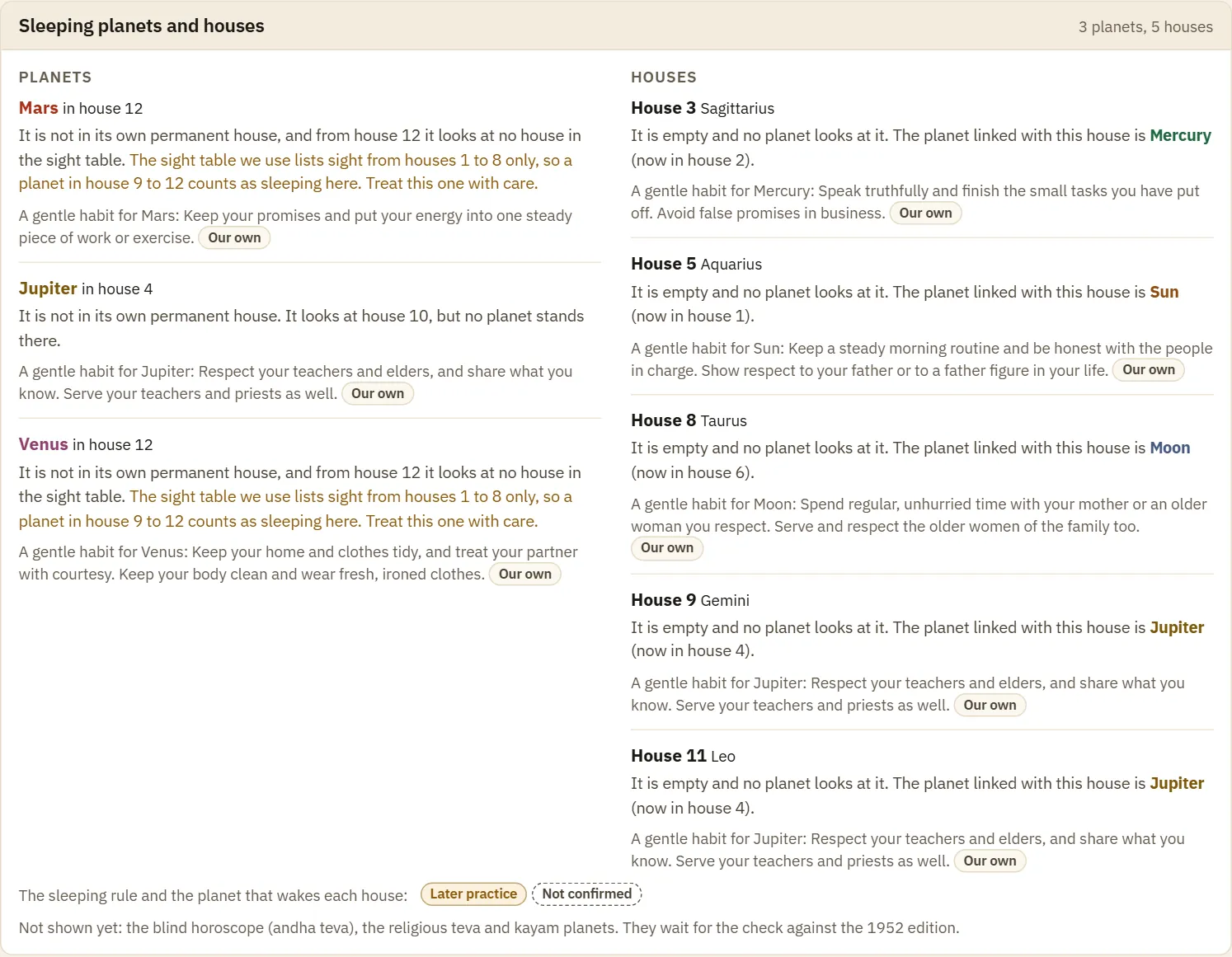
Sleeping planets and houses
Each sleeping planet has its reason and a gentle habit. Each sleeping house names the planet linked with it.
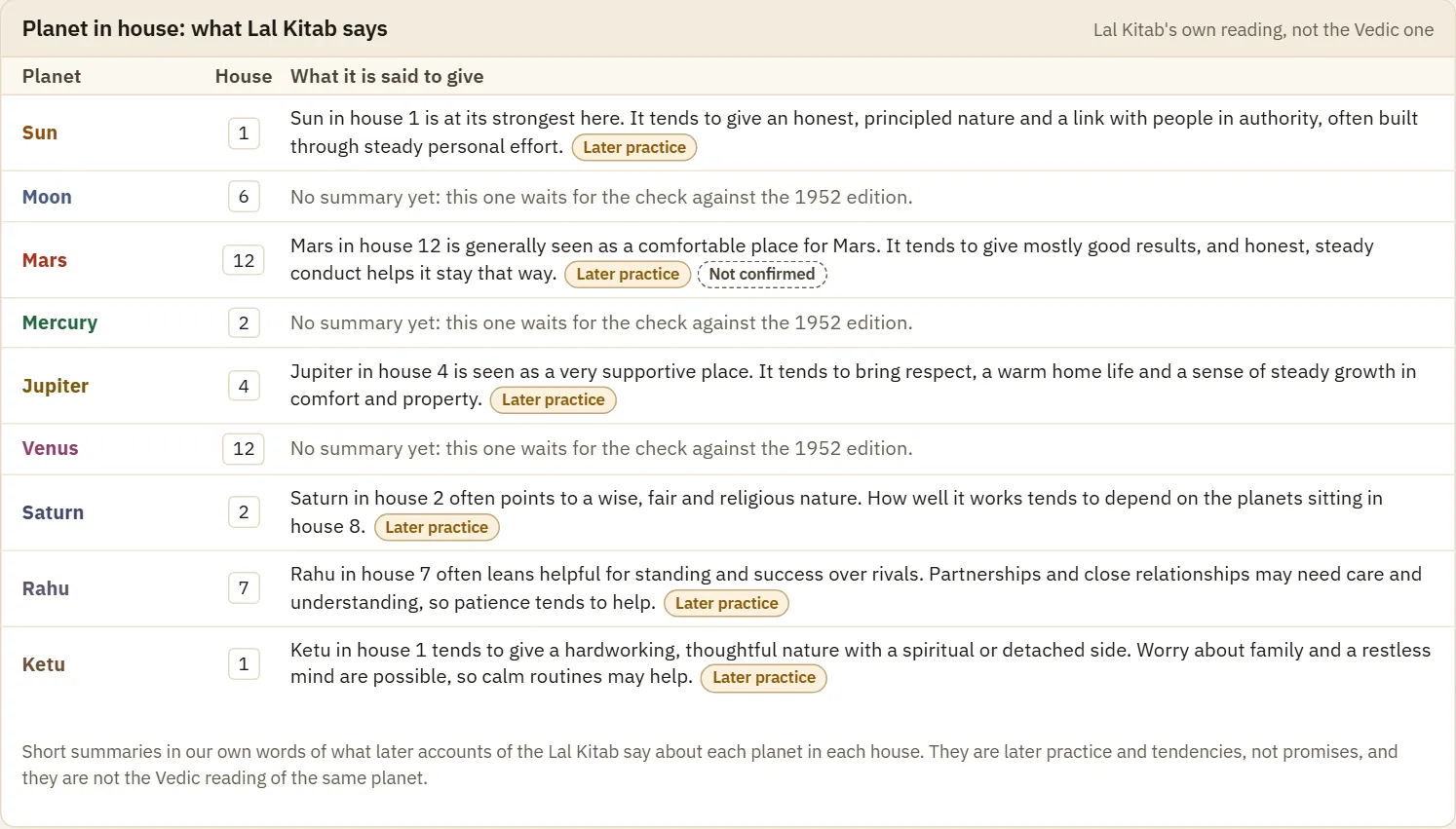
What each planet is said to give
Short summaries in our own words of what later accounts say about each planet in its house. A pair with no summary yet says so.
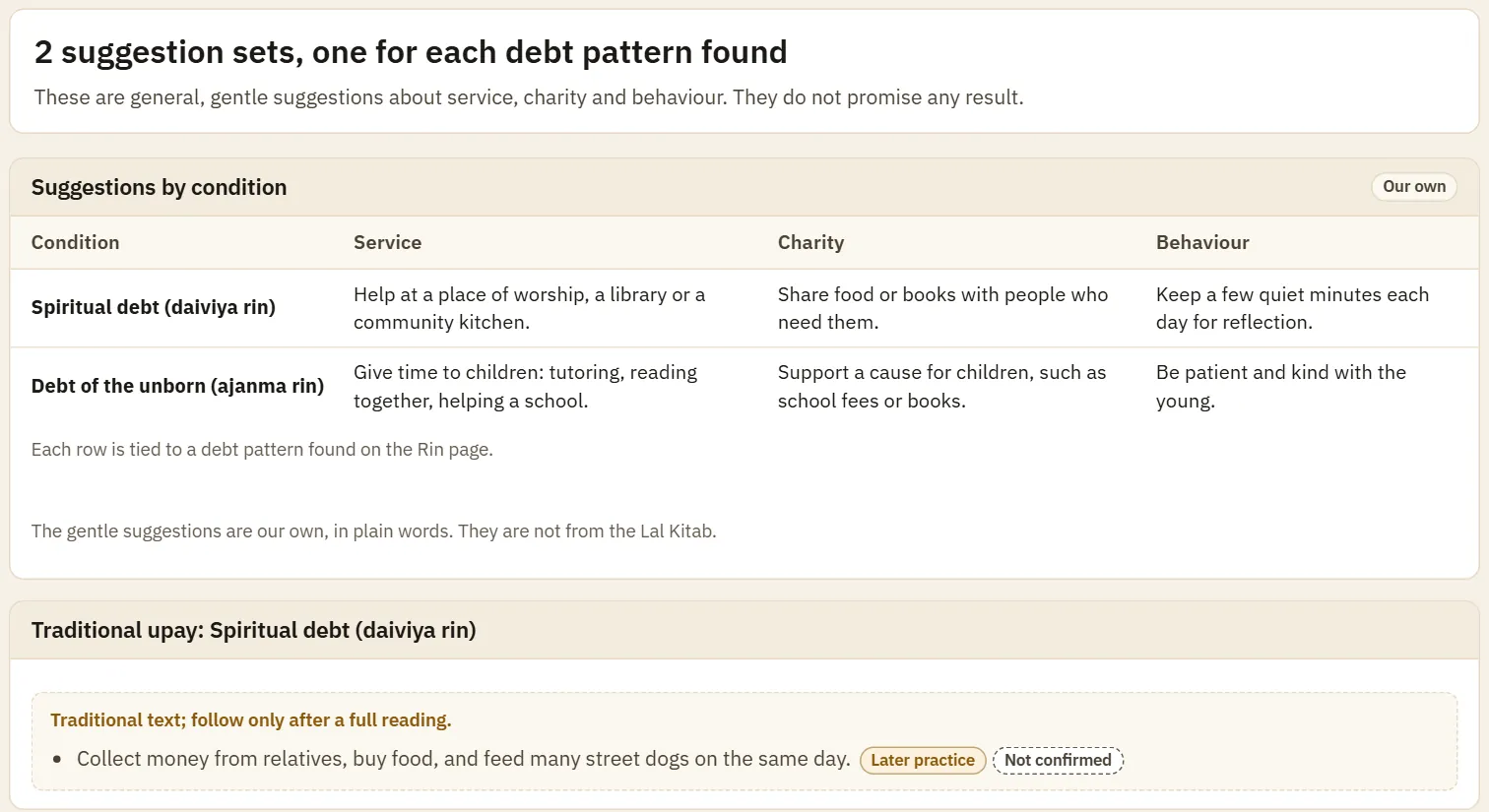
Remedies, with the traditional upay switched on
The gentle suggestions come first. The traditional upay appear only when you turn them on, and each line carries its label.
How it fits a sitting
- Open the client's kundli and go to Lal Kitab Home. The top line gives the count of debts, sleeping planets and sleeping houses.
- Show the chart. Explain which planets are at home in their permanent houses, and which houses are asleep.
- Open the debts found and read the reason together. Say plainly that a debt is a theme to be mindful of. It is not a curse.
- Go through what each planet is said to give, and use what fits the person's life.
- Choose one gentle habit with the person. One is enough. Turn on the traditional upay only if you and the client want them.
- Print the Remedies page for the client to take home.
Method and sources
Lal Kitab takes the birth chart as it is cast from the ascendant and writes the fixed numbers 1 to 12 over the houses, so a planet's house here is its whole-sign house from the rising sign. Debts, permanent houses, sight and sleeping states are all read from those houses. The nine debts follow the table of debts in the Lal Kitab of 1952 and are shown as Classical. No other rule has yet been read against a printed edition, so the rest are shown as Later practice. A rule, or a part of one, that even the later accounts do not settle, for example a condition that only one account gives or a house list that later lists give differently, is also shown as Not confirmed, with a note that says which part.
- Five Urdu books attributed to Pandit Roop Chand Joshi: Lal Kitab ke Farman (1939), Lal Kitab ke Arman (1940), Gutka (1941), Lal Kitab ke Farman, revised (1942), and Lal Kitab (1952). The table of debts in the 1952 book is read in the page-wise Hindi transliteration by Nirmal Kumar Bhardwaj (pp. 125 to 127), and the nine debts follow it. The other rules have not yet been checked against the books.
- The gentle suggestions are our own and are not from the Lal Kitab.
What it does not do
- Apart from the nine debts, the rules here have not yet been checked against the 1952 edition. They follow later accounts, in our own words, and nothing is quoted from the books.
- There is no Lal Kitab yearly chart (Varshaphal by age). Teva types, the blind horoscope (andha teva), artificial planets (Masnui) and fixed planets (Kayam) are left out until the book check.
- The sight table lists houses 1 to 8, with three special sights, so most planets in houses 9 to 12 count as sleeping. The page tells you when this applies.
- Exalted and debilitated houses are given for the Sun and Saturn only.
- The debts and readings are themes and tendencies. A remedy here promises no result, and nothing here is a prediction.
Questions
Is house 1 always Aries here?
No. The chart is cast from the ascendant, as any birth chart is, and then the houses carry the fixed numbers 1 to 12. So a planet's Lal Kitab house is its house from the rising sign, not the number of the sign it stands in.
Which planets have which permanent house?
Sun 1, Moon 4, Mars 3 and 8, Mercury 7, Jupiter 2, 5 and 9, Venus 7, Saturn 8 and 10, Rahu 12 and Ketu 6. Later lists differ on some of these, so the table carries the Not confirmed label.
Are the remedies taken from the Lal Kitab?
There are two kinds and they are kept apart. The gentle suggestions on service, charity and behaviour are our own. The traditional upay come from later accounts, are off to start with, and name no weekday. Anything that harms a living being or needs a costly item is left out.
Why are so many planets sleeping in my chart?
The sight table we use lists sight from houses 1 to 8 only, so a planet in house 9 to 12 that is not in its own permanent house counts as sleeping, apart from three special sights. The page marks those planets and asks you to treat them with care.
What if the birth time is not known?
The page still works, in a rough way. The houses are then counted from the Moon's sign, and every page says so. For a full reading it needs the birth time, because the rising sign sets house 1.
Does a debt in the chart mean a curse?
No. A debt here is a pattern of planets that later accounts link to a duty to family. Many charts have one or two. The page calls it a theme to be mindful of. For general remedies by the Vedic texts, see the Remedies tool.
Have another question?