Western astrology software
A Western desk in your browser, from the natal wheel to transits, progressions, time lords, horary and astrocartography. Every wheel and table follows one set of chart settings, and your reports go out on your own letterhead.
Included in the Western plan, Rs 5,001 a month. No card needed. Sign in with Google to start.
Who it is for
For an astrologer who reads tropical charts for clients, and for a Vedic astrologer adding Western work to the practice. Modern and traditional methods sit in one place, so Placidus and whole sign houses, Chiron and Lilith, Lilly's dignities and Hellenistic time lords are all a click apart.
Each page has a How to read strip in plain words, with the terms explained, so a method you have not used before is easy to follow. Your saved clients are the same ones you use across the tool, so a Western chart for a client is one click away.
What you can do with it
The birth chart
- Western Home puts the chart on one page, with the Sun, Moon and rising sign in one line, the wheel, the big three readings, the chart ruler, day or night chart and Moon phase, balance and patterns, and each planet's sign, house and dignity.
- Natal Wheel at full size. Click a planet to read its position, aspects and a short reading. Point at an aspect line to see which two planets it joins.
- Set the zodiac once, tropical or sidereal, with true or mean node and four wheel styles: Classic, Modern, Minimal and Print.
- Fourteen house systems, from Placidus and Koch to Regiomontanus, Porphyry and whole sign. The House Systems page lists the cusps of all fourteen and names the planets that change house between them.
- Positions and Houses gives each planet's sign, degree, house and dignity, the cusps with their rulers, and the four angles.
- Aspect Grid covers eleven aspects with orb, applying or separating. Change the orb of each aspect, or use orbs by planet (moieties) for traditional work.
- Patterns are found for you: grand trine, grand cross, T-square, yod, kite and stellium.
- Elements, modes, hemispheres and quadrants are counted, with the Ascendant in the count if you wish.
- Chart Readings covers the Sun, Moon, rising sign, each planet in its sign and house, and the major aspects in plain words.
Transits, progressions and returns
- Transits lays the sky of any date over the natal wheel. Step by hour, day, week, month or year, or press play and watch it move.
- Transit List gives the date a transit enters orb, each exact date and the date it leaves, over 1 to 24 months. A planet that turns retrograde has each exact pass dated, and house ingresses are listed too.
- Secondary Progressions, with three ways to move the angles: the Sun's arc in right ascension, Naibod, or mean quotidian.
- Progression List runs 5 to 40 years, with progressed aspects, the progressed Moon through signs and houses, Sun and Moon phases, stations and sign changes.
- Solar Arc Directions by the true arc, Naibod key or one degree a year, with exact dates up to 20 years ahead.
- Solar Return for any year, at the birth place or another place, with the natal planets around the wheel if you want them.
- Returns finds each return of the Moon, Sun and planets to Pluto. A slow planet's retrograde passes are grouped into one return.
- Tri-wheel shows natal, progressed and transits as three rings on one date.
Time lords and traditional work
- Forecast Timeline lines up profections, firdaria, zodiacal releasing and primary directions against the years of life. Point at any age to read all four.
- Annual Profections from the Ascendant, Sun, Moon or Lot of Fortune, with the Lord of the Year, monthly profections and the transits to that lord.
- Firdaria for day and night births, with major periods and seven sub-periods. Choose where the nodes go, since the old authors differ.
- Zodiacal Releasing from Spirit or Fortune, to four levels, with peak periods and the loosing of the bond marked.
- Primary Directions by Placidus semi-arc, zodiacal and mundane, direct and converse, with the Ptolemy, Naibod or solar arc key and a full speculum.
- Essential Dignities with Lilly's table or the Hellenistic table, accidental scores, sect, mutual receptions, terms, faces and the almuten of the chart and of each house.
- Arabic Parts lists 19 lots with day and night formulas and the source of each. Two more, the lots of illness and death, stay hidden unless you switch them on.
- Declinations and Antiscia shows out of bounds planets, parallels, contra-parallels, antiscia and contra-antiscia.
- Horary after William Lilly lays out the considerations before judgement, the significators, and perfection by translation, collection, prohibition and refranation. Every line is an indication, not a promise.
- Electional Finder searches up to 90 days against 13 conditions you mark off, preferred or required, and ranks the windows with reasons.
People and places
- Synastry compares two saved charts with an aspect grid, house overlays in both directions and both charts in one wheel, and puts the closest links in plain words.
- Composite Chart builds the midpoint chart. Davison Chart casts a real sky for the midpoint in time and place, so it has speeds and retrograde marks.
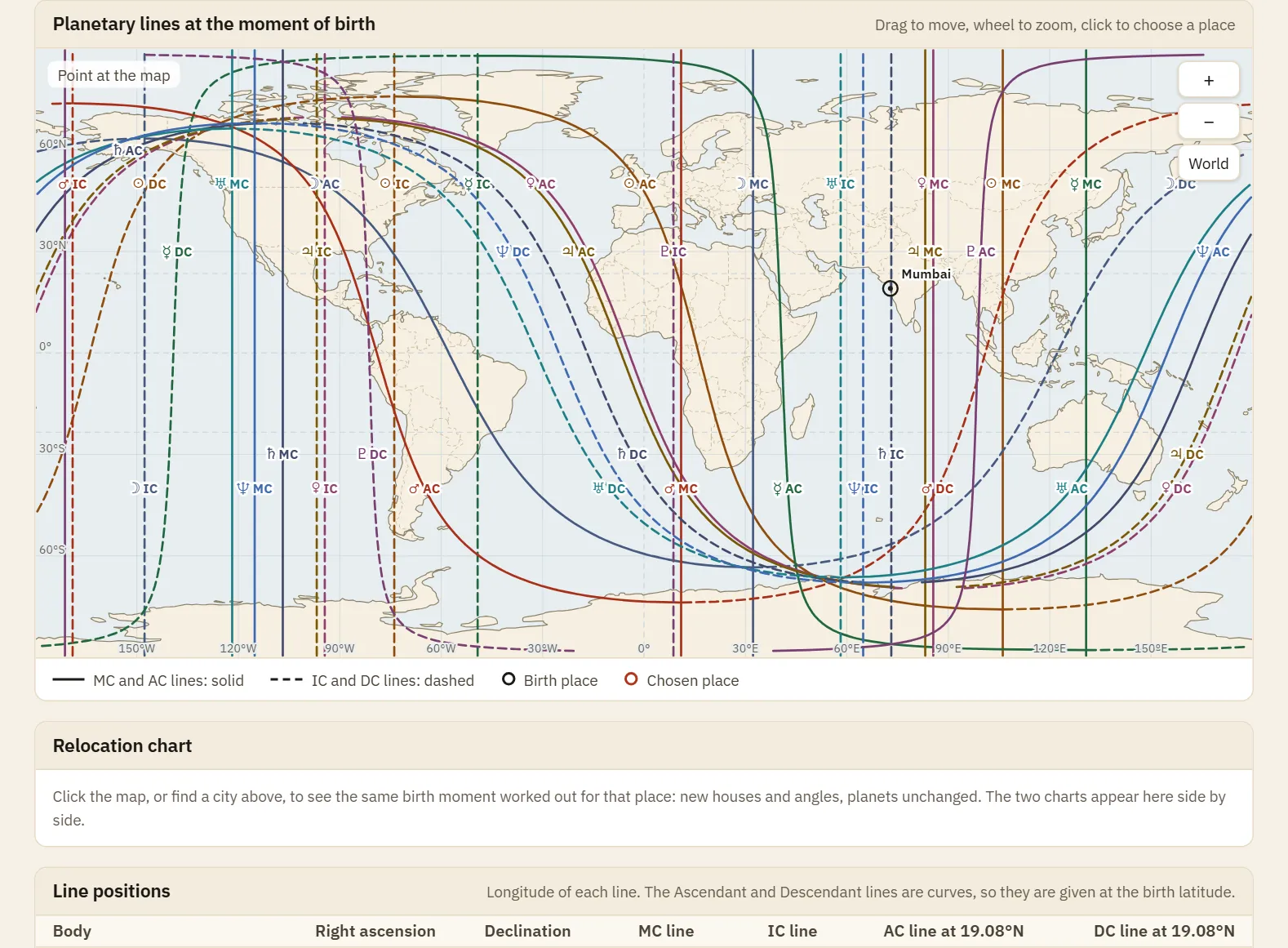
- Astrocartography Map draws rising, setting, top and bottom lines for the ten planets, the nodes, Chiron and Lilith on a world map.
- Click any place, or find a city, for its relocation chart with new houses and angles.
- Parans by latitude, local space lines and a table of line positions sit under the map.
- A places list ranks cities near the lines for nine themes, such as work, love, home and fresh starts. The planet and angle rule behind each theme is shown, and you can change it.
Analysis and extra points
- Harmonic Charts from 1 to 360, with the conjunctions in each and a spectrum that ranks the strongest.
- Midpoints in order of degree, and a midpoint tree for any planet, with the 90 and 45 degree relations if you want them.
- The dial comes in 90, 45 and 360 degree forms. The pointer snaps to points and midpoints, and an outer ring can show transits, solar arc or progressions.
- Graphical Ephemeris draws moving planets against natal points, with every exact crossing listed by date.
- Rectification Assistant takes dated life events, tests a window of birth times against transits, progressions and solar arc, and ranks the times with reasons. A chosen time saves as a new chart, and the client's chart stays as it was.
- Asteroids and Centaurs lists 63 bodies, from Ceres to Eris and Sedna, with aspects to your natal points. Tick one to draw it on the wheel.
- Fixed Stars covers 151 stars, with conjunctions, parans and filters for the Behenian and royal stars.
- Points settings picks what shows on every wheel, including lots, the Vertex and the East Point.
Calendars, printouts and reports
- Astro Calendar shows eclipses, Moon phases, sign changes, stations and void of course Moon, for a month or a year from 1900 to 2074, in the time zone you choose.
- Ephemeris prints daily positions for a month or a year, at 0h or 12h universal time, on A4.
- Aspectarian lists every exact aspect by date and time, planet to planet or to one natal chart, on A4.
- Chart Workspace puts two to four wheels side by side, each natal, progressed or transit, from any saved chart. Point at a planet and it lights up in all of them.
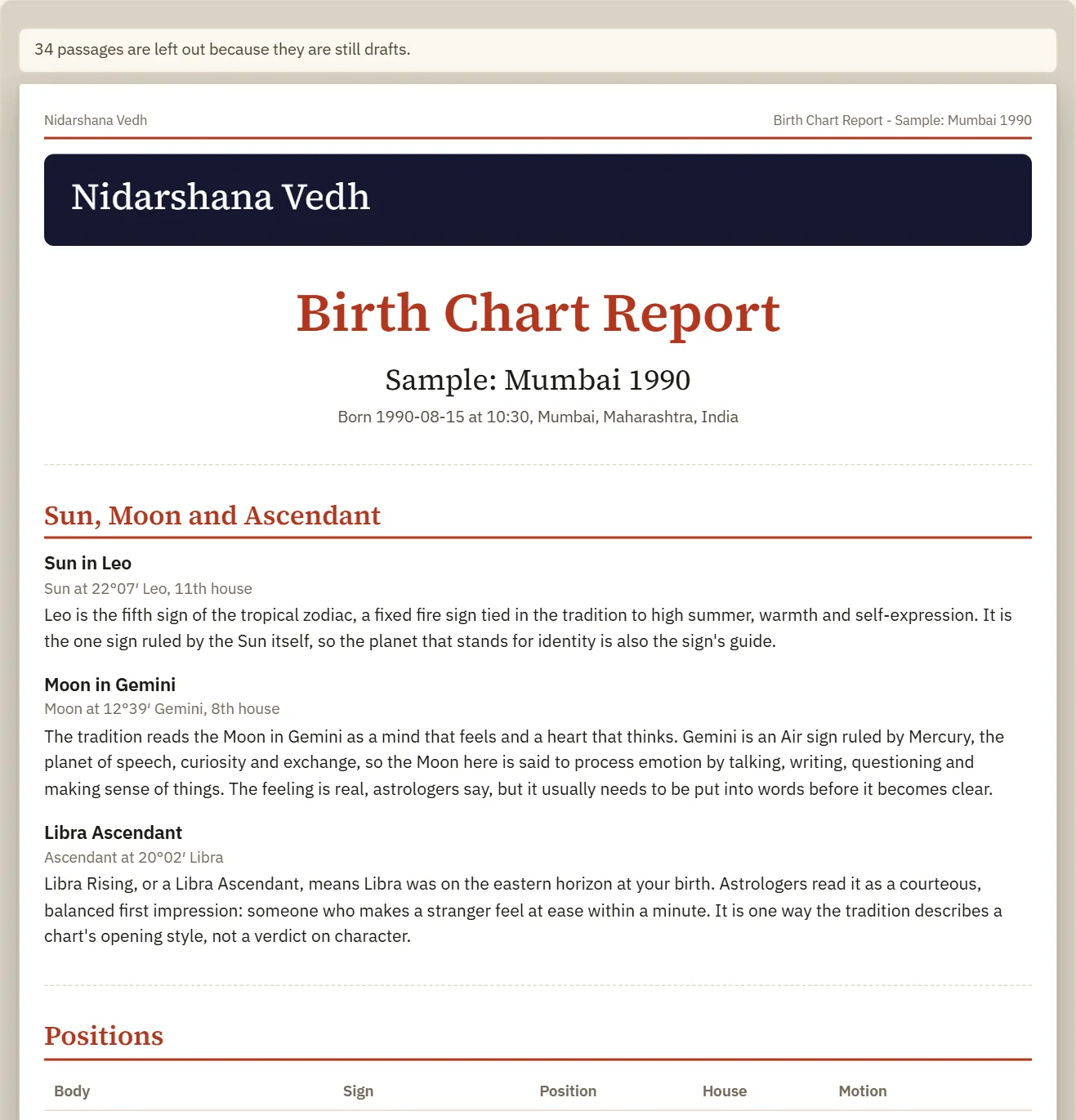
- Report Writer makes three kinds of report: birth chart, twelve-month forecast and relationship. Tick the sections, see the preview, and print or save a PDF on your letterhead, for one client or several.
- AI Client Report drafts a personal report in one of four tones. Each sentence keeps the placement it came from, and nothing prints until you have read it and ticked the review box.
- Interpretation Library holds every passage reports use, with its source. Edit the wording, approve it, and export your edits as a file.
- Chart File Exchange brings charts in and sends them out as AAF, CSV or labelled text.
See it in the tool
Real screens from the tool, made with sample charts. Select a screen to see it larger.
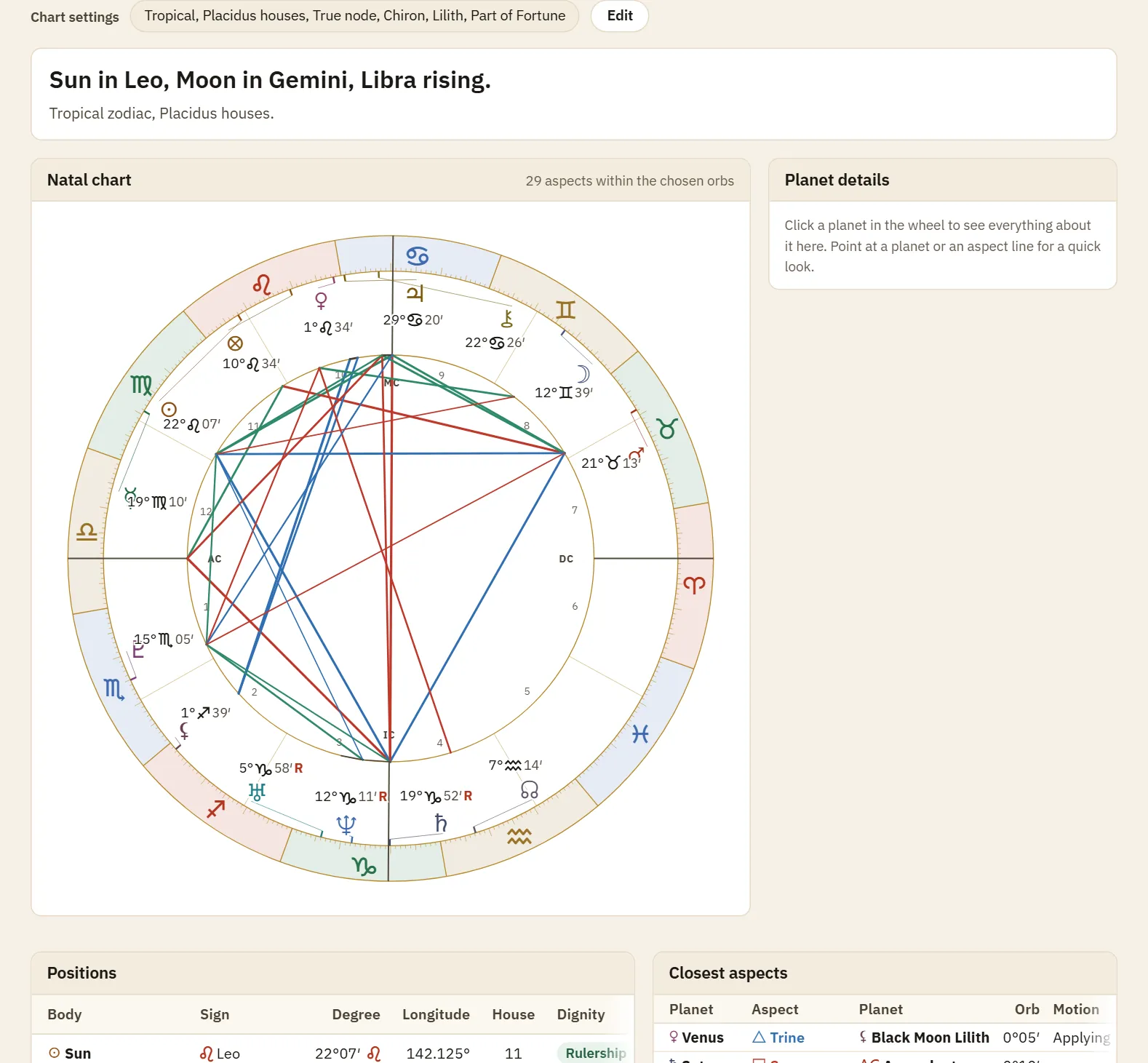
Natal Wheel
The birth wheel at full size, with its aspect lines. Blue lines flow easily and red lines are tense. Click a planet to read about it beside the wheel.
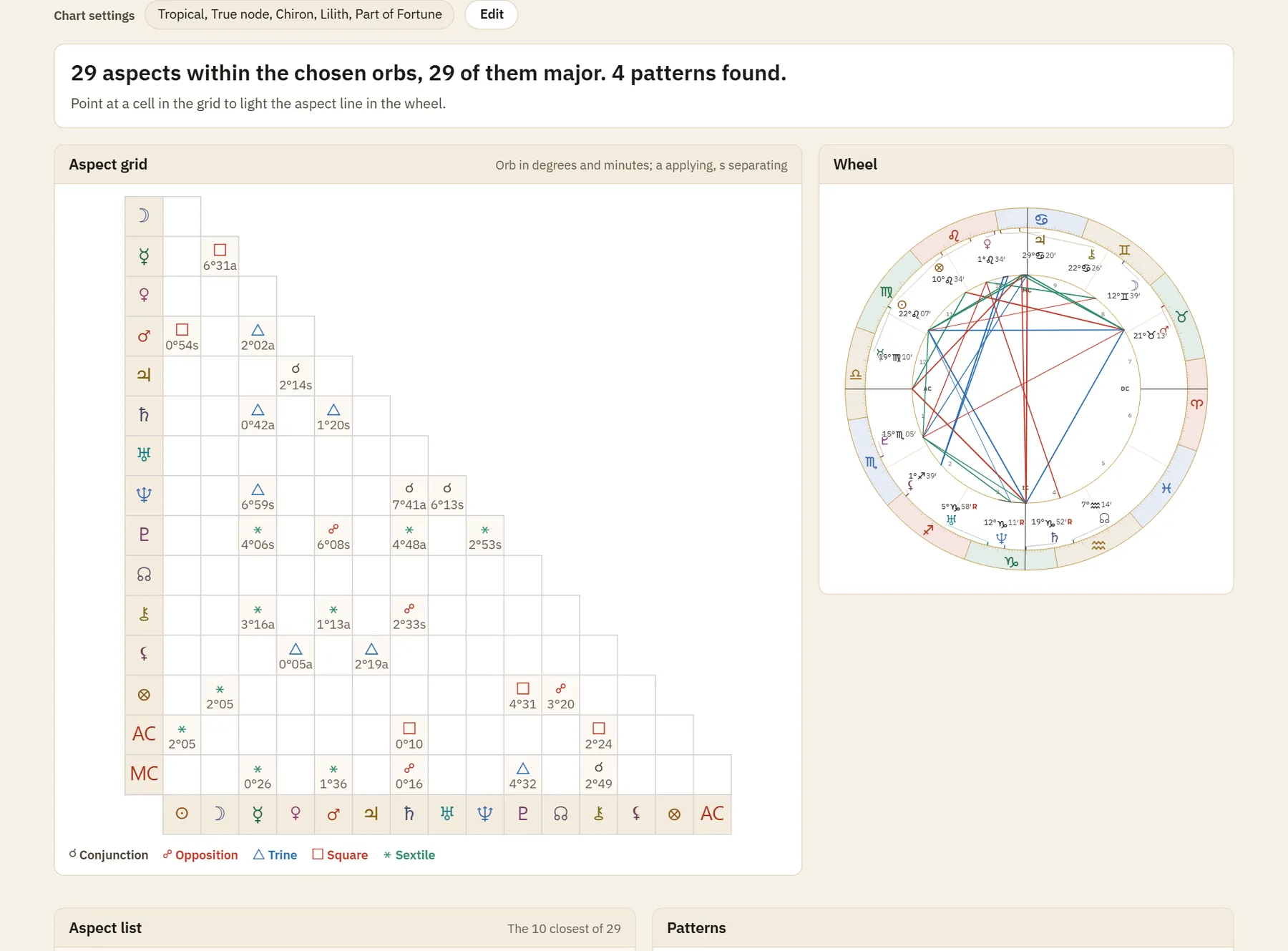
Aspect grid and patterns
Each box gives the orb and whether the aspect is applying or separating. Point at a box and its line lights up in the wheel.
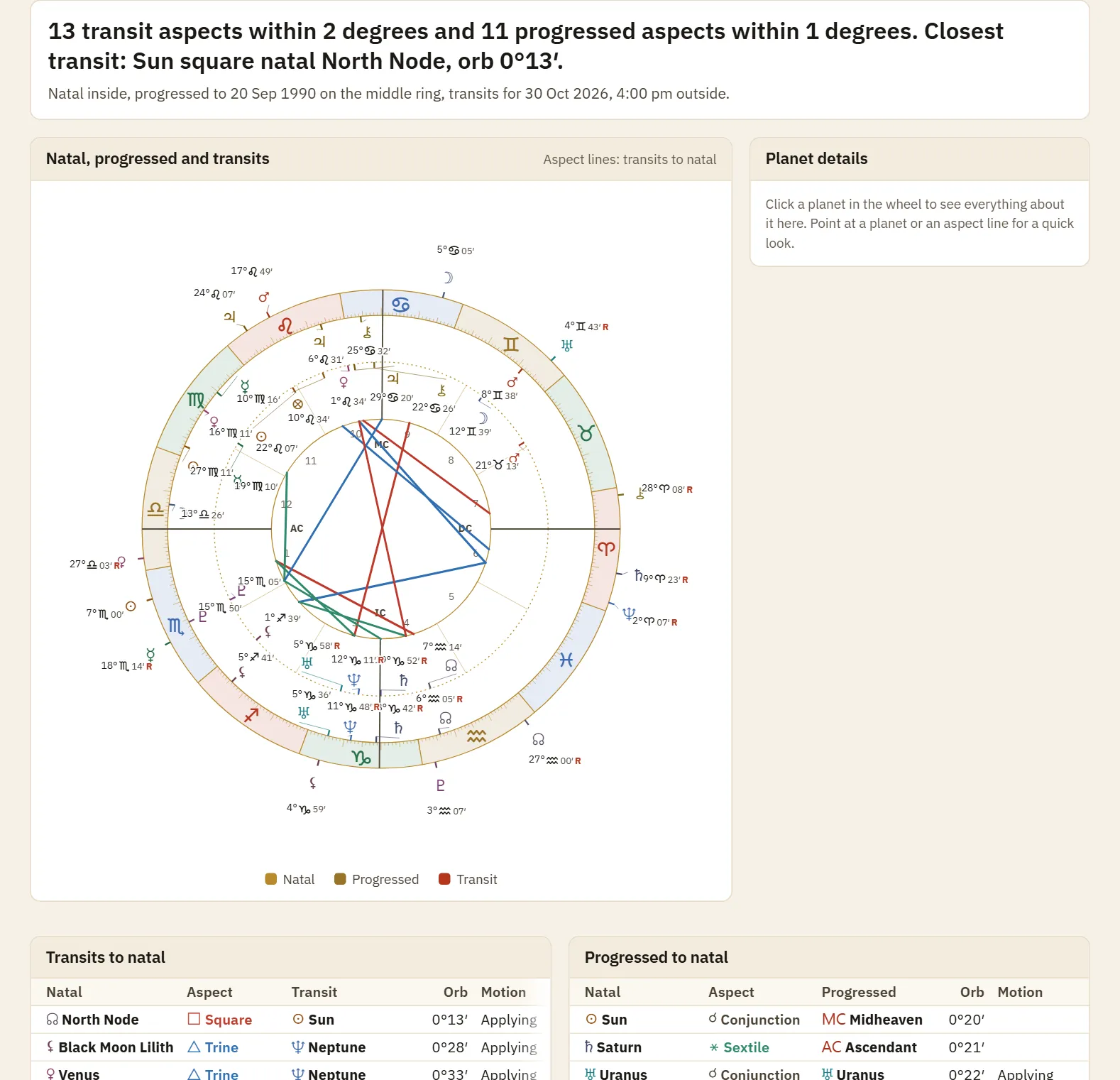
Tri-wheel
Natal inside, progressed in the middle and transits outside, all moved by one date bar.
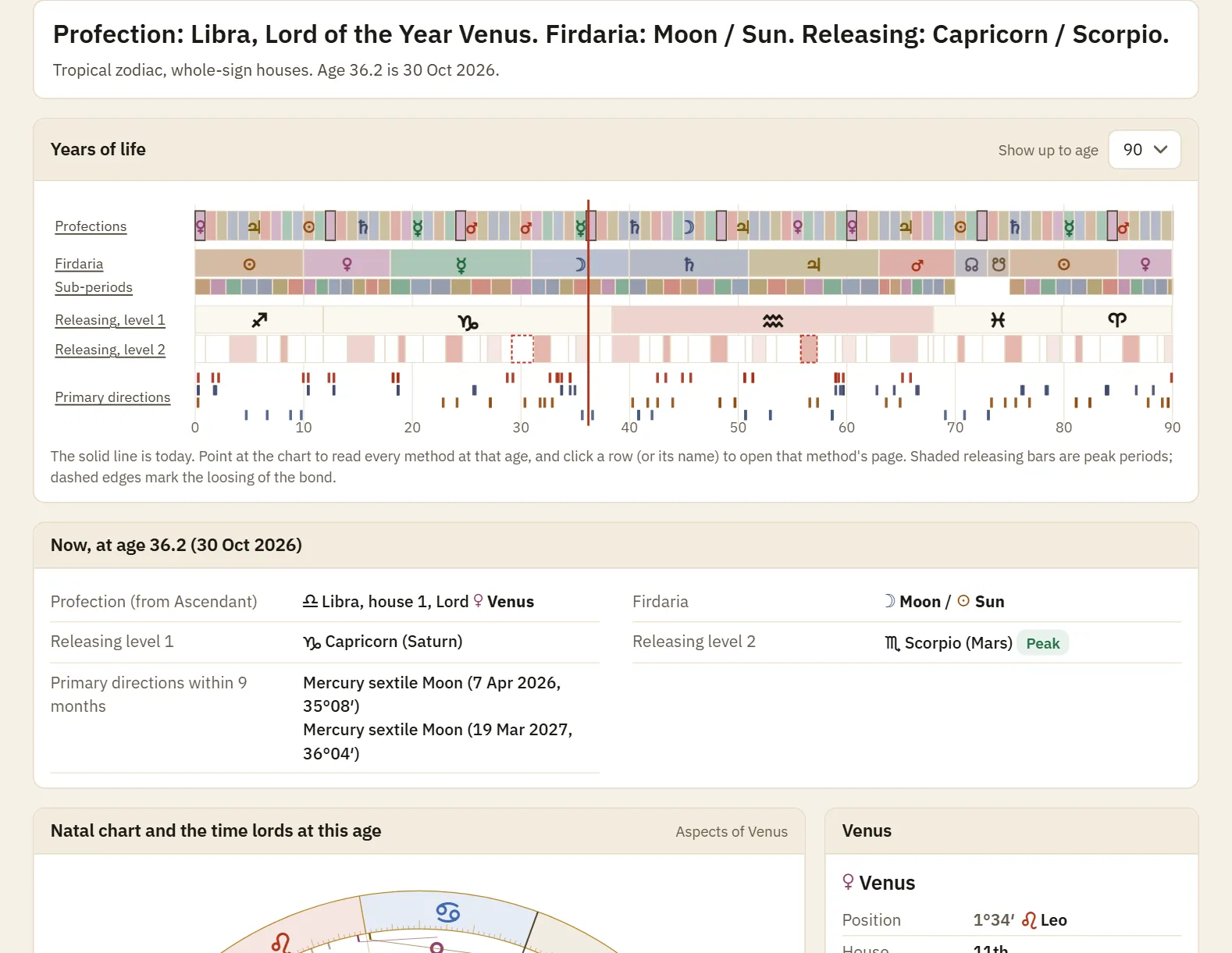
Forecast Timeline
Four time lord methods against the years of life, with a line for today. Years where they agree stand out.
Astrocartography map
Planet lines at the birth moment on a world map. Click a place to see the relocation chart.
Report Writer
A birth chart report on your letterhead, written from the library. Passages still marked as drafts stay out until you approve them, and the page tells you how many.
How it fits a sitting
- Open the client's saved chart on the Natal Wheel and read the Sun, Moon, rising sign and the patterns.
- Open the Forecast Timeline to see which time lords are running this year.
- Use the Transit List and the Tri-wheel to date what the client is asking about.
- For a relationship question, open Synastry and the Composite Chart with both saved charts.
- For a question with no birth data, cast a Horary chart for the moment it was asked.
- Finish in the Report Writer, tick the sections, read the preview, and print or save the PDF.
Method and sources
Planet positions come from NASA JPL DE440 tables, and houses and angles are worked out from the birth moment and place. Where the old authors disagree, the page marks the point as disputed and gives you the choice. Readings describe tendencies for reflection, not fixed events.
- Dignities and horary: William Lilly, Christian Astrology (1647).
- Arabic parts: Al-Biruni, The Book of Instruction (1029), and the lots of Paulus Alexandrinus.
- Profections and zodiacal releasing: Vettius Valens, Anthology book IV.
- Firdaria: Abu Ma'shar and Bonatti. Primary directions: Placidus and Ptolemy.
- Eclipses: Jean Meeus, Astronomical Algorithms, checked against the NASA catalogue.
- Asteroids: NASA JPL small-body orbits. Fixed stars: Yale Bright Star Catalogue with IAU star names.
- Maps: Natural Earth. Cities: GeoNames.
- Reading text: Nidarshana Vedh's own guides, and Alan Leo, How to Judge a Nativity (1903), in modern wording.
What it does not do
- Primary directions take every point on the ecliptic, without latitude. Directions in mundo with latitude are not built.
- It does not open other programs' own chart files. Move charts by AAF or CSV, and check the time zone of a chart or two after importing.
- The Fixed Stars page gives positions and contacts, with no written meaning for each star.
- Report text is in English. Without a birth time, the houses, angles, lots, zodiacal releasing and primary directions are left out.
Questions
Can I read sidereal charts here?
Yes. Choose Sidereal in Chart settings and the wheels follow, with the ayanamsa set in Settings. Traditional pages such as Dignities, Arabic Parts, Declinations and the time lords always use tropical signs, and so does Chart Readings, because those methods and texts belong to the tropical zodiac. The page says so when this happens.
Which house system does it start with?
Placidus, with the true node, and Chiron, Lilith and the Part of Fortune on the wheel. Change them once in Chart settings and every Western page follows.
What if the birth time is not known?
The planets and signs still work, and Sun and Moon profections need only the date. The Rectification Assistant can help you test a window of times against life events, and the result is an aid for your judgement, not a verdict.
Can I change the wording of reports?
Yes. Open the Interpretation Library, edit a passage in your own voice and approve it. Passages still marked as drafts stay out of client reports unless you choose to include them. Your edits are kept on the device, so export them before moving to another one.
Do I have to use AI for reports?
No. The Report Writer builds reports from the library text with no AI. The AI reader is there if you want a draft in a chosen tone.
Can it do horary without a birth chart?
Yes. Horary and the Electional Finder need only a place and a time, so they work with no client chart open.
How do I compare two people?
Save both as clients. Synastry, the Composite Chart and the Davison Chart then offer them in a list. The kundli matching tool is the Vedic side of the same question.
Have another question?