Kundli matching software
Kundli Milan for two people, with both charts on screen, the eight-fold score out of 36, and the checks that can raise a flag even when the score is high. It then shows the dashas the two will share and the stretches where marriage indicators gather.
Included in the Vedic plan, Rs 3,001 a month. No card needed. Sign in with Google to start.
Who it is for
Families often arrive with a score and a worry. This tool is for the astrologer who has to explain what stands behind that number, which dosha is cancelled and why, and what the two charts say that 36 points cannot.
Every page starts with the same two people, so you move from the score to the doshas to the dashas without entering anything twice. South Indian practice is covered too, with the four extra Dashakoota factors kept beside the score.
What you can do with it
Kundli Milan
- Pick each person from your saved kundlis, or type in new details without saving them as a client.
- Birth charts side by side, then both Navamsa charts. Each chart has its own selector for the birth chart, the Moon chart or a divisional chart.
- The eight gunas, Varna, Vashya, Tara, Yoni, Graha Maitri, Gana, Bhakoot and Nadi, in a colour-coded table with each person's value. Click a row for what it measures.
- The total out of 36 with its band, very high, good, acceptable or below the usual minimum of 18.
- Boy and girl roles follow the saved gender. Change them with one click, and Swap trades the two sides.
- Match by Moon star only, by picking nakshatra and pada, for when the birth time or place is not known.
- Show each person's planets inside the other person's chart.
Links between the two charts
- Links view draws arrows for Moon to Moon, each 7th lord to the other Lagna, the boy's Venus and the girl's Jupiter to the other 7th house, and Mars to Mars.
- The same links are written out in a table, so they can be read and printed.
- A planet by planet table for the Lagna, Navamsa or Moon chart, with the signs apart and the house each planet lands in the other chart.
Dosha checks
- Nadi and Bhakoot, with the classical exceptions that apply to this pair, such as the same nakshatra in different padas or Moon signs that share a lord.
- Gana for both people, with its points.
- Manglik for each person, with the cancellations that hold, and a plain comparison of the two.
- Kaal Sarp for each person, as a separate check.
- Rajju, Vedha, Stri-Dirgha and Mahendra on the Dashakoota page, marked favourable, neutral or flagged, with the rule and its exceptions. They are read beside the score, never added to it.
Dasha match and timing
- Each person's Antardasha as a strip for the next 5, 10 or 20 years, and a Together strip coloured for each shared stretch.
- A stretch by stretch table saying why each one is coloured as it is.
- Both Vimshottari trees side by side, opened to the same date with Go to date.
- For each person, the marriage planets, the 7th lord, planets in the 7th, Venus, and Jupiter for a woman, with what is classical and what is later practice marked.
- The top four to six stretches of the next six years, graded very good, good or fair, each with its reason, the sub-period lord, Jupiter's transit, or the Jupiter and Saturn double transit.
- Stretches the two share, or the closest pairings when none overlap.
Keep and hand over
- A match sheet where you choose what prints, the details, charts, Navamsa, gunas, Manglik and the South Indian factors.
- Your own notes for the client, printed under the verdict. Print it or save it as a PDF.
- Saved matches with the score, date and a note. Open one to put both people back on the page.
See it in the tool
Real screens from the tool, made with sample charts. Select a screen to see it larger.
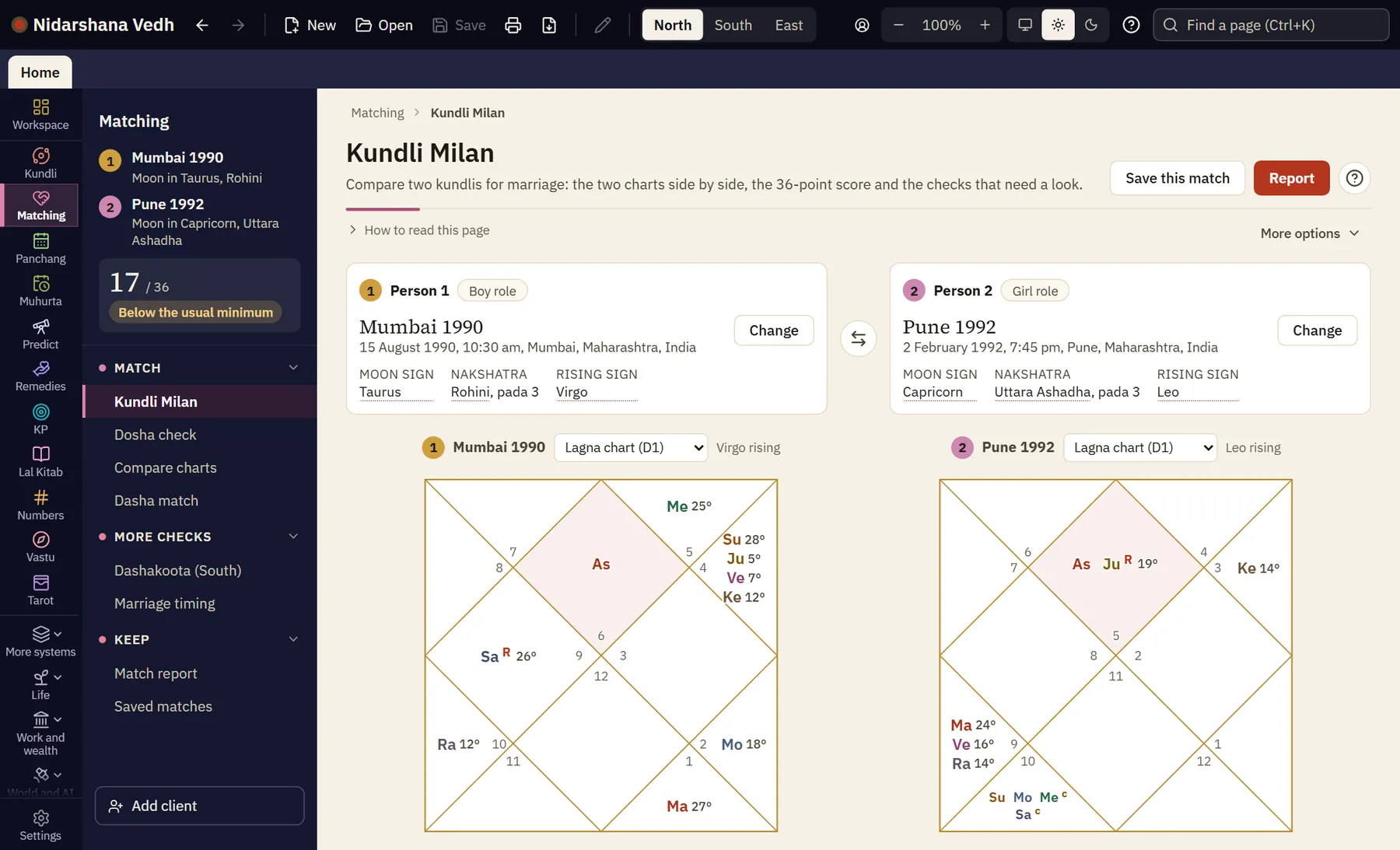
Two people, two charts
The two people sit at the top of every matching page. Their birth charts come first, each with its own selector, so you read the charts before the number.
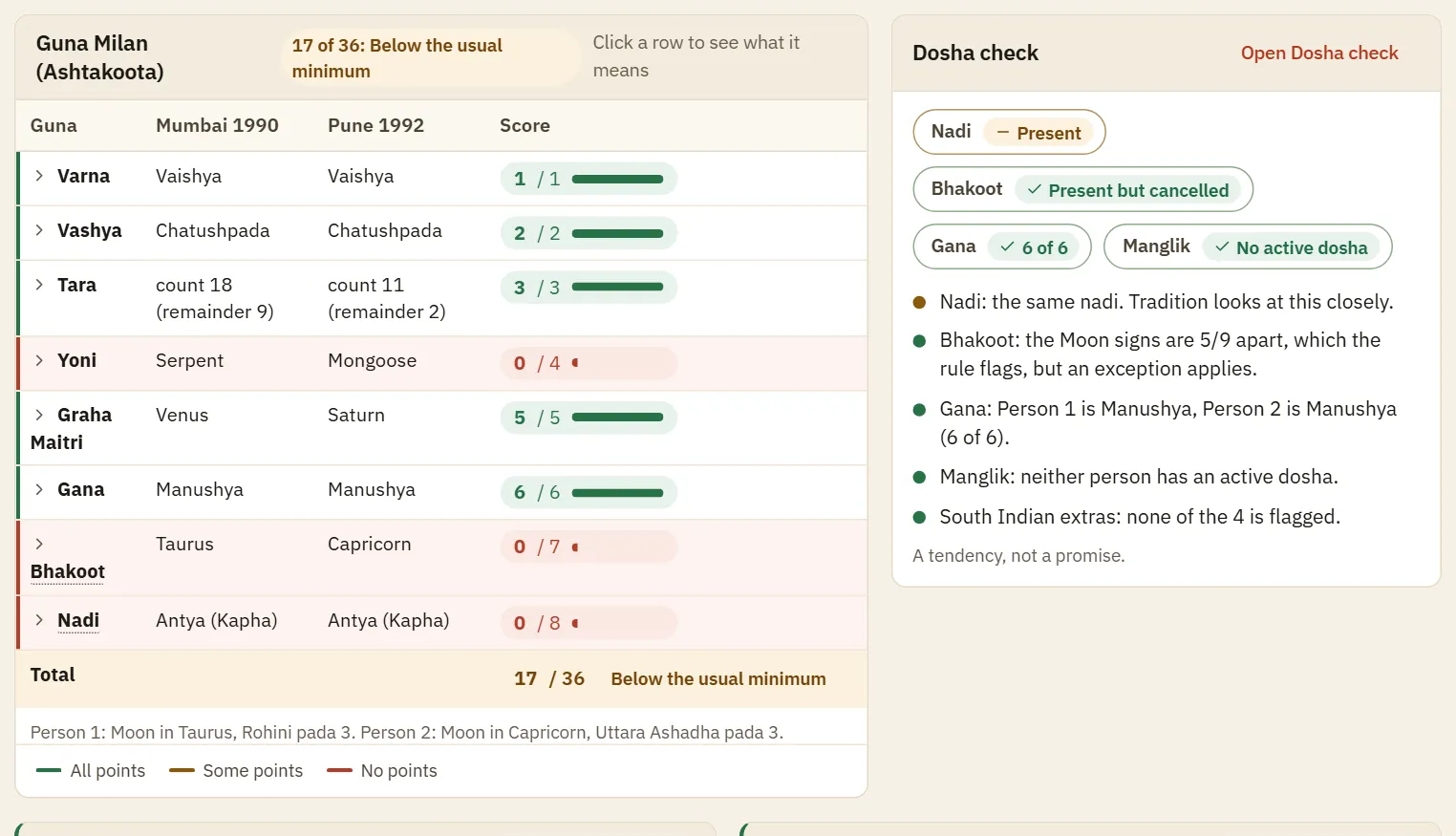
The Guna table and the flags
Green rows took every point, amber some and red none. The panel beside it lists the checks to look at and says each one in a short line.
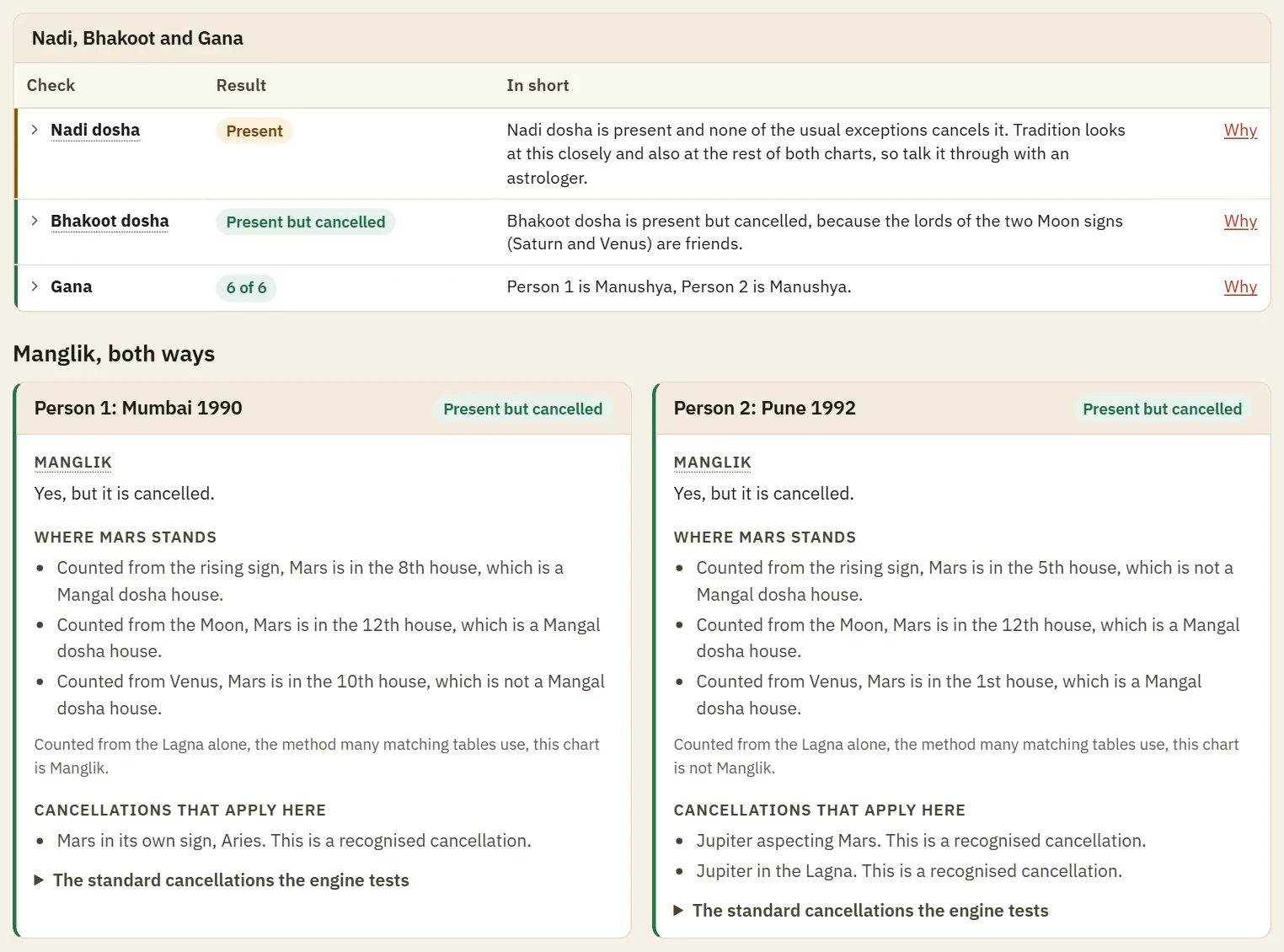
The Dosha check
Nadi, Bhakoot and Gana in a table, then Manglik both ways. Open a row to see the rule and the exceptions that apply.
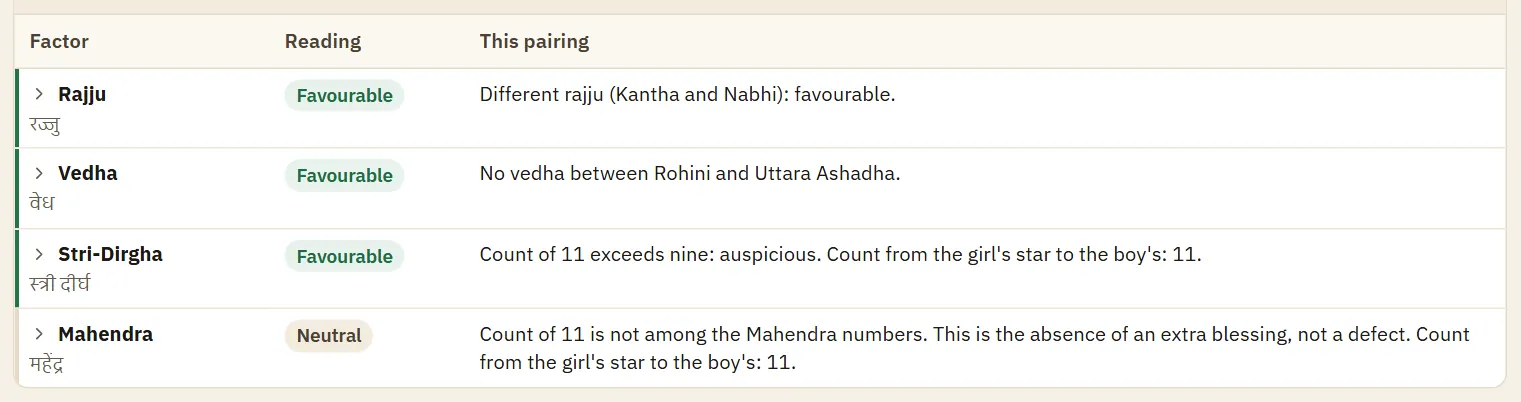
The four South Indian factors
Rajju, Vedha, Stri-Dirgha and Mahendra for this pair. Click a row for the rule, the exceptions, and what applies here.
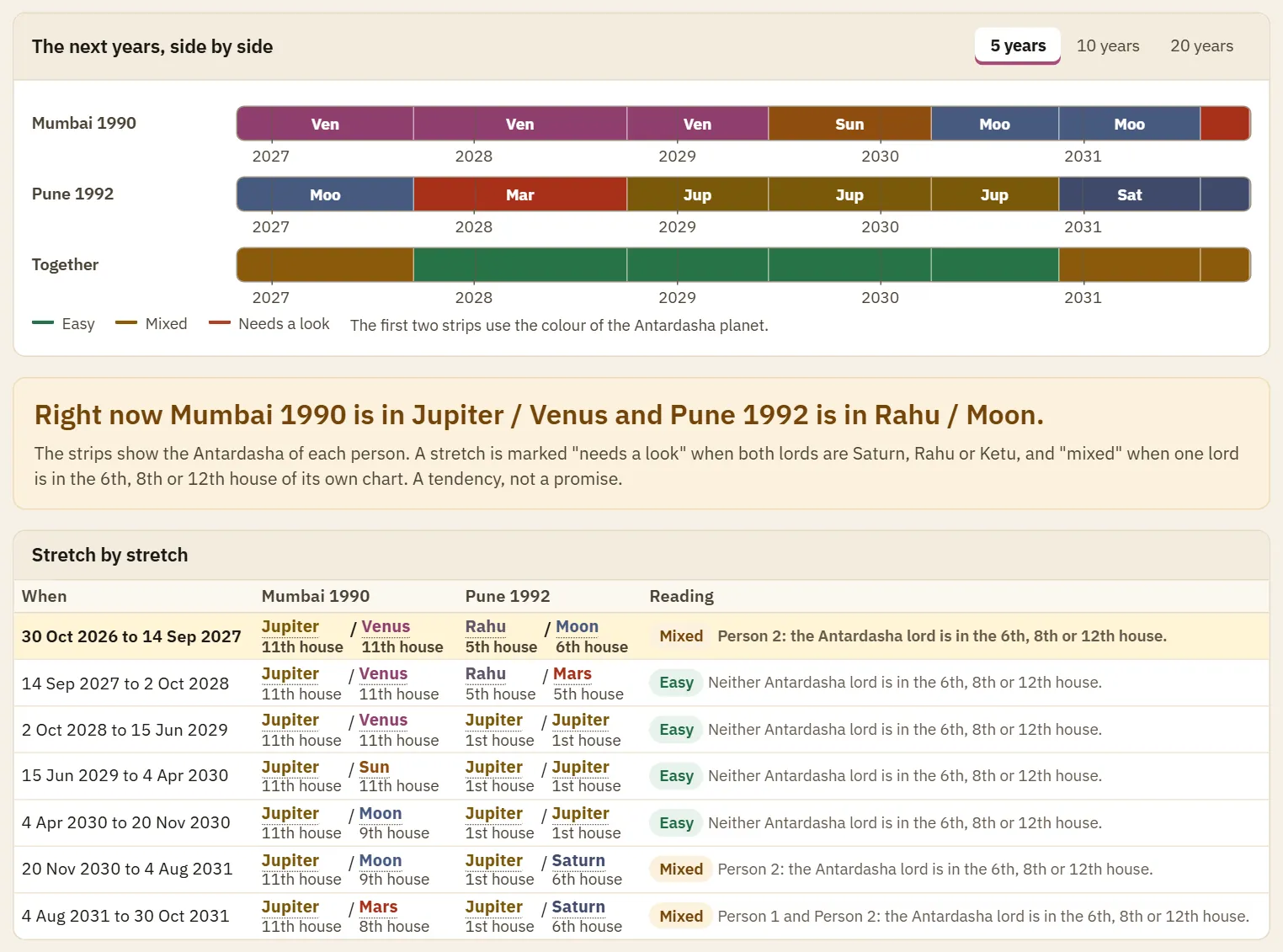
Dasha match
One strip for each person and one for the two together. Plan around long amber or red stretches and talk them through with the family.
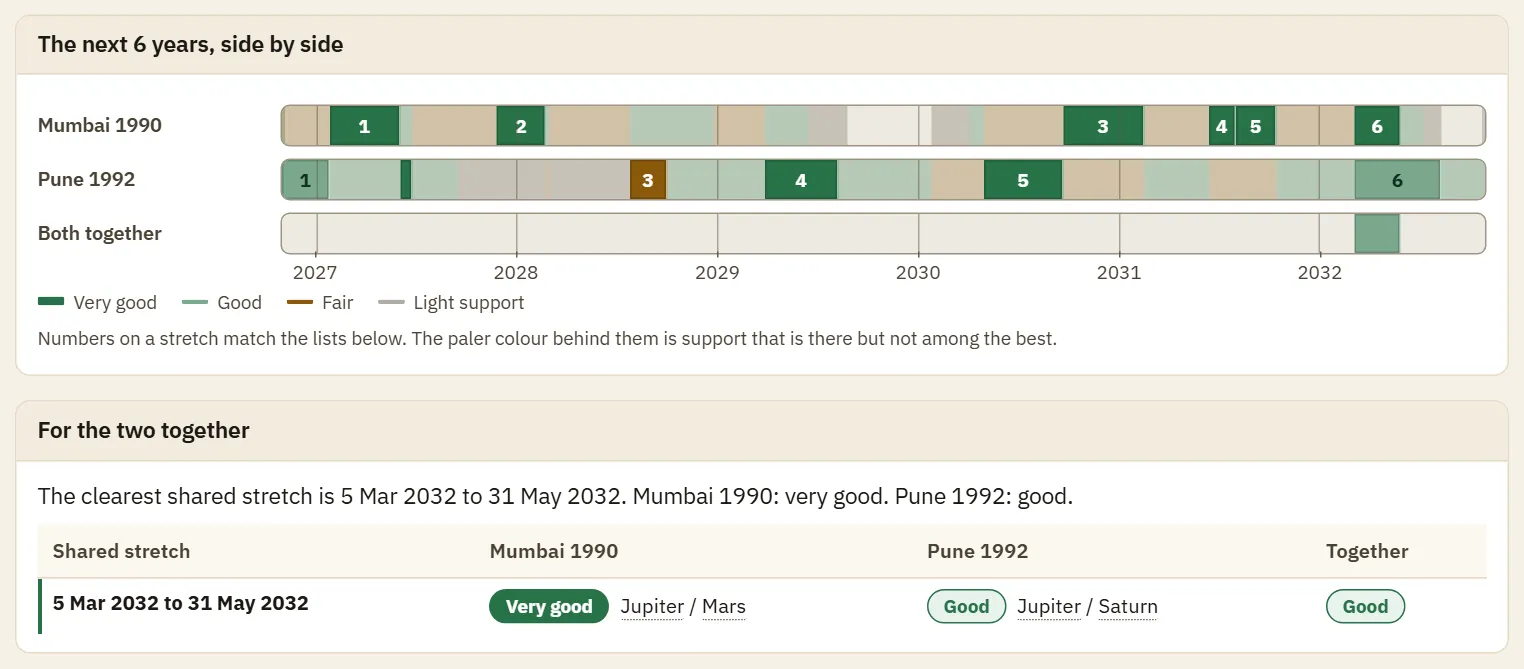
Marriage timing
Numbered stretches for each person, and where they meet. The page shows where indicators gather. It does not name a date.
How it fits a sitting
- Choose the two people. Check the boy and girl roles, because some gunas read them differently.
- Read both charts first, as you would any single chart, then the Navamsa row.
- Go through the Guna table with the family. Click any row they ask about.
- Open the Dosha check before you comment on Nadi, Bhakoot or Manglik, so you state the exceptions that apply.
- Look at Dasha match to see what the first years together may ask of them, and Marriage timing if a date is being discussed.
- Add your notes, print the sheet, and save the match for the next visit.
Method and sources
The score is the Ashtakoota method, worked from the Moon sign, nakshatra and pada of each person. The Manglik comparison counts Mars from the Lagna, the Moon and Venus. Marriage timing lists where the period lords and the transits of Jupiter and Saturn gather, and marks each rule as classical or later practice.
- Brihat Parashara Hora Shastra, the chapters on the 7th house and on the results of the Vimshottari periods
- Phaladeepika of Mantreshwara, chapters 8, 19 and 20 and the chapter on transits
- The double transit of Jupiter and Saturn is later practice, not in these two texts, and the page says so
What it does not do
- It does not say whether two people should marry. The verdict reads the score on the traditional scale and tells you what to look at next.
- It does not give a marriage date. Stretches are where indicators gather, and those before age 21 for the boy role or 18 for the girl role are left out.
- Star-only matching leaves out the Manglik check, because it has only the Moon star and sign to work with.
- Saved matches stay on this device. They are not part of a kundli file or the backup.
Questions
Does a low score mean the match is bad?
No. The score is one method and one number. The page shows the two full charts, the exceptions and the dashas beside it, so you can explain what the number leaves out.
Are Nadi and Bhakoot exceptions shown?
Yes. The Dosha check names the exception that applies to this pair, and shows when none does. For Nadi it looks at nakshatra, pada and Moon sign. For Bhakoot it looks at the lords of the two Moon signs.
Can I match when one person has no birth time?
Yes. The score needs only the Moon, and Marriage timing counts from the Moon when the rising sign is not known. With only a Moon star for each person, use Match by Moon star only under More options.
Does it cover Dashakoota for South Indian families?
Yes, for the four factors the eight-fold score leaves out, Rajju, Vedha, Stri-Dirgha and Mahendra. They are advisory and sit beside the 36, not inside it.
Can I print one sheet for the family?
Yes. The Match report page lets you choose what goes on the sheet and add your own notes, and the print window can save it as a PDF. For a Manglik check on its own, this website also has a free Mangal dosha matching page.
Have another question?