Palmistry software
A guided palm reading for astrologers and palm readers. Look at the hand, choose the picture that matches, and the reading is written as you go, with the source of each line named.
Included in the Palmistry plan, Rs 3,001 a month. No card needed. Sign in with Google to start.
Who it is for
Palm readers and astrologers who have the client's hand in front of them, or a palm photo sent from a phone. The questions follow Cheiro's method, and the Indian names, signs and hand rule sit beside it.
It also suits a reader who is still learning. The Palm Guide lets you look up any shape, line or sign, without starting a reading.
What you can do with it
The guided reading
- 27 questions, from the shape of the hand to the relationship lines, and two extra sets for signs and fingertip patterns.
- A quick reading of the six main questions takes about three minutes. A full reading goes line by line.
- Every answer has a drawn picture, and the large hand beside the question shows the answer you point at. Skip any question you are unsure of.
- The seven hand types, the fingers, the nails, the thumb, and the eight mounts, each marked flat, level or raised.
- The heart, head, life, fate and sun lines, the Mercury line and the relationship lines, with their Indian names such as hriday rekha.
- A chip beside each question and each line of the reading names the text: Cheiro 1897, Brihat Samhita, or Later practice.
- The hand rule is a setting: the Indian rule, right for a man and left for a woman when the gender is known, or Cheiro's rule of both hands with the right relied on.
Signs and the Indian layer
- Cheiro's 8 signs: star, cross, square, island, circle, triangle, grille and tripod.
- 11 auspicious signs of the Indian tradition: fish, thunderbolt, conch, umbrella, lotus, wheel, trident, barleycorn, flag, pitcher and svastika.
- Say where each sign is found, on a mount, a line or an area. On a photo, click the spot and the place is filled in.
- Fingertip patterns for each finger: chakra, shankha or arch. Rahu and Ketu on the palm are shown as later practice.
Reading from a photo
- Add a photo as a file, paste a phone photo with Ctrl+V, or use the camera with a hand-shaped guide.
- The hand finder runs in your browser. It places the hand on the photo and shows where the mounts usually lie.
- It tells you if the photo is dark, blurry or too small, if the palm is the wrong hand, or if two hands are in the picture.
- When no hand is found, mark four points yourself: the wrist, the bases of the first and little fingers, and the base of the thumb.
- Trace each line by clicking along it, then drag any point to adjust it. Zoom to 200 percent, and strengthen faint creases with Enhance lines.
- Cheiro's ages, by his system of sevens, are marked on the traced fate and life lines, with age windows on the relationship lines.
- The lines you traced suggest answers, and finger and thumb measurements are listed unticked for you to judge. Add more photos, such as the other palm, the edge of the hand or the fingertips.
Guide, records and report
- The Palm Guide shows every shape, line and sign with its meaning and source. Search it, or tick Compare to see two or three side by side.
- Classic plates shows 12 plates from Cheiro's book of 1897.
- Saved readings are kept by client, with a small photo and how far each reading got. Put two readings of one client side by side to see what changed.
- A backup file holds every reading and carries the photos.
- The palm report carries your name, logo and colours, one or both hands, the photos with numbered lines and Cheiro's ages, a summary and the written reading.
- Print the report, or save it as a PDF from the print window, and copy a short text of the reading for a message.
See it in the tool
Real screens from the tool, made with sample charts. Select a screen to see it larger.
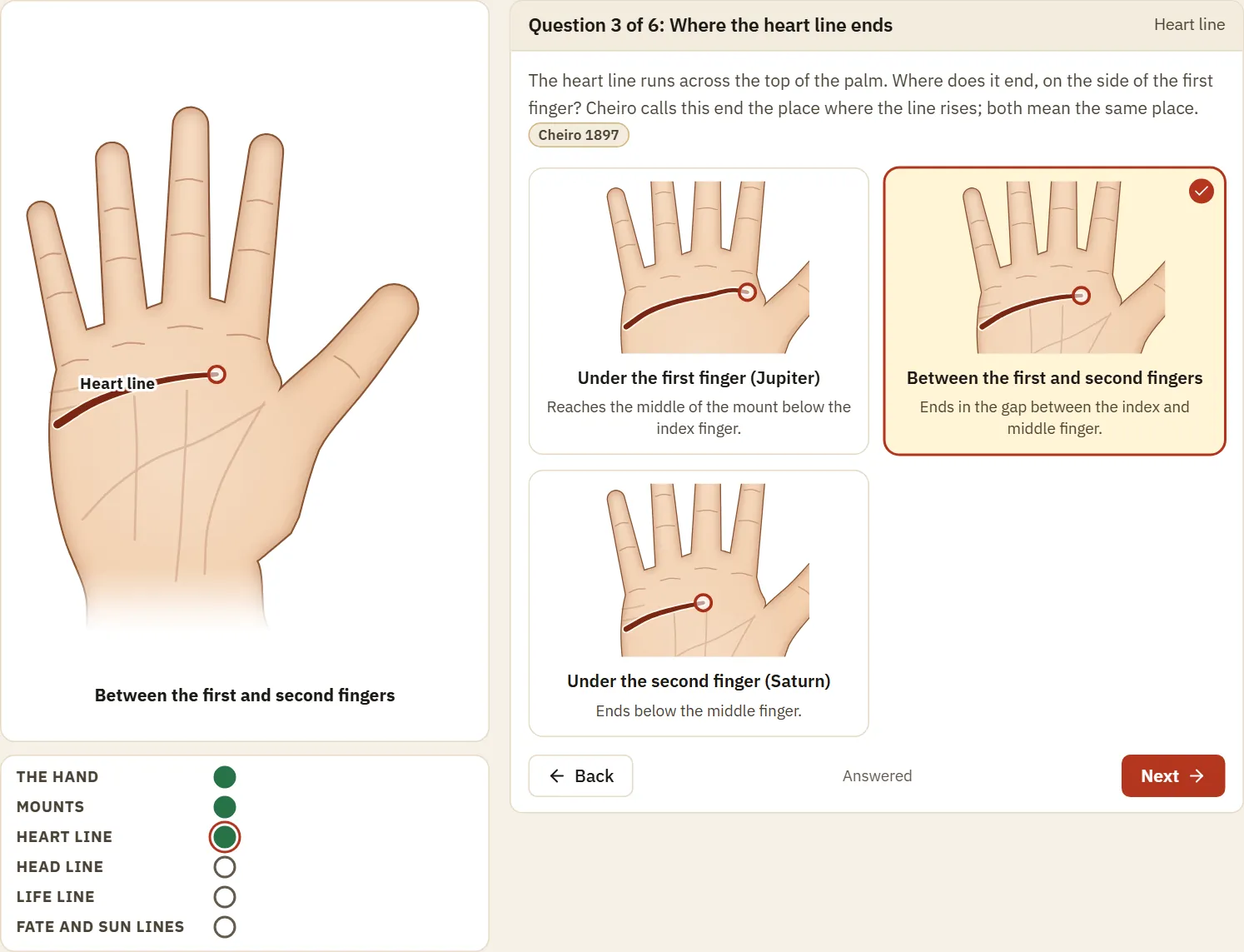
A guided question
Each answer has a picture, and the large hand shows the answer you point at. The chip names the text behind the question, and the dots show how far you have got.
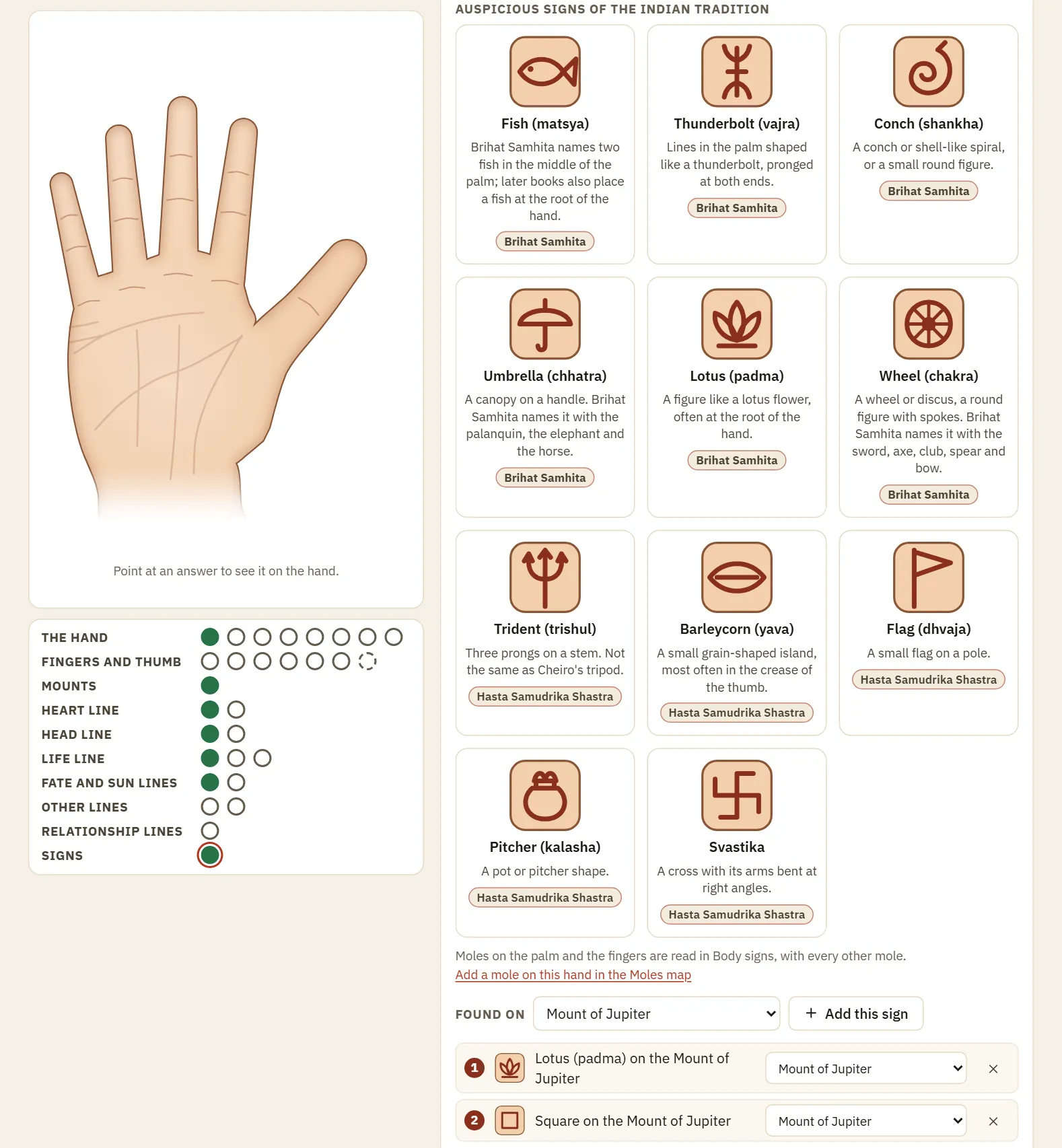
Signs of the Indian tradition
The auspicious signs have their own pictures and chips. Choose where a sign is found, and it joins the list under the picture.
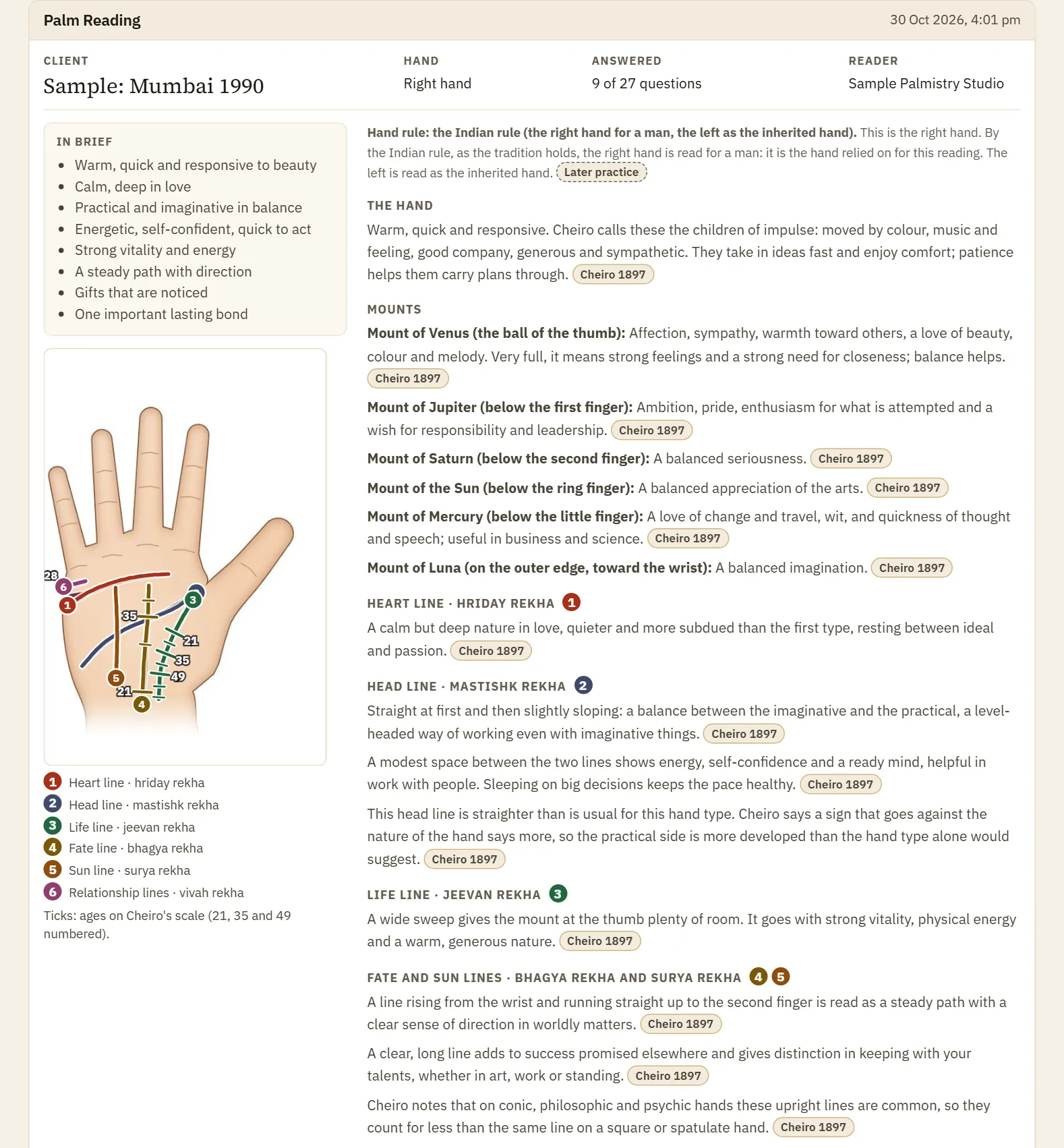
The written reading
The reading is written from your answers. The numbers on the hand match the numbers beside each part, and each line carries its source. The hand shown is a drawing, not a client's palm.
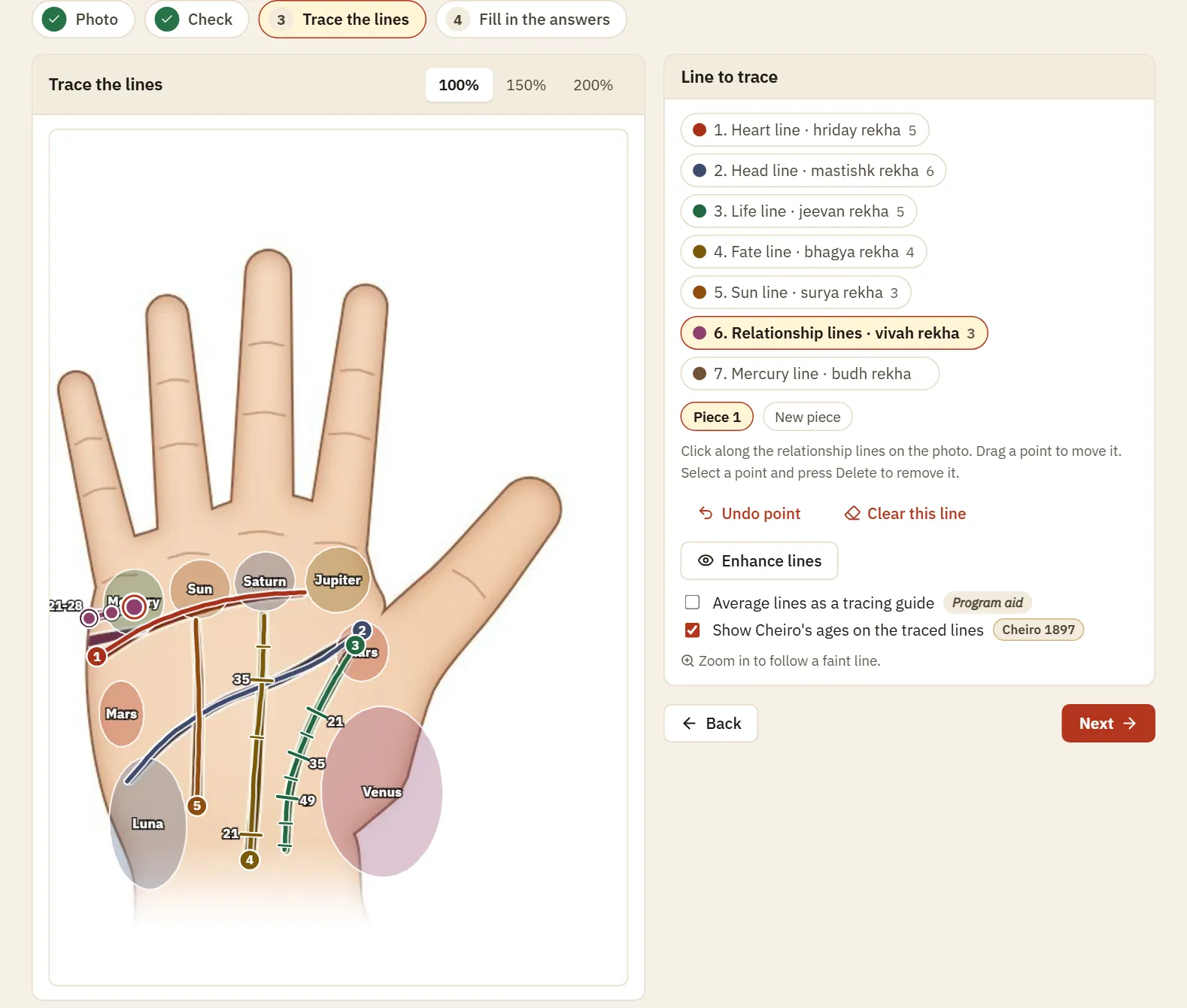
Tracing the lines
Click along each line. The mounts and Cheiro's ages are laid over it. The picture here is the tool's drawn hand in place of a photo, so the four points were marked by hand.
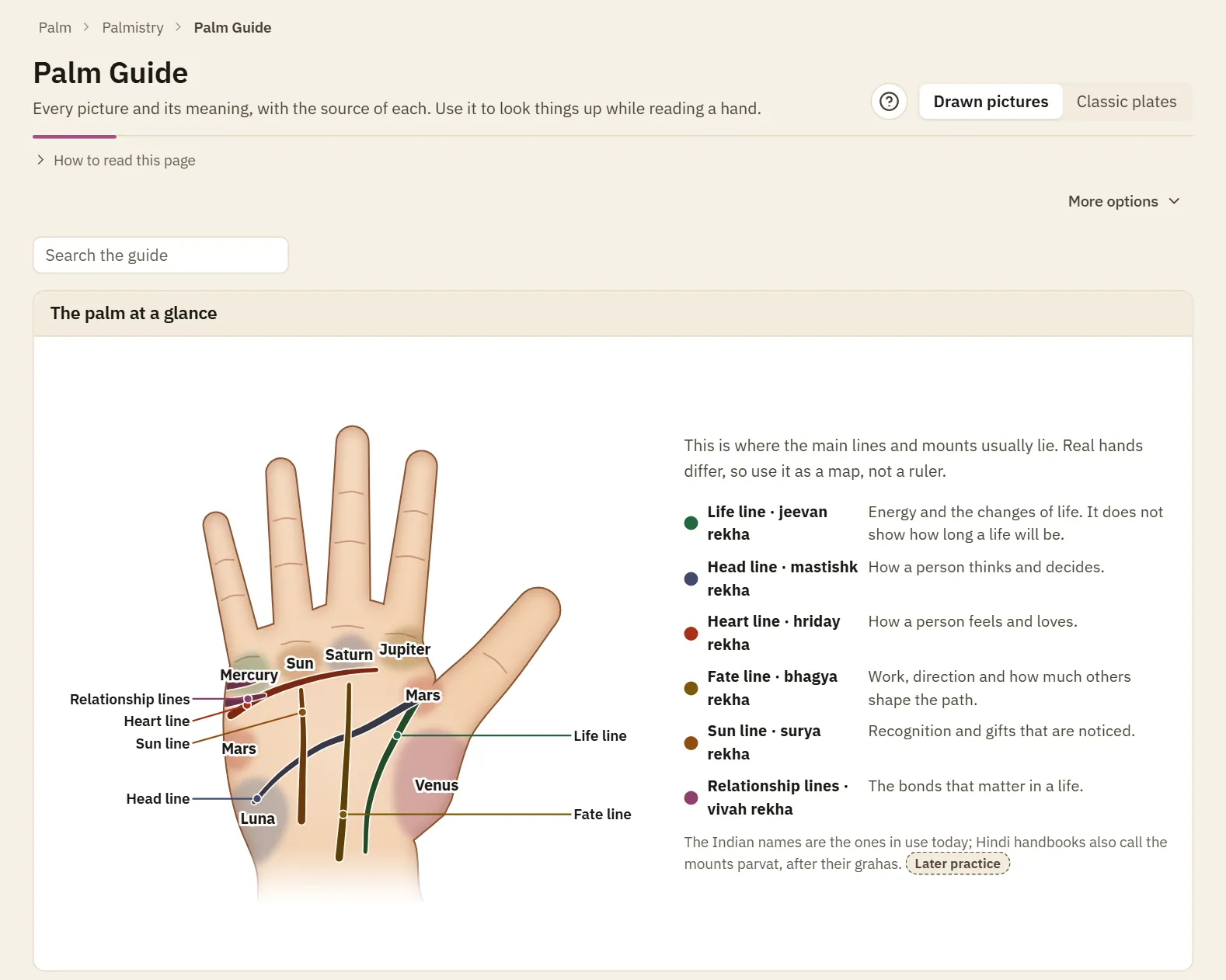
The Palm Guide
A map of the main lines and mounts with their Indian names. Below it, a picture for every shape, line and sign.
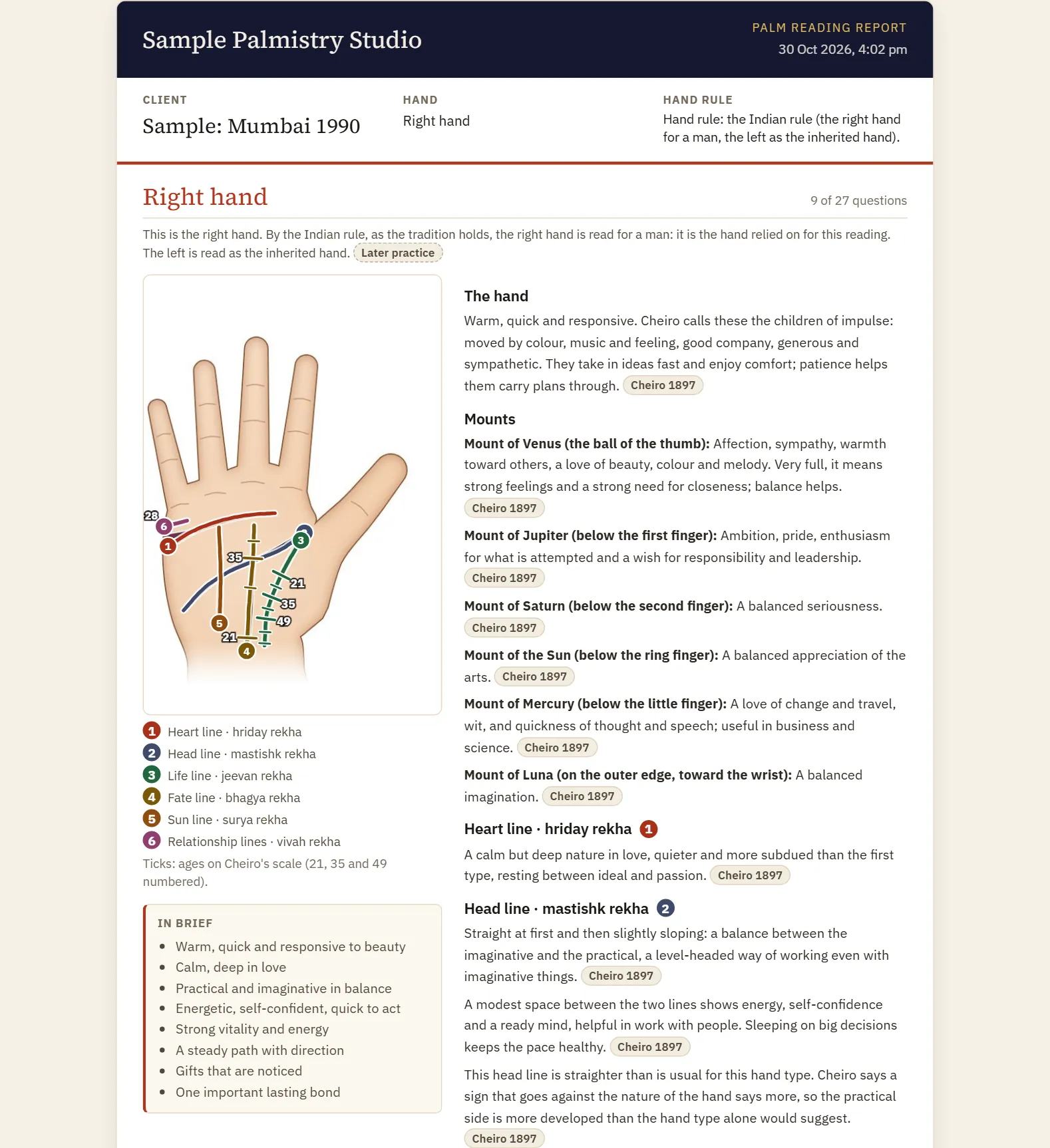
The palm report
A report under a sample studio name, with the hand rule, the hand with its numbered lines, a summary and the reading.
How it fits a sitting
- Choose the client and which hand you are reading. Under the Indian rule the tool starts on the hand the rule reads.
- Take the quick reading, or go through the full questions with the hand in front of you.
- If you have a photo, add it, trace the lines, and let the tracing fill in the matching answers.
- Add any signs and fingertip patterns you see.
- Read the other hand as its own reading. The report can put the two side by side.
- Save the reading, open the report, and print it or copy the short text.
Method and sources
The questions follow Cheiro's method, with each answer rewritten in calm modern words. His lines on illness, length of life and death are left out on purpose, and the life line is read as energy and change only. Where the reading is modern, the chip says Later practice.
- Cheiro, Language of the Hand (9th edition, 1897): the main source, with his timing by sevens and the classic plates
- Casimir d'Arpentigny, La Chirognomonie (1843): the seven hand types
- Brihat Samhita of Varahamihira, the signs of men: figures in the palm
- Garuda Purana and Brihat Samhita: the hand as a whole
- Hasta Samudrika Shastra: figures the later compilations add
What it does not do
- It does not see the lines on a photo. The hand finder places the hand, and you trace every line and decide every answer.
- It never predicts health, length of life or events, and the end of the life line is never given an age.
- A mehndi hand, an ink print or a palm with the fingers cut off is often not found. Mark the four points by hand instead.
- The AI reader works from the notes you type on its page. It does not read the guided answers or the photo. The tool does not send anything for you, so save the PDF or copy the short text and send it yourself.
Questions
Does it read the lines from a photo by itself?
No. The hand finder places the hand and shows where the mounts usually lie. You trace the lines, and the tool turns your tracing into suggested answers that you check.
Is the palm photo sent to your server?
Not to read it. The hand finder runs in your browser, and the photo stays on your device with the reading. A backup file you download carries the photos, so keep it safe. If you cancel a plan in the tool, the locked copy for the emailed link can carry them too, and it is deleted after 30 days.
Which hand should I read?
The tool follows the Indian rule when the client's gender is known, and Cheiro's rule otherwise. You can choose either rule under More options, and the rule used is written on the reading.
Can I read both hands?
Yes. Save each hand as its own reading for the client. The report can then show both, in the order the rule gives.
Where are moles on the palm read?
In Samudrika, with every other mole. The Palm Reading page has a link to add one on the Moles Map.
Have another question?