Samudrika Shastra software
Read a person from the whole body, the traditional way: moles, the face, build, the soles, gait and voice. Each reading names its text and says how far it can be trusted, and all of it gathers in one summary.
Included in the Palmistry plan, Rs 3,001 a month. No card needed. Sign in with Google to start.
Who it is for
Astrologers and palm readers whose clients ask about a til on the cheek or the shape of a forehead. It gives you a place to record what you see, the old reading in brief, and a calm line you can say to a client.
It suits readers who want to stay careful. Nothing here reads complexion or caste, and the same readings are given to everyone.
What you can do with it
Moles Map
- 39 places on the head, face and body, drawn on an outline from the front, from the back and on the face close up.
- Click a spot to see its name in English and Hindi, one tendency line, its source and how far to trust it.
- Old books say opens the old reading in brief. Books differ shows where the texts disagree.
- Record the side and the kind of mark, a mole, a raised mark, a birthmark or a scar, with a note. Each kind is read the same way, by where it is.
- Tick Reading from a mirror or selfie and the sides follow. A List view shows every place as a button, for the keyboard.
Face Reading
- 13 questions: the forehead's shape, its lines and a mark on it, then the brows, eyes, nose, cheeks, lips, teeth, chin, ears, head and hair.
- Each answer has a drawing, and the large face shows the feature you point at. Not sure leaves a feature out.
- Source and basis under an answer names the text and its verse. Where the old text is harsh, the line is named as left out, not hidden.
Body Signs
- Tick what stands out for build and proportion, chest and neck, and the feet, such as the banyan proportion or arms that reach toward the knees.
- Marks on the soles on a drawn sole: fish, conch, lotus, wheel, flag and umbrella. They are labelled later practice and are never scored.
- Choose one of 5 gaits and one of 4 voices, in the old text's own images of the elephant, the lion, the swan, the drum and the cloud.
Summary and report
- Five themes gather every answer: mind and outlook, temperament, expression, presence and bearing, and practical bent.
- Palm and body together brings in the client's latest palm reading beside the matching theme. Nothing is weighed.
- When the client's chart has one of the five great men yogas, a fold shows the body picture of that type and whether the matching sign was ticked.
- Saved readings are kept by client and date. A backup file holds every reading, and Restore brings them back.
- A one-page report carries your name and design, the themes, the moles, the answers and the palm lines. Print it, or save it as a PDF from the print window.
To learn from
- The Body Guide draws every mole place and every answer, 39 places and 66 answers, with the reading and its sources. Search it, or compare two or three side by side.
- The 32 Marks page gives the verse in Devanagari, in Roman letters and in plain words, with the seven groups and Rama's marks. It is for learning and is never scored.
- Method and Sources sets out 25 rules, what is set aside and why, where the books differ, and how far each source can be trusted.
See it in the tool
Real screens from the tool, made with sample charts. Select a screen to see it larger.
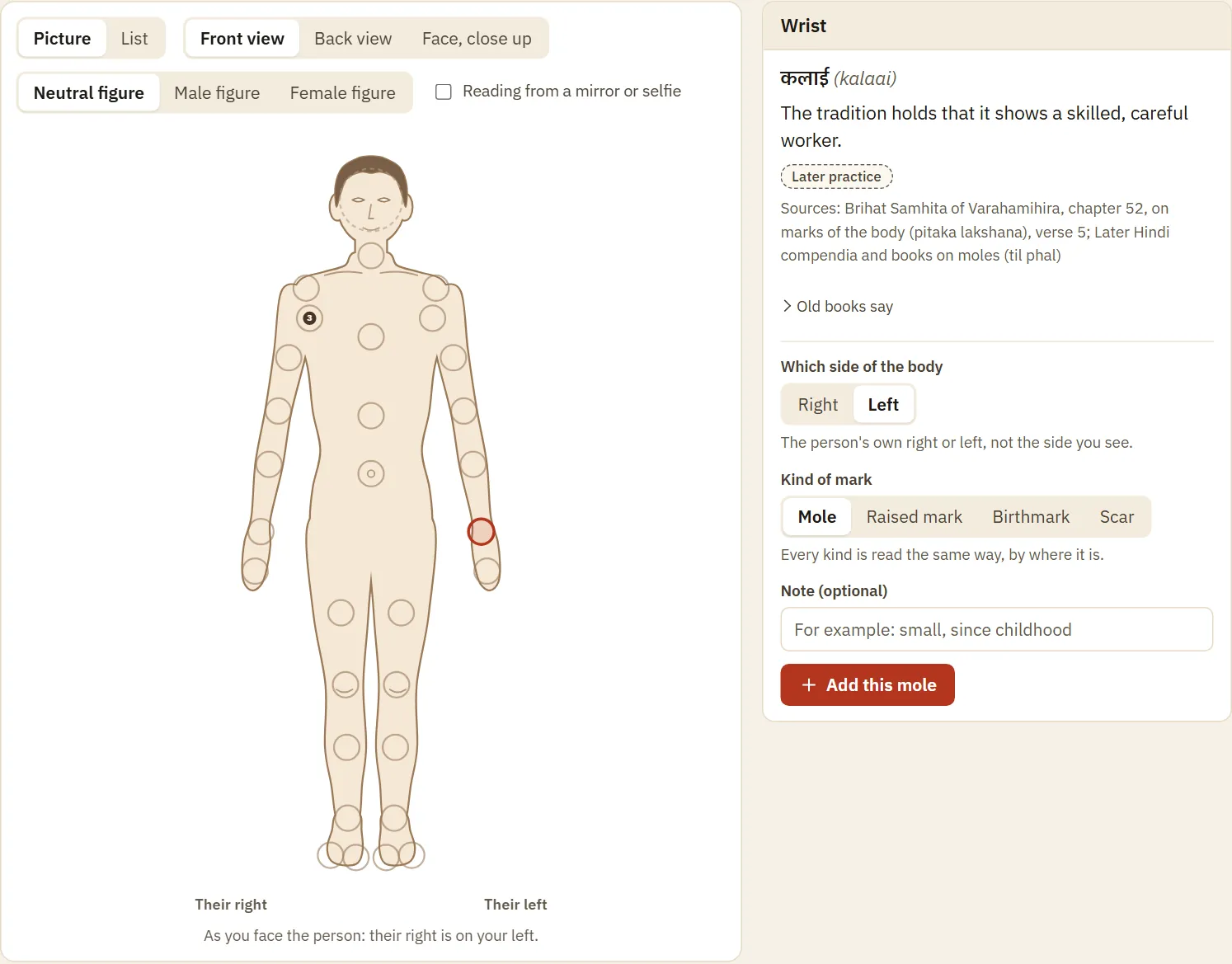
The Moles Map
Click a place on the outline. The card beside it gives the Hindi name, the reading, the chip and the sources, and you add the side and the kind of mark.
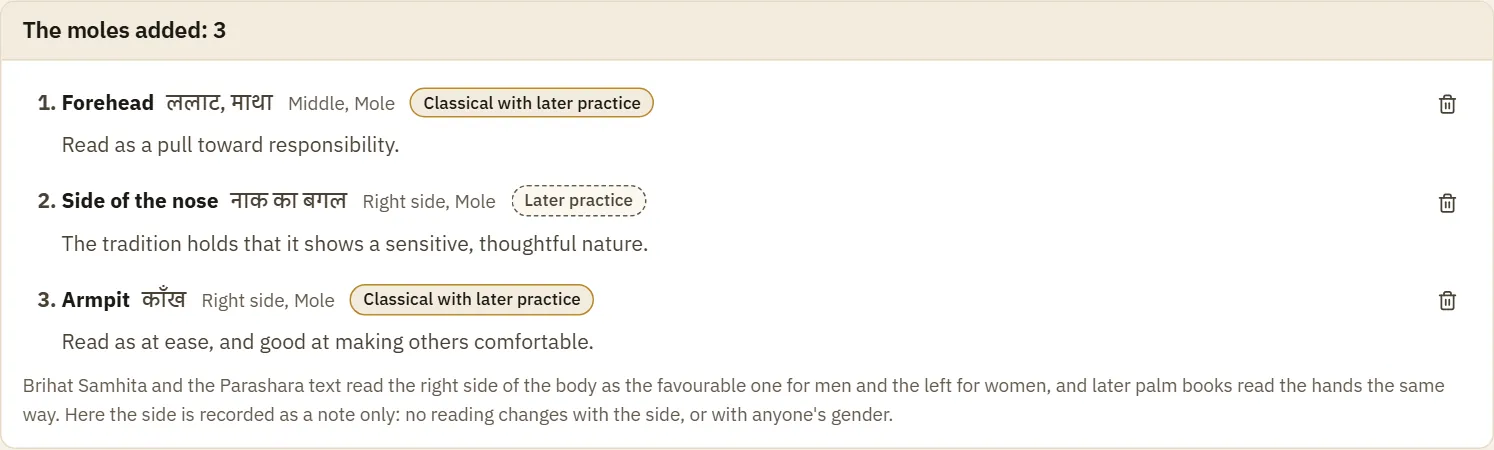
The moles added
Each mole you add is listed with its reading and its chip. The note under the list says the side is recorded and changes no reading.
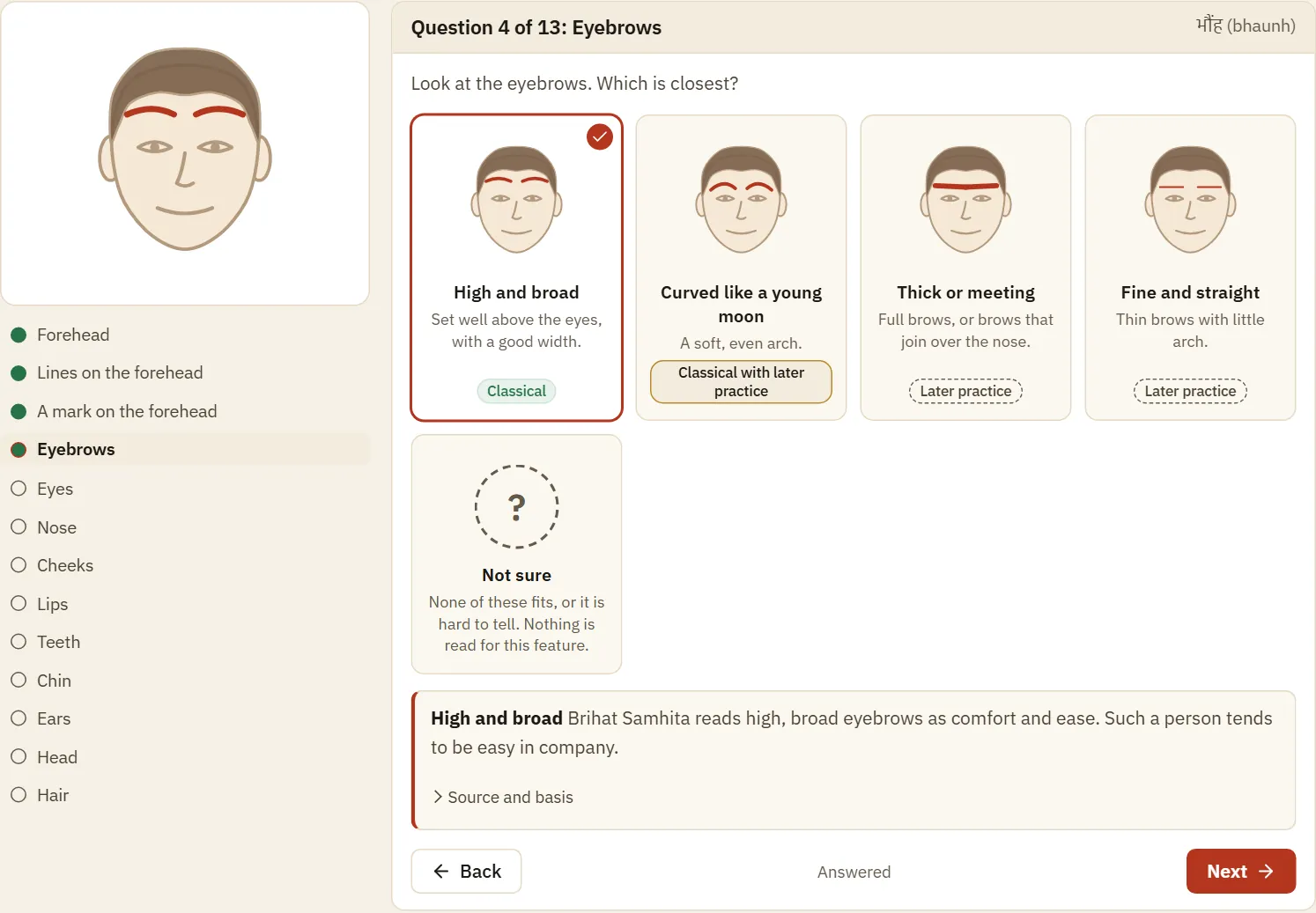
A face question
One question for each feature, with a drawing for every answer and a Not sure card. The reading of your answer appears under the choices.
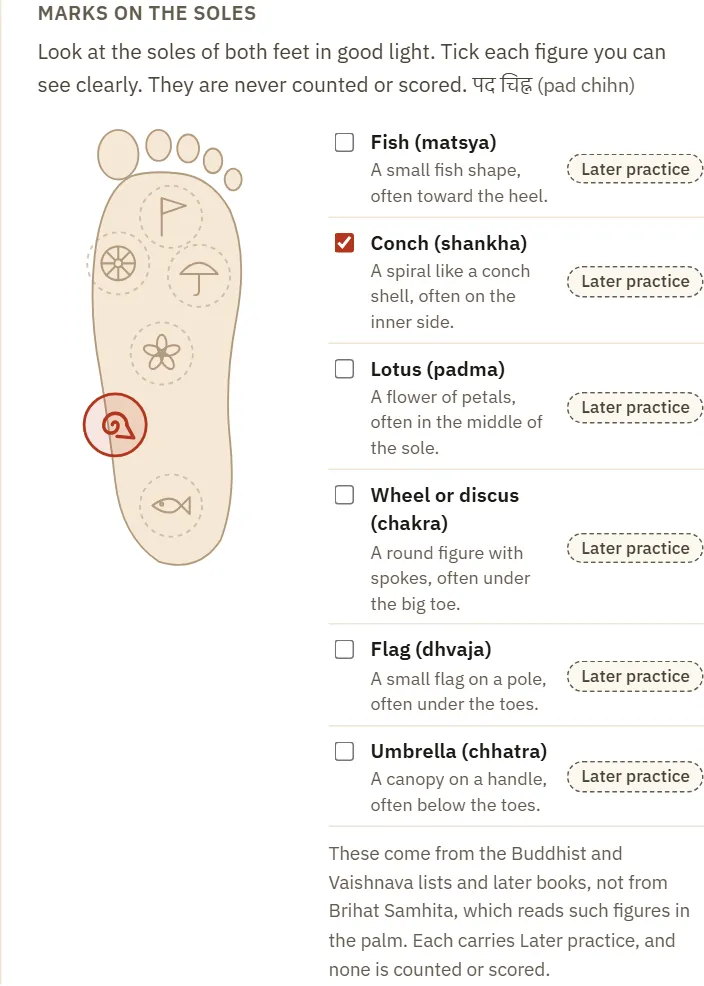
Marks on the soles
Tick a mark on the drawn sole or in the list. Each one carries Later practice, and none is scored.
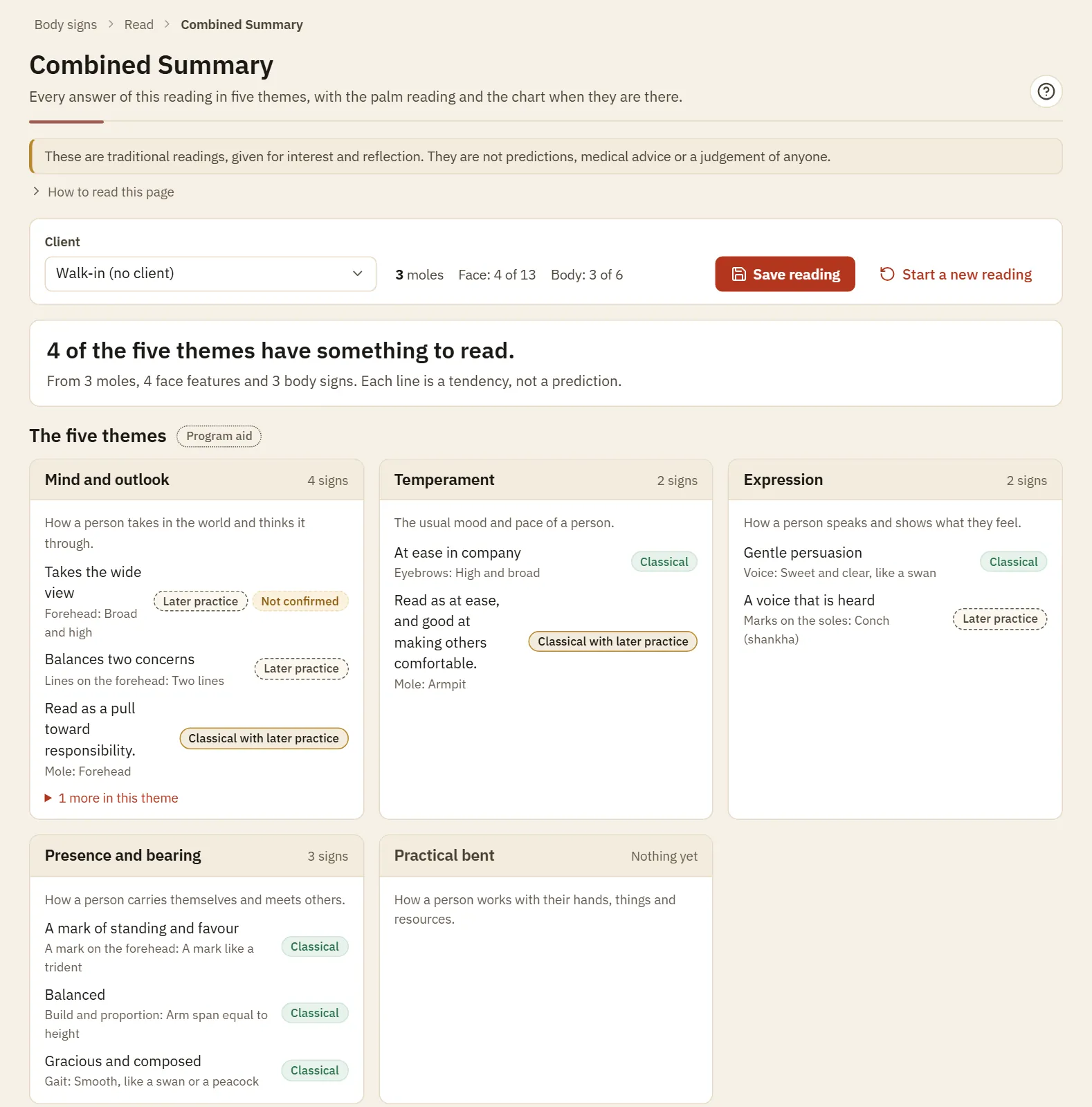
The Combined Summary
Every answer gathered in five themes, each line with where it came from and its chip. The themes are a grouping of the tool, and the page says so.
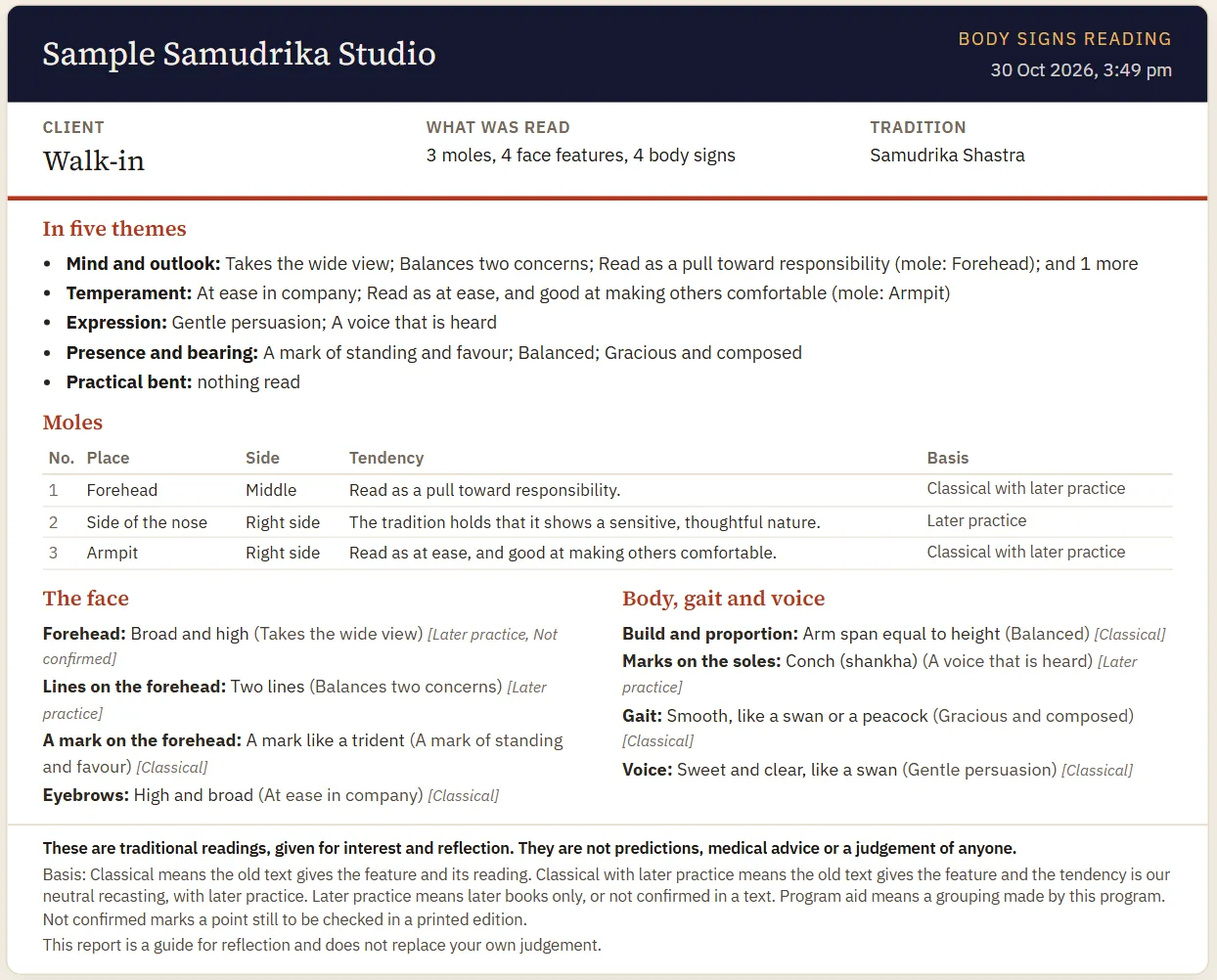
The one-page report
The report under a sample studio name, with the themes, a table of moles, and the face and body answers. The basis of each is printed in words.
How it fits a sitting
- Check that the person agrees to be read, and choose the client.
- Add the moles you see on the Moles Map, using their right and left, not yours.
- Answer the face questions by looking at the person. Use Not sure whenever you are in doubt.
- Tick only the body signs that stand out, then choose the gait and the voice.
- Read the five themes in the Combined Summary, with the palm reading if the client has one.
- Save the reading and print the one-page report.
Method and sources
Every reading is a tendency in our own neutral words, with a chip: Classical, Classical with later practice, or Later practice. Marks are read by where they are, not by colour. Where an old text is harsh, its line is left out and named as left out.
- Brihat Samhita of Varahamihira, chapters 52, 68 and 69, cited in the Iyer translation of 1884
- Brihat Parashara Hora Shastra: moles, marks and the side rule
- Agni Purana: the banyan proportion
- Valmiki Ramayana and Chaitanya Charitamrita: the thirty-two marks
- Lakkhana Sutta: the Buddhist list, kept apart
What it does not do
- Complexion, caste, beauty, height and weight are never read. It gives no reading of health, children, length of life or death.
- Of the 105 readings, 9 are Classical, 44 are Classical with later practice and 52 are Later practice. The chips show which is which, and points still to be checked in print are marked Not confirmed.
- No mole positions are given for the intimate areas of the body, though the old lists include them.
- It does not read a photo of a face or body. You look and answer. The AI reader does not draft from these readings. The hand as a whole is read in Palmistry.
Questions
Do the side of a mole and the kind of mark change the reading?
No. The old books read the right side for men and the left for women, and the tool records the side, but the reading is the same on either side and for everyone. A mole, a raised mark, a birthmark and a scar are read by where they are.
Why does it not read skin colour?
Readings of complexion are set aside on purpose, under any name, along with anything that ranks people by birth, beauty or body size. The Method page lists what is left out and why.
Are the 32 marks scored for a client?
No. The page on the thirty-two marks is there to learn from. Nothing on it is counted for a person.
How does this link with a palm reading?
Moles on the palm and fingers are read here. The hand itself is read in Palmistry. A client's latest palm reading appears in the Combined Summary and can go on the report.
How does it use the birth chart?
Only for the five great men. If the client's saved kundli has one of those yogas, the summary shows the body picture of that type. It needs a birth time, and it adds nothing to any count.
Have another question?