Muhurta software
Pick the event, the people and the place, and the tool ranks the good windows with the rising sign of each. Every line of the reason names its rule and the text it comes from, so you can show a family why a time was chosen.
Included in the Vedic plan, Rs 3,001 a month. No card needed. Sign in with Google to start.
Who it is for
For the astrologer who is asked "when should we do it" every week. A family wants a wedding date, a builder wants a day for bhumi pujan, a parent wants a date for mundan, or a client arrives with a time someone else gave and asks whether it is good.
The module follows the two steps of the texts. The day must suit the event, then the moment must suit the rising sign and the people. Both steps are worked out for you and stay open to read, so the final call is still yours and the family priest's.
What you can do with it
The events
- 22 events in 7 families, on their own pages. Marriage, home and land, travel and vehicles, child ceremonies, work and money, health, and worship and vrat.
- Home and land covers griha pravesh, moving back in after travel or repair, bhumi pujan, property purchase and registration, planting and sowing, and digging a well or borewell.
- Seven child ceremonies, from Pumsavana and Seemantham to Upanayana. The customary age shows above the windows, with the child's age in months at the top window.
- Starting a job and court matters say where the classical text has no rule of its own, and name the nearest rule used. A shop opening links to its own page in Work and wealth.
- Planned surgery and starting a long course of medicine open with the note that urgent treatment is never delayed for a muhurta and the doctor decides.
Finding the window
- Look 30, 90 or 180 days ahead from today, for any town you pick.
- Three strictness levels. Relaxed keeps to the day rules, Standard also leaves out the major faults, and Strict leaves out every confirmed fault.
- Fit the time to one person or two from your client list, with Tara bala, Chandra bala and the Moon in the 8th from the birth Moon (Chandrashtama) counted from their own Moon.
- Each window shows the date, the hours, the nakshatra, the tithi, the month, its strongest rising sign and a grade of Excellent, Good or Fair.
- Why this window opens every rule that fired, sorted into Meets, Helps, Watch and Left out nearby. Each line carries a label for how far it can be trusted.
- When a day is shut, the page counts the days left out by the first rule they fail. When no window exists, it names the first good day in the year after.
Marriage
- The ten doshas of the Muhurta Chintamani marriage chapter are worked out for every window and listed as present or clear. Jamitra is read from the rising sign and from the Moon.
- Five of the ten are marked to be checked. They lower the score and never leave a time out on their own.
- The Moon in the 6th, 8th or 12th from the rising sign leaves a marriage time out at every strictness. From Standard, the 7th and 8th houses must be empty and Mars not in the 8th. Guru bala is read for the bride and Surya bala for the groom.
- Choose how many days to keep clear around Venus and Jupiter setting and rising, from none to 15.
- The cancellations of the doshas are shown as notes for you to apply. The program never applies them by itself.
Tools for one day or one time
- The lagna list of a day gives the rising signs from sunrise to sunrise, each marked clean, care or avoid for the event, with its Pushkara and vargottama minutes.
- The timings of the day follow, with Rahu Kaal, Varjyam, Bhadra and where it resides, Panchaka and Godhuli bela.
- The good days calendar shades 3, 6 or 12 months by the top grade of each day. Pick a shaded day to see its windows, or a blank day to read why not.
- Check a time tests a date and hour someone gave you. It names what rules the time out, then shows the five limbs and every rule by group.
- The travel compass reads Disha Shool, Nakshatra Shool, Yogini and the Moon's direction for all eight directions. Give a destination town and it works out the direction.
Regional practice
- West India practice comes on by itself for a town in Gujarat, Maharashtra or Rajasthan, and you can set it by hand. It adds Kartika and Margashirsha for a house-warming, Guru and Ravi Pushya for buying, Jupiter in Leo for marriage and the choghadiya cuts.
- Separate switches for choghadiya, Holashtak and Panchaka rahita, a choice of amanta or purnimanta month names, and the direction of the main door for a house-warming.
Saving and printing
- Save any window as an election with the event, the people, the place and the reasons as they stood that day. Rename or delete it later.
- The working sheet prints every reason, the ten doshas for a marriage, and your note for the family.
- The muhurta patrika is a certificate with your letterhead and colours, the panchang of the moment, the muhurta chart, the rules met and a signature line.
- Print it, save it as a PDF, or copy the sheet as plain text to paste into a message.
- Rules and sources lists all 105 rules. Filter by how far a rule can be trusted, by event, or by the tables still to be checked.
See it in the tool
Real screens from the tool, made with sample charts. Select a screen to see it larger.
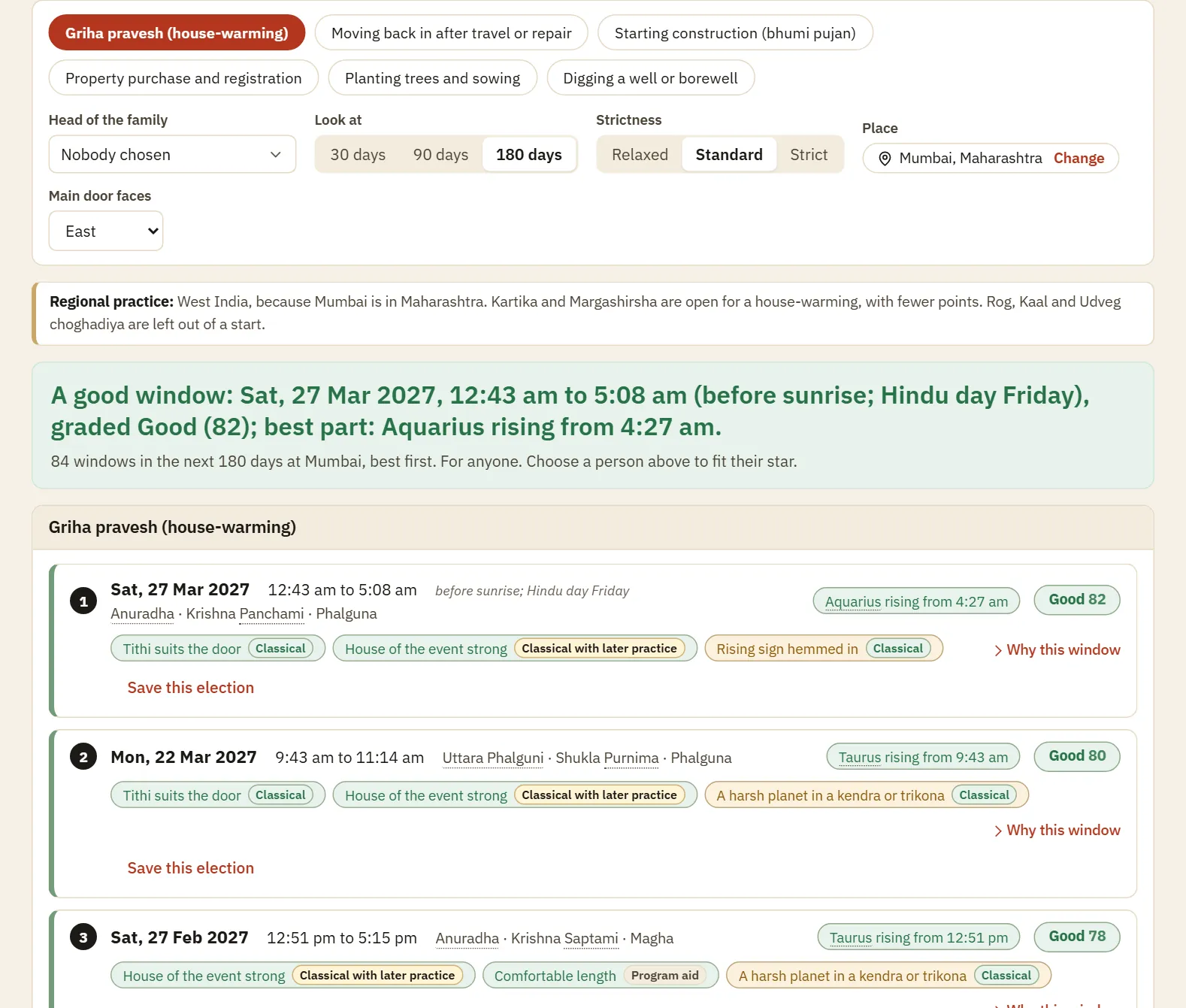
Griha pravesh windows, ranked
The next 180 days at Mumbai for a door facing east. The green line gives the top window, and each card below shows its rising sign, grade and strongest reasons.
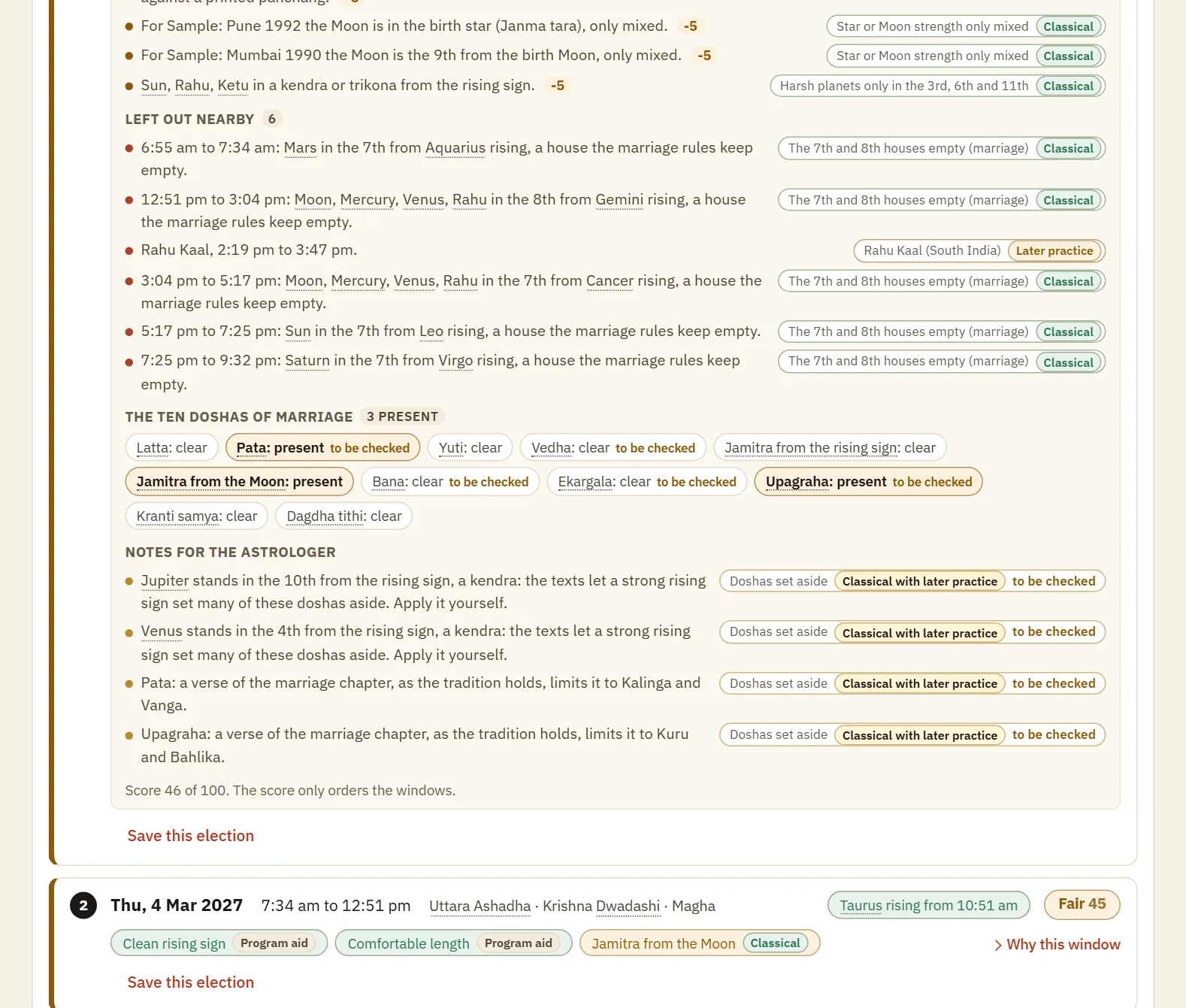
The ten doshas of a marriage window
One window opened for a sample couple. The ten doshas sit together as present or clear, and the notes below them are cancellations for you to weigh and apply yourself.
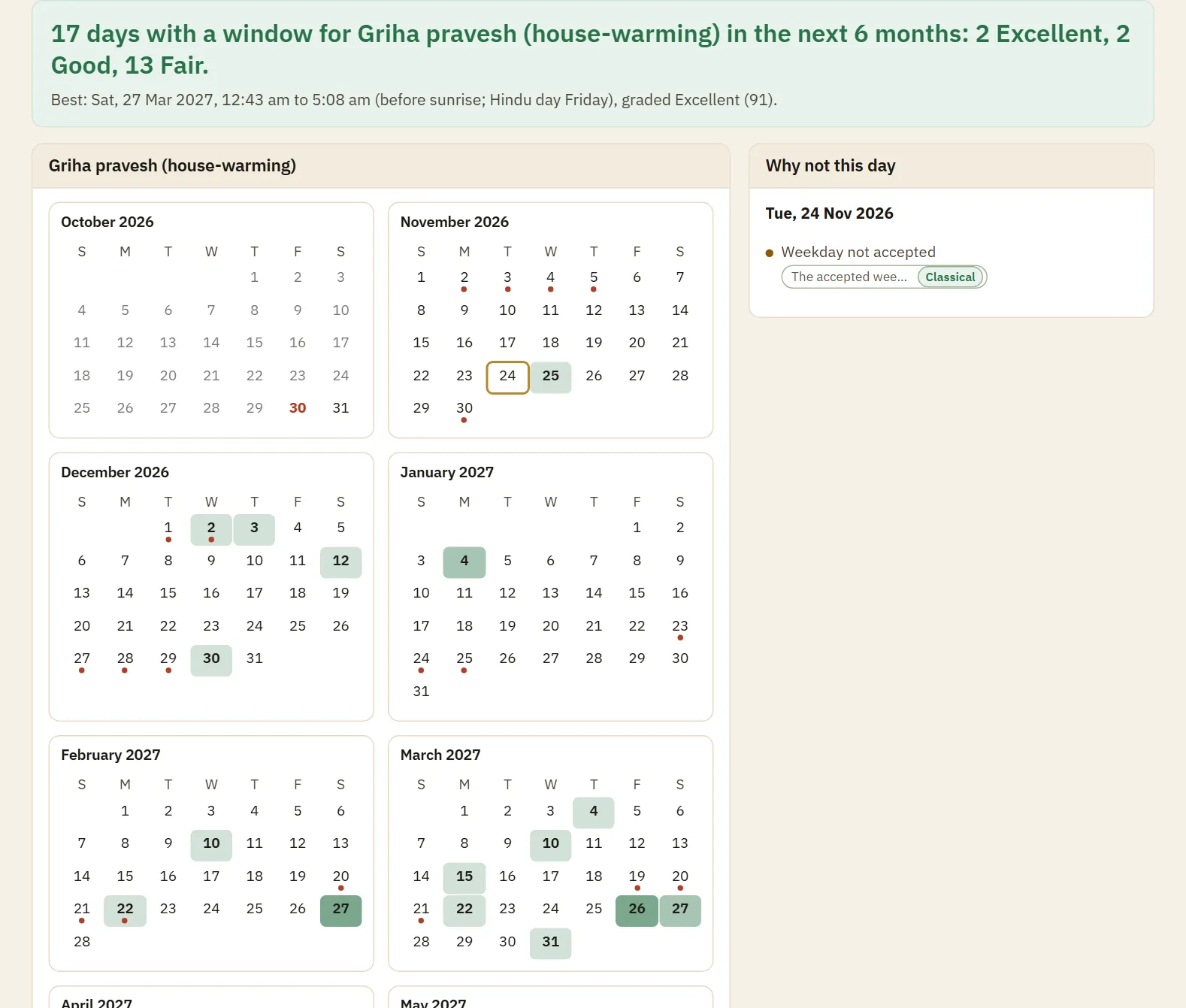
Good days calendar
Six months shaded by the top grade of each day, with red dots for the Moon in the 8th. A blank day was picked here, so the side panel says why it has no window.
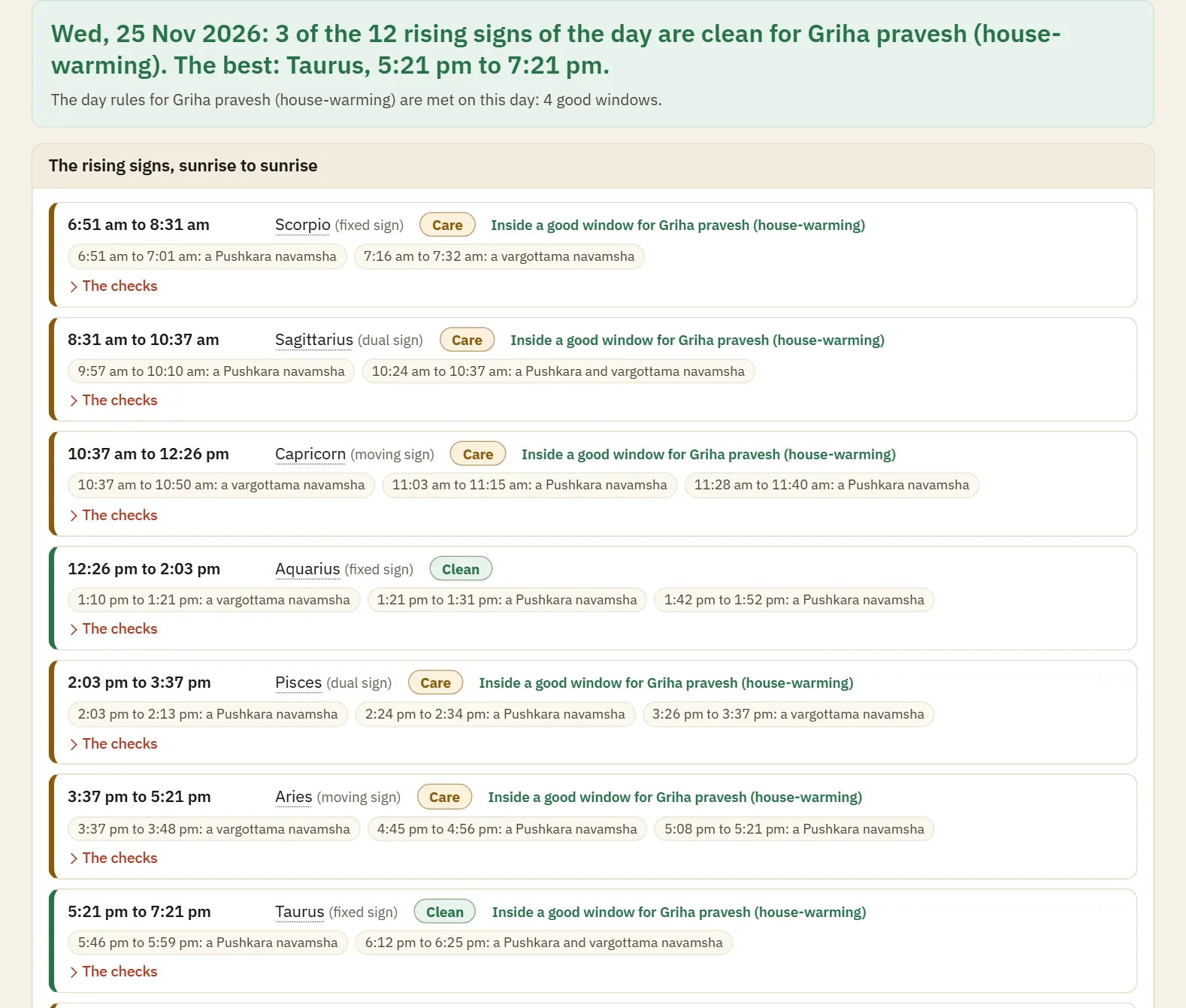
The rising signs of one day
The rising signs of one day for griha pravesh, each marked clean or care. Chips point out the Pushkara and vargottama minutes inside each sign.
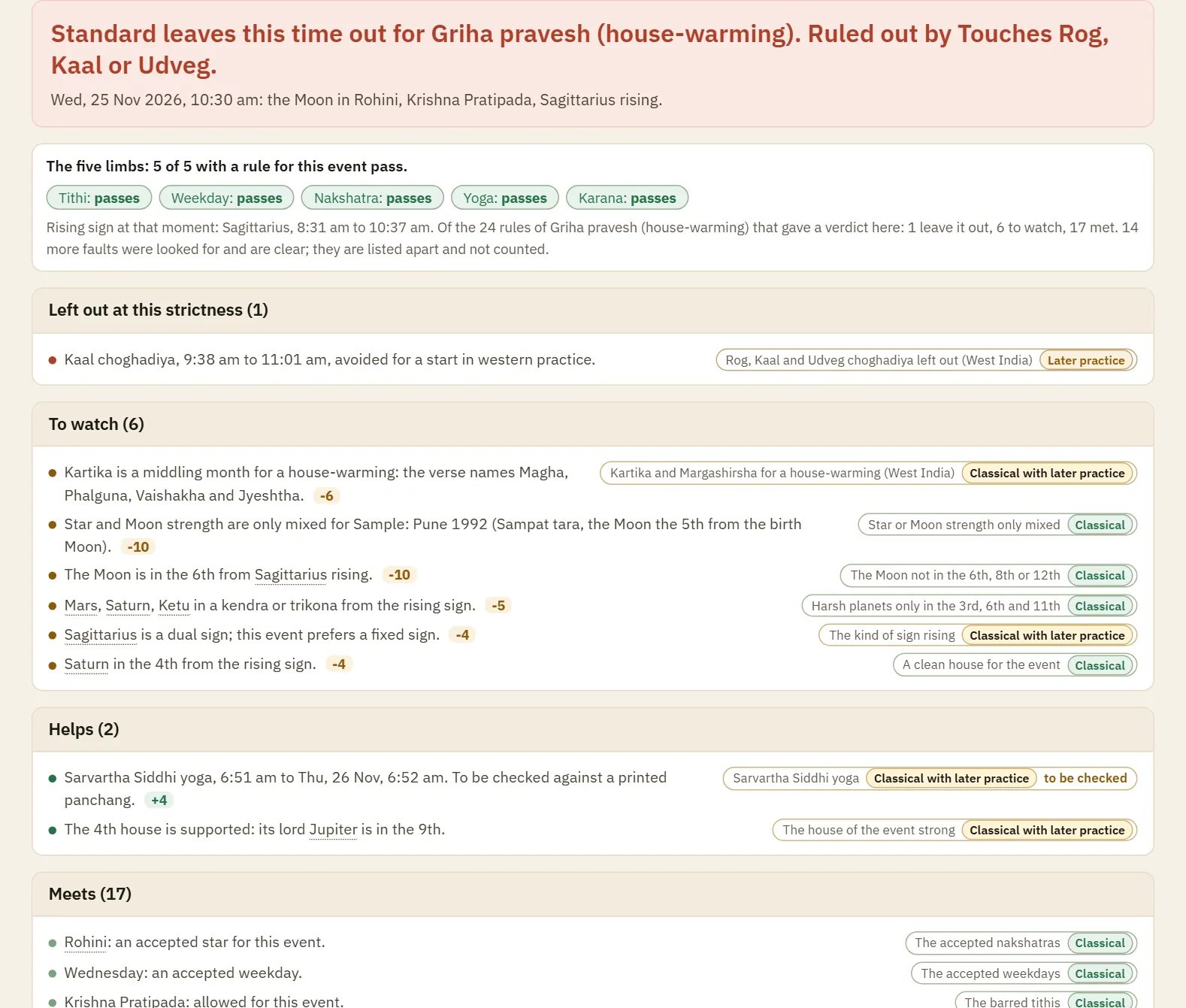
Check a time someone gave you
A date and hour tested for griha pravesh. Standard leaves it out for one fault, the five limbs pass, and every other rule is listed with the points it moves.
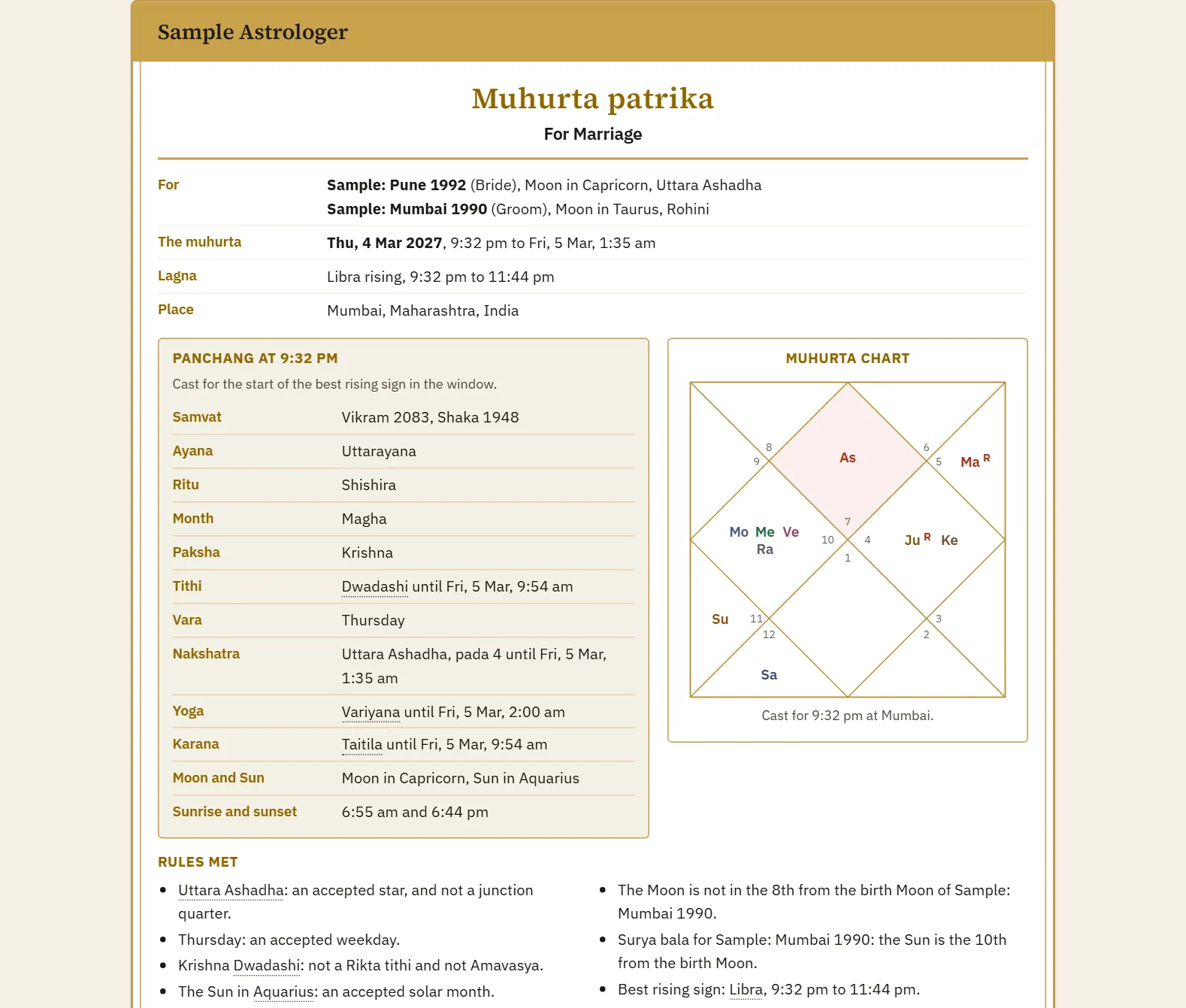
The muhurta patrika
The certificate for a saved election, with the astrologer's name in the band, the people and their Moons, the panchang of the moment and the muhurta chart.
How it fits a sitting
- Ask what the family is planning and open that event.
- Choose the people from your client list. For a wedding choose the bride and the groom, so both Moons are checked together.
- Set the town where the event will be held, the look ahead and the strictness your family follows.
- Read the green line, then open Why this window and go through it with the client. If nothing suits, try the calendar or a longer look.
- If the family already has a date from someone, type it into Check a time and show them what passes and what does not.
- Save the window and print the working sheet for your file or the patrika for the family, with a note for them.
Method and sources
The day is judged first, by the star, tithi, weekday, yoga, karana and month each event names. Then the rising signs inside the open hours are checked, and the Moon is fitted to the people. Points and grades only put the windows in order, and the page says so.
- Muhurta Chintamani of Ramacharya Daivajna, the main text for the rules
- Muhurta Martanda of Narayana Daivajna, the marriage chapter
- Kalaprakashika, for southern practice
- Dharmasindhu and Nirnayasindhu, for vrata and the leaped month
- Brihat Samhita of Varahamihira, for planting and the facing of the stars
- B. V. Raman, Muhurtha
- Eclipses of 2026 and 2027 from the NASA tables, other years from Meeus
What it does not do
- A window is a tendency from the classical rules, never a promise. The sheet says so, and it tells the family to confirm with their priest or astrologer.
- 25 tables could not be confirmed, among them Varjyam, Dur muhurta, Sarvartha Siddhi and five of the ten marriage doshas. They only move the score until checked against a printed panchang.
- It does not apply dosha cancellations. They are shown as notes, and the decision stays with you.
- Not worked out yet: Kunavamsha, Udayasta, Amrit kalam, Agni vasa and Shiva vasa for a homa, the corner Shool and the facing of Venus for travel, and the exceptions of Bhadra.
Questions
A pandit gave my client a date. Can I check it here?
Yes. Open Check a time, enter the date, the hour, the event and the place, and choose the person if you have the chart. The answer names any fault that leaves the time out at your strictness, then lists the rest of the rules with their points.
Why does a printed panchang show a date this tool leaves out?
Printed lists can follow other conventions. If no window appears, try Relaxed to see which faults Standard was leaving out. The rules behind each cut are listed on the page, so you can see where the two differ.
Is Rahu Kaal left out?
From Standard, yes, the same way the Panchang pages treat it. At Relaxed it only lowers the score. The page marks it as a South Indian custom and not a rule of the Muhurta Chintamani.
What do Excellent, Good and Fair mean?
They come from a score of this program, which only puts the windows in order. Excellent is from 85, Good from 70, and Fair is below that. Fair is still a window that meets the rules, with less in its favour.
Is there a free version of this?
The website has free muhurat pages for common events, and a couple vivah muhurat calculator. The Pro tool adds the rising sign checks, the ten doshas, Check a time and the printed patrika.
Have another question?