Nadi astrology software
Find the named nadiamsa of the rising degree and of each planet, read planets against each other in the Bhrigu Nandi way, and follow Jupiter and Saturn over the natal planets year by year. The tool covers the Nadi methods that can be worked out from the birth details, and no others.
Included in the Vedic plan, Rs 3,001 a month. No card needed. Sign in with Google to start.
Who it is for
It suits an astrologer who studies the Chandra Kala Nadi or Bhrigu Nandi Nadi and wants the working done for each client. The tool finds the part, checks how firm it is against the birth time, and lists the links and the meetings. The reading stays with you.
If a client asks about palm leaves, this is not that. The tool does not read leaves or imitate them, and one page says so in plain words that you can show the person. Each line here has a rule, and each rule has a label that says where it comes from.
What you can do with it
The 150 parts of a sign
- The nadiamsa of the rising degree and of all nine planets, each with its number in the sign and its name in Roman and Devanagari letters.
- The sense of each name, in our own words. Point at a name to see it. A name is a meaning of the word, never a reading.
- The counting order of the Chandra Kala Nadi. Movable signs count forward, fixed signs backward, and dual signs begin at the 76th name.
- Two other counts as switches, only to compare numbers from other programs.
- Parts of equal size, 12 minutes of arc each, or unequal parts cut where any Parashari divisional chart changes part.
- The D150 chart, by four published schemes for the sign of each part.
- Printed, the Nadi Home is a one page Nadi sheet.
How sure the rising part is
- The rising part at the birth time and at 1, 2 and 5 minutes either side, each marked Same part or Another part.
- The clock time the rising part starts and ends at the birth place, and how many seconds it takes to rise.
- Every part the rising degree passes in the five minutes either side, with its exact start and end times.
- The crossings are found by stepping two seconds at a time and halving, to a tenth of a second.
- A clear line when a birth time rounded to five minutes cannot settle the part.
Key facts of the chart
- The Moon's pada and the Lagna pada, each with its navamsa sign and lord.
- The 108 padas in one table, with the planets and the Lagna marked where they fall.
- The self planet, asked once for each client. Jupiter by default, or Venus as the Bhrigu Nandi teaching gives it for a woman's chart, with Mars as the husband.
- Saturn as the karma planet, the planets moving backward, and every point in a gandanta pada.
The Bhrigu timeline
- A strip from birth to age 100 with a mark at each meeting of Jupiter or Saturn with a natal planet, and a mark for each return.
- Every stay of Jupiter or Saturn in a sign as its own row, with the day it came in and how, and the day it went out and how.
- A retrograde loop gives one sign more than one row, each with its own dates.
- The exact day a transit crosses the natal degree, up to three times with a retrograde loop.
- Rahu and Ketu passing the natal planets, beside Jupiter and Saturn.
- The sign return and the degree return named apart.
- The next 12 years, the years so far, or the whole life. True transit by default, and the symbolic clock as a labelled switch.
Planet links, by sign
- Planets read against each other by sign, counted from the self planet first and then from Saturn. Houses from the rising sign are not used.
- Jupiter's and Saturn's circles, each with a chart counted from that planet.
- Links by kind. In one sign, in trine, facing, in the 2nd and the 12th, and exchanged signs. The 3rd and 11th are a switch.
- A sign with three or more planets is read once, as one group.
- The three pairs nearest to exact by degree.
- One fixed meaning for each planet, a link grid, and the retrograde rule that also reads a planet from the sign behind it.
Dasha and sources
- Vimshottari first, then Kalachakra and Yogini, with the period running now and the sub-periods inside it.
- The balance at birth worked out step by step for each of the three.
- For Kalachakra, the deha and jeeva signs, the named jumps, and what the other rule would give today.
- 44 rules listed in our own words with their sources, with a filter by label.
- A table of where the sources disagree and what the tool does, and a table of how far each text is trusted.
See it in the tool
Real screens from the tool, made with sample charts. Select a screen to see it larger.
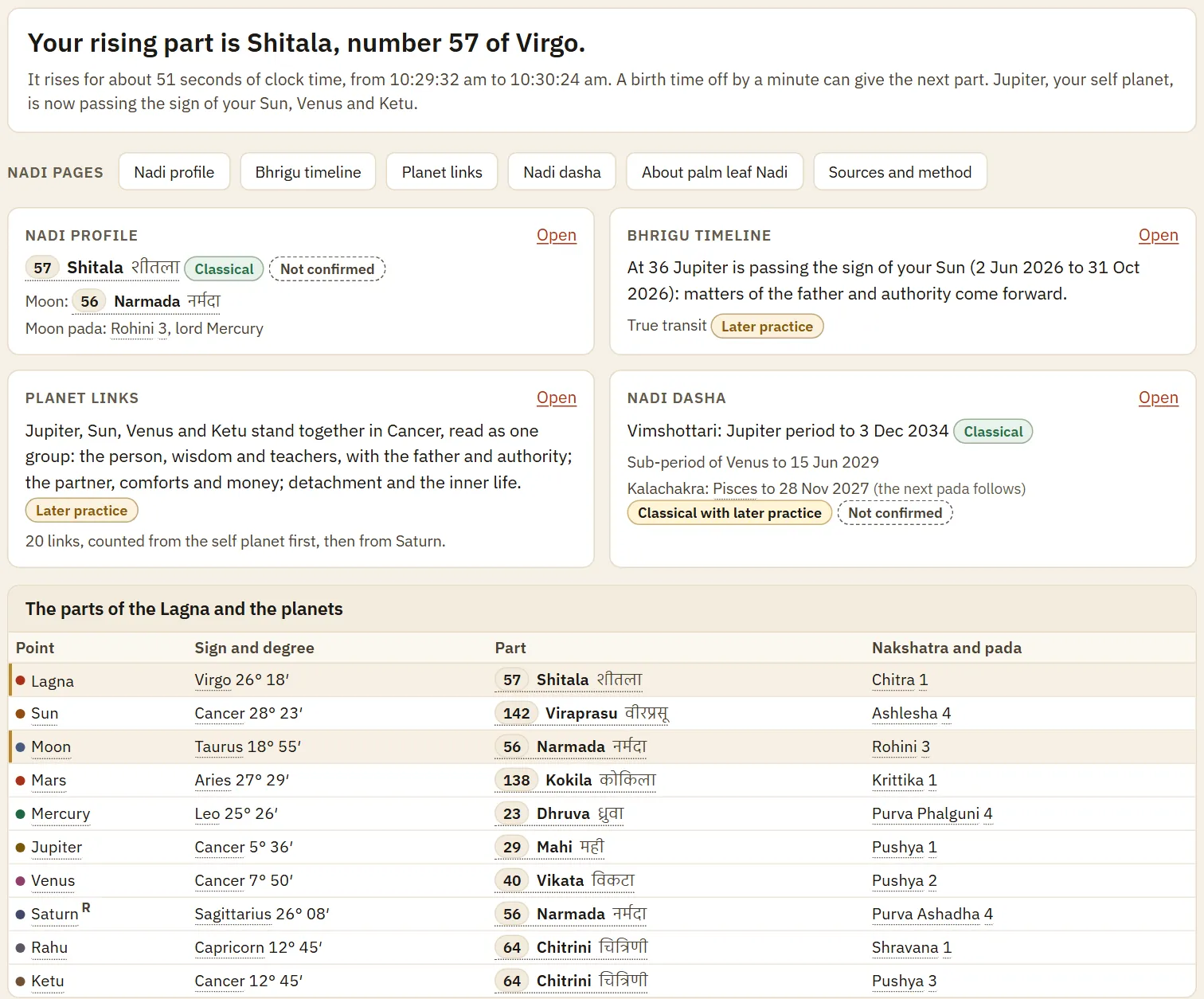
Nadi Home for one client
The rising part by name and number, how long it rises, what Jupiter is passing now, four tiles to the deeper pages, and the part of every point.
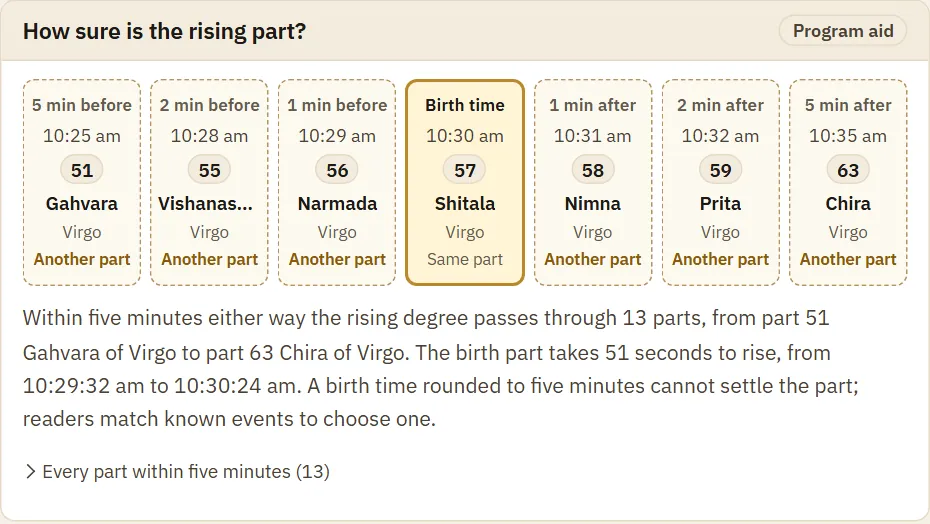
How sure is the rising part
Seven times around the birth time, each with its part. A change of a minute or two can give another part, and the card says so.
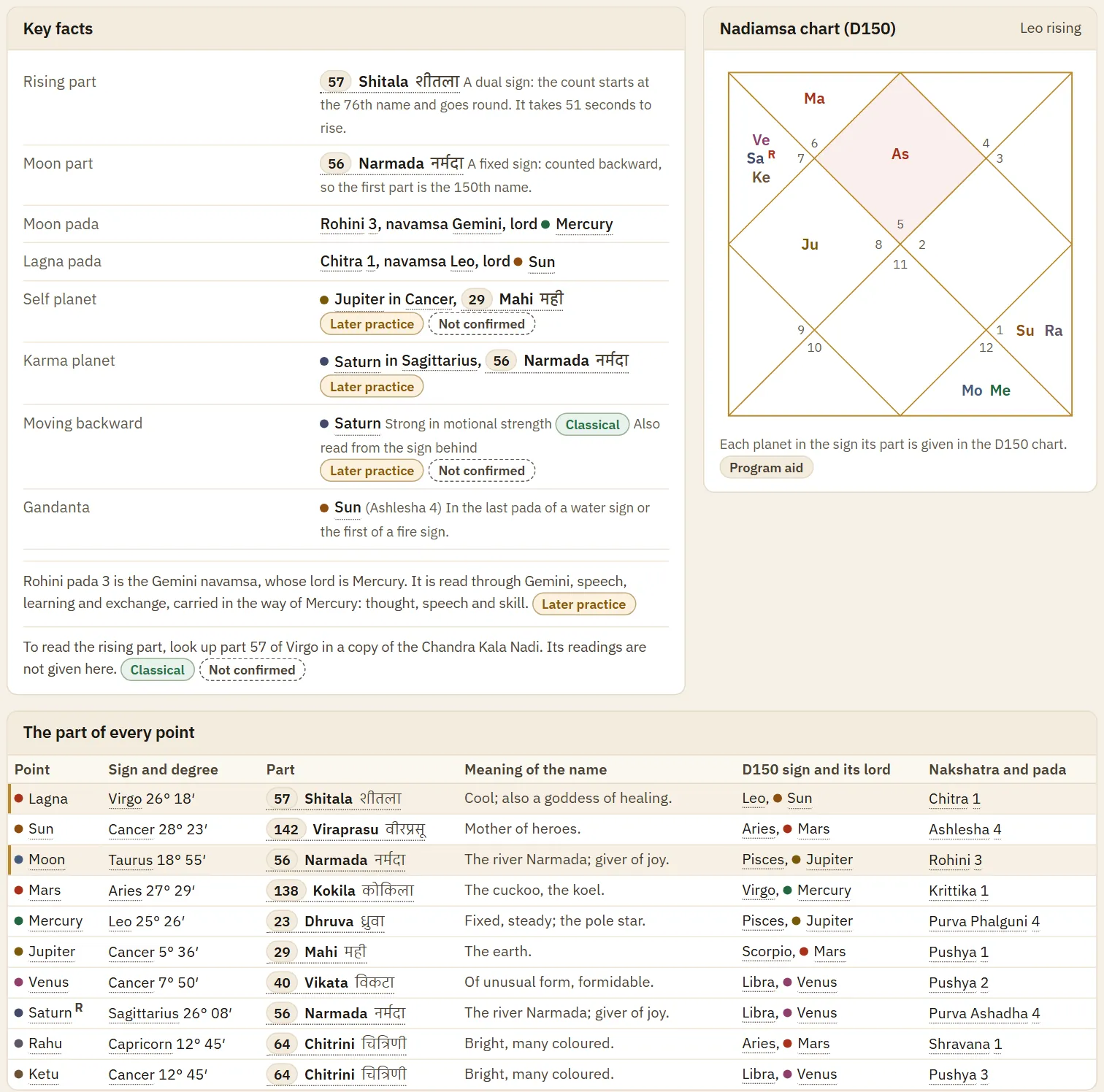
Key facts, the D150 chart and the part of every point
The Moon and Lagna padas, the self and karma planets, the D150 chart, and each point with the sense of its name and its D150 sign.
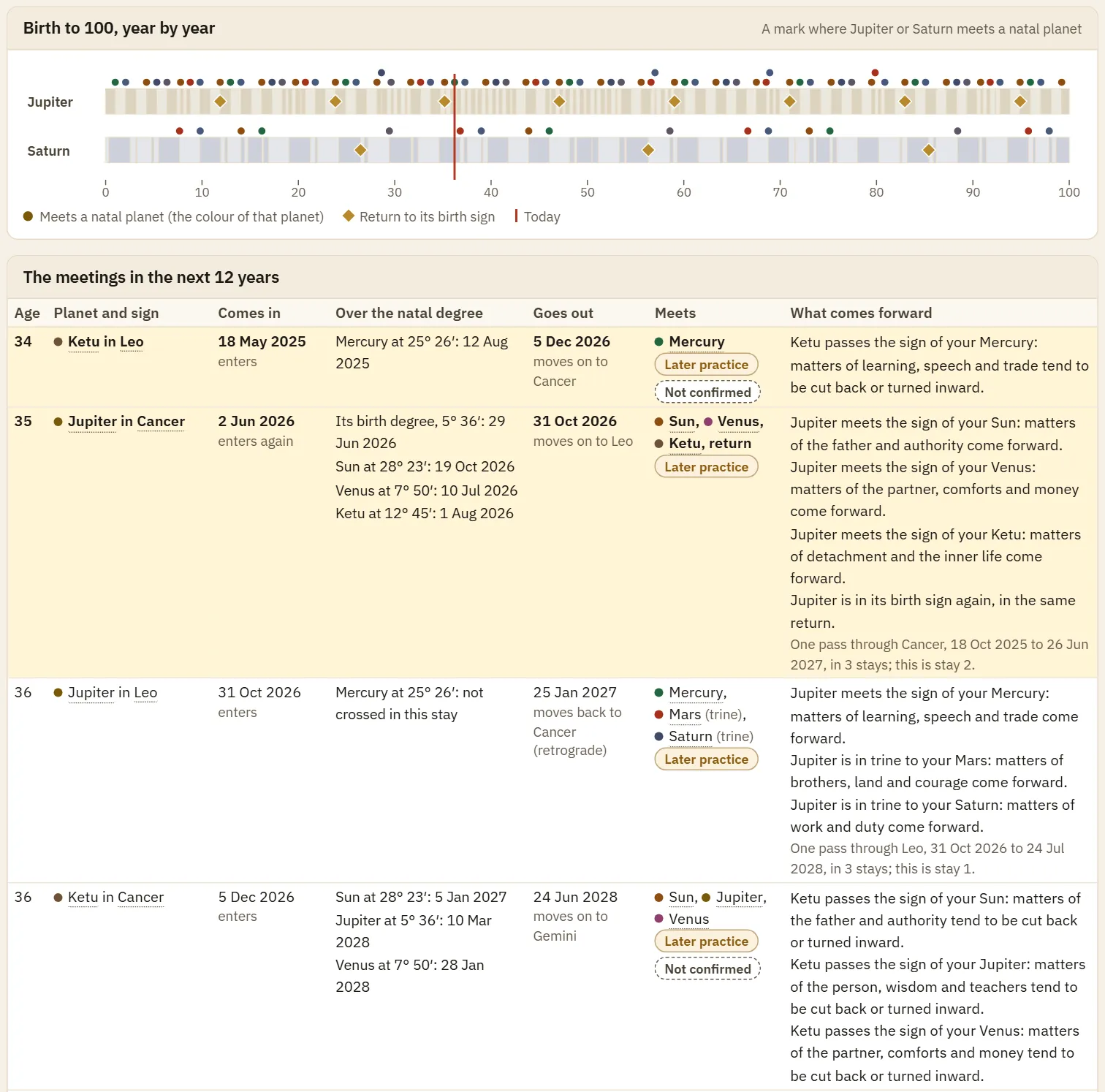
The Bhrigu timeline
Jupiter and Saturn from birth to 100, then each stay in a sign with its dates, the exact crossing and what comes forward.
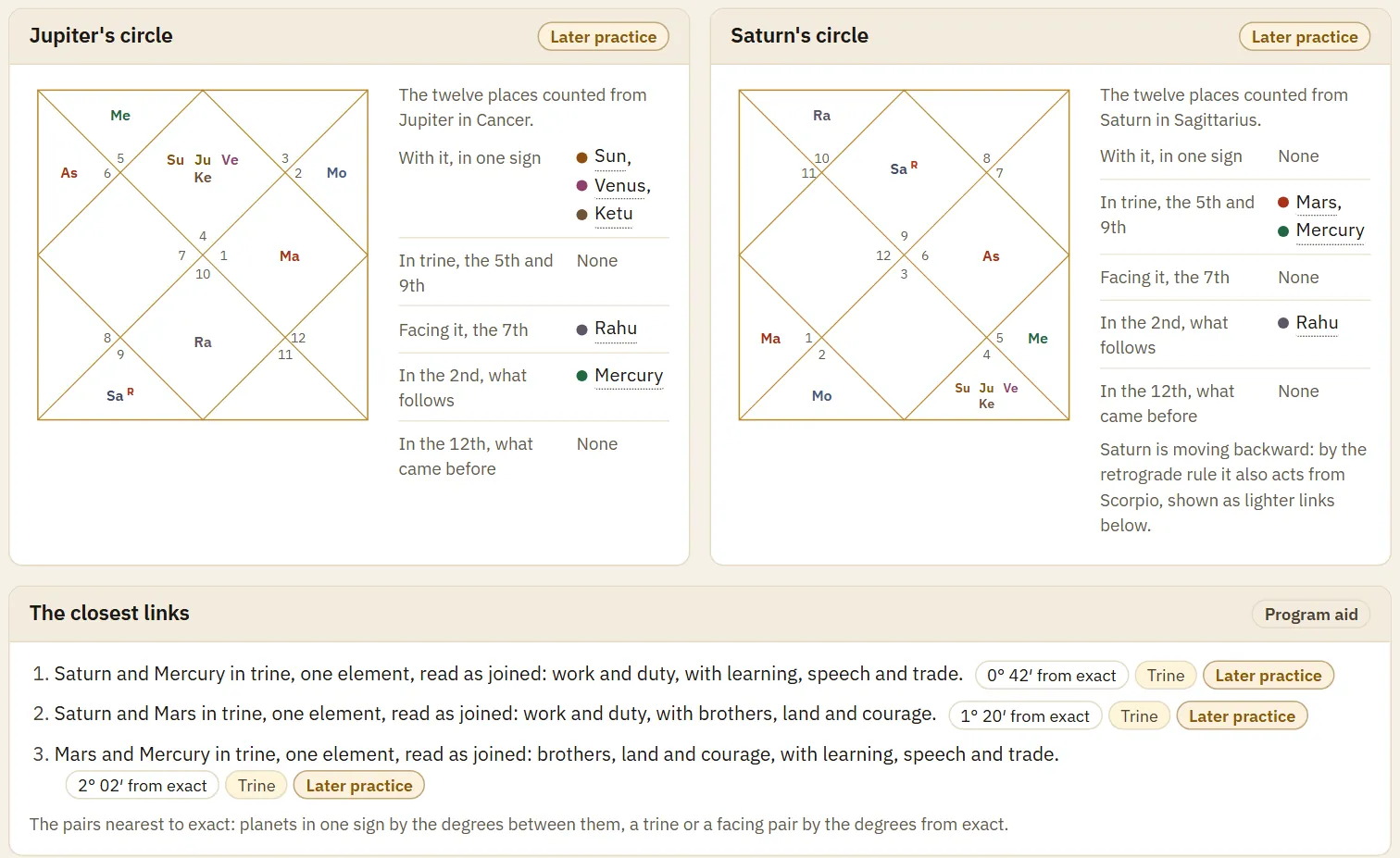
Jupiter's and Saturn's circles
The chart counted from each planet, who stands with it, in trine, facing, in the 2nd and in the 12th, and the closest links by degree.
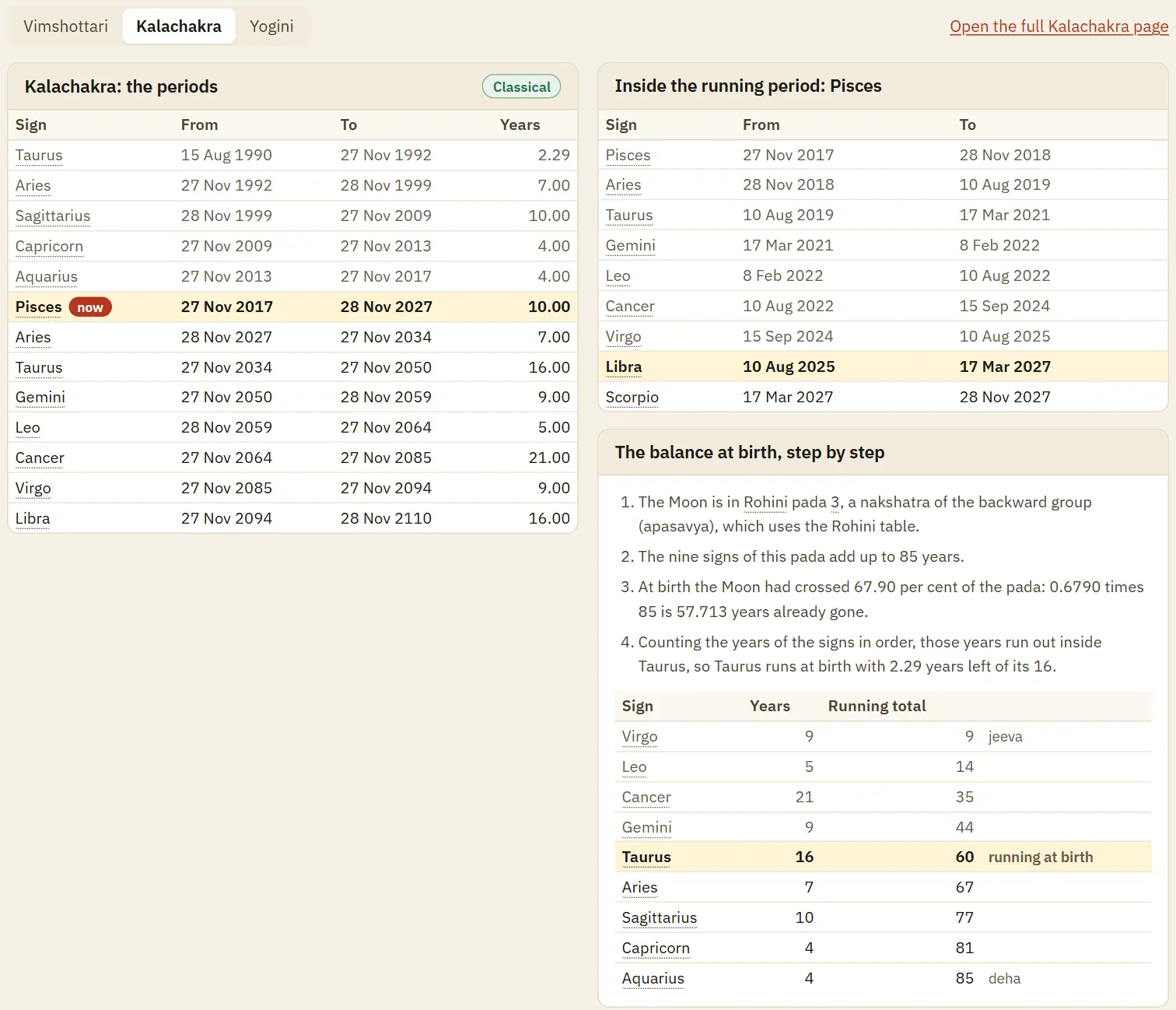
Kalachakra with the balance worked out
The periods from the Moon's pada, the sub-periods of the one running, and each step of the balance at birth.
How it fits a study of the chart
- Open the client's kundli and go to Nadi. Note the rising part and how long it takes to rise.
- On Nadi profile, check how sure the part is. If the birth time was rounded, use known events of the life to choose among the parts.
- Look up that part in your own copy of the Chandra Kala Nadi. Its readings are not given in the tool.
- On Planet links, read the self planet's strongest link and Jupiter's and Saturn's circles.
- On the Bhrigu timeline, see which natal planets Jupiter and Saturn meet in the next 12 years, and check each against the dasha running then.
- Speak of what comes forward as a tendency. A meeting never fixes the date of an event.
Method and sources
Each sign is cut into 150 parts and the names follow the counting order of the Chandra Kala Nadi. Planet links follow R. G. Rao's exposition of Bhrigu Nandi Nadi, which is later practice. The 44 rules split into 9 classical, 6 classical with later practice, 21 later practice and 8 program aids, and 17 of them also say Not confirmed.
- Chandra Kala Nadi, also called Deva Keralam, tr. R. Santhanam, Sagar Publications, 1992: the 150 nadiamsas, their names and counting order
- R. G. Rao, Bhrigu Nandi Nadi, Ranjan Publications: later practice, for the planet links, Jupiter as the self, Saturn as karma, and timing by transit
- Brihat Parashara Hora Shastra: navamsa and padas, karakas, exchange of signs, and the Kalachakra, Yogini and Vimshottari dashas
- P. V. R. Narasimha Rao, Vedic Astrology, An Integrated Approach: the Kalachakra tables and worked examples
- Saptarishi Nadi, Tamil edition, 1961, ed. C. G. Rajan and R. Chandrasekhar: worked charts
- Satya Jatakam, the base of Dhruva Nadi, Ranjan Publications: results of planets by sign and combination
What it does not do
- It does not read palm leaves and does not imitate them. There is no thumb impression screen and no chapters in a reader's voice.
- The 1,800 readings of the Chandra Kala Nadi are not given. The tool names the part, and you look it up in your own copy.
- It does not choose a part for you or correct a birth time. Matching known events to a part is the reader's work.
- No dasha called Nadi dasha was found in the named texts, so the page offers Vimshottari, Kalachakra and Yogini under that name.
- No line fixes a date for marriage, children, illness or loss. A row says what comes forward, and a tendency is all it claims.
Questions
Does it give the Chandra Kala Nadi reading for my rising part?
No. It gives the part's number and name, and the sense of the name in our own words. The text's readings belong to the text and its translator, so the page tells you which part to look up in a copy of the book.
Which is right, equal or unequal parts?
Both are later readings of the text. Equal parts of 12 minutes are the default here, and unequal parts are a switch under More options. The page shows what your rising part would be with the default switches, so you can compare.
My old software gives a different part number. Why?
Programs count the names in different orders. This tool uses the order of the Chandra Kala Nadi, and offers a plain forward count and an odd and even count as switches so you can compare numbers. The Sources and method page says which counts match no text.
Which planet stands for the person in a woman's chart?
The tool asks once for each client. Jupiter is the default for everyone, and Venus is the Bhrigu Nandi teaching for a woman's chart, with Mars as the husband. Some teachers keep Jupiter, so the choice is yours.
What is left when the birth time is not known?
In part. There is no rising part without a birth time, and the Moon's part is only a guess, because the Moon moves through a part in about 20 minutes. The planet links read signs and not houses, so most of that reading still works.
What should I tell a client who asks about palm leaves?
That it is a different practice from what the chart shows. The page About palm leaf Nadi explains what the practice is and why a program cannot do it, and you can show it to the person.
Have another question?