Ashtamangala Prashna software
The Kerala way of answering a question as a small rite, with the sums done for you. You enter what the rite gave, and the tool works out the Arudha, the Ashtamangala number, the Thamboola planet, Gulika and the sphutas, and keeps the record.
Included in the Vedic plan, Rs 3,001 a month. No card needed. Sign in with Google to start.
Who it is for
Written for Daivajnas and for astrologers trained in the Kerala method. The rite happens in front of you, with the lamp, the drawn chakra, the gold and the 108 cowries. This tool does not replace any of that. It takes what you saw and counted, and turns it into a clean sheet with the working shown.
It covers three forms of the rite. Ashtamangala Prashna for a person's question, Thamboola Prashna when the reading comes from the betel leaves, and Deva Prashna for a temple, with sittings that stay together over several days.
What you can do with it
The time of the question
- The moment the gold was placed, at your place or at the place of the rite.
- The Malayalam date, with the month, the day and the Kollam year.
- The weekday, tithi, nakshatra, yoga and karana of the moment.
- The hora and the nazhikas since sunrise.
- The birth star of the person asked about can be picked from the list, or taken from a saved client's chart.
Arudha, cowries and betel leaves
- The Arudha found four ways: the gold on the drawn chakra, a number from 1 to 108, the direction of the person, or the sign touched.
- The chakra is drawn as a square with east at the top. Click the square where the gold was placed.
- A number over 108 is reduced by 108 as often as it goes, and the page shows the sum.
- The cowries typed as shells in each heap or as the three digits. The past, present and future digits are worked out, and a sum other than 108 is flagged.
- Each digit shows its planet and whether it is read as favourable.
- The count of betel leaves gives the Thamboola planet, with the sum written out.
- Each leaf can be marked fresh, withered, torn or holed, and stands for a house from the Thamboola lagna.
Lagnas, Gulika and the sphutas
- The Udaya and the Arudha read together, each as supported, mixed or needs care, from the planets on it and the state of its lord.
- The Chhatra by two rules and two readings of the Sun's path, in one table of four rows. It is not counted until one rule is checked.
- The house of the matter, counted from the Udaya and from the Arudha.
- Gulika always by the Kerala table on these pages, and first in the reading when it stands on or aspects the Arudha, the Udaya or the Moon.
- The house of hindrance (Badhaka), its lord, and the deity linked to that lord, with the traditional worship.
- Six sphutas. Trisphuta, Chatusphuta, Panchasphuta, Pranasphuta, Dehasphuta and Sookshma Trisphuta.
- Each sphuta with its sign, degree, nakshatra, navamsha, house and tara from the birth star.
- Whether Pranasphuta and Dehasphuta are in each other's trine, by sign and by navamsha.
- The working of every sum in degrees, so it can be checked by hand.
Omens (Nimitta)
- 68 omens to tick, in ten groups, including the breath, the person's speech and posture, the messenger, the lamp, the gold and the sounds heard.
- The time of the question is filled in as its own group, with Rikta tithi and Rahu Kalam, and counted apart.
- Each omen you tick shows what it is read for, with its label.
- If two opposite omens are ticked, the page says so and leaves the choice to you.
- The first syllable of the question is kept as written, and is not read.
- The counts are never weighted and never change any other reading.
Deva Prashna checklist
- The twelve temple houses from two lists side by side, one practitioner's account and the list commonly taught, with the differences marked.
- For each house, the sign, the lord, the deity of the lord and the planets there, with a Discussed box and a note.
- The taras count from the deity's star instead of a person's birth star.
- The sittings of one temple kept together, and the next sitting started from the page.
- Nine faults to tick when the gathered Daivajnas name them, each with its traditional remedies.
- A remedy log (Daivahitham) that keeps each proposal with its new three digits. No cost is kept.
- The houses read for each part of the temple, in five groups.
The reading and the record
- Every part of the rite in one calm sentence a line, each ending with its label.
- Your own notes kept with the question.
- Print one A4 sheet, copy the reading, or save it as a text file with the labels in brackets.
- One saved list with the Prashna tool, filtered by section. Prashna, Ashtamangala, Thamboola or Deva Prashna.
- 47 rules listed with their sources, the Kerala Gulika table, and where the sources disagree.
See it in the tool
Real screens from the tool, made with sample charts. Select a screen to see it larger.
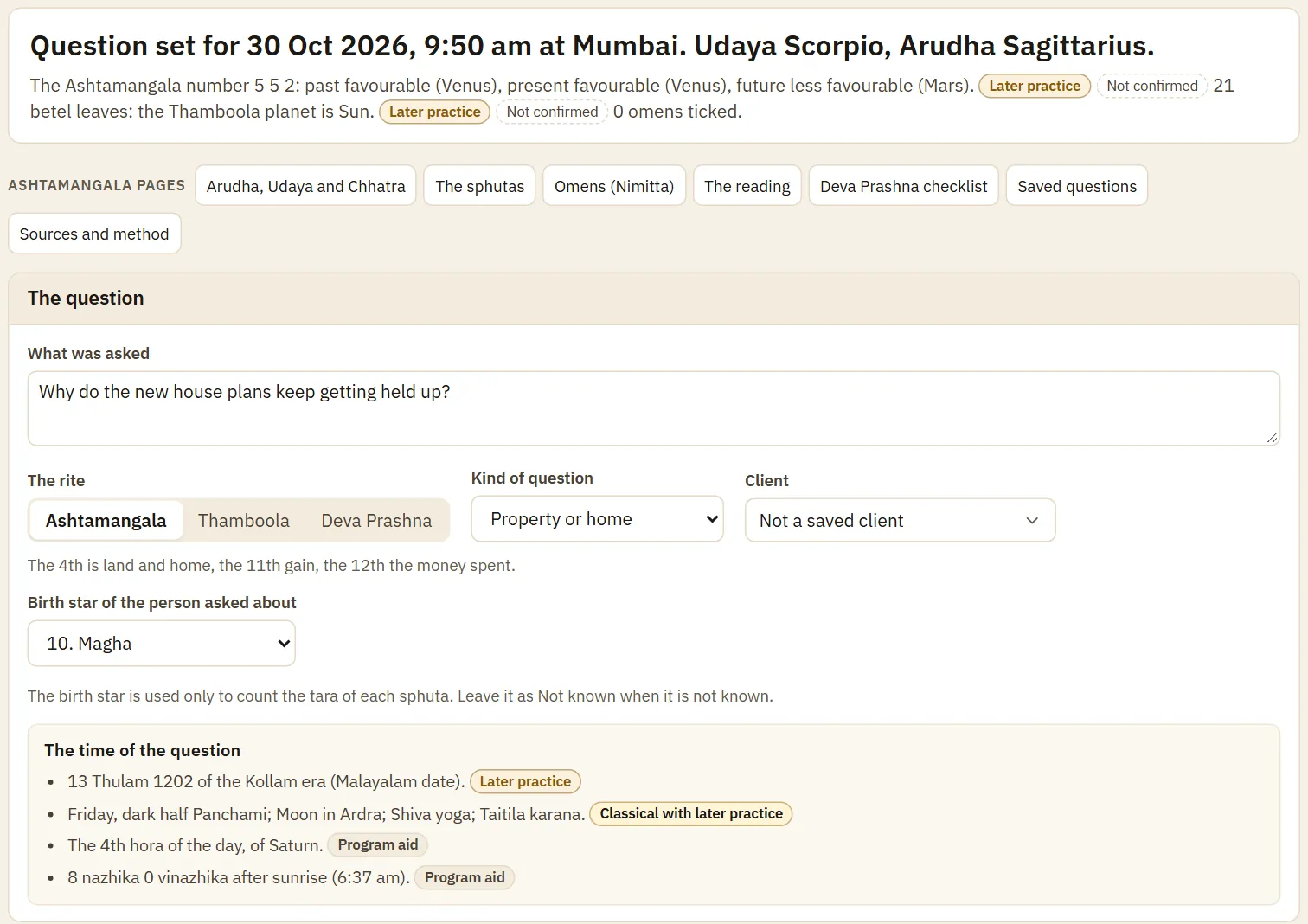
The rite at a glance and the time of the question
The first line says what the rite has given so far. The question card carries the Malayalam date, the panchanga, the hora and the nazhikas.
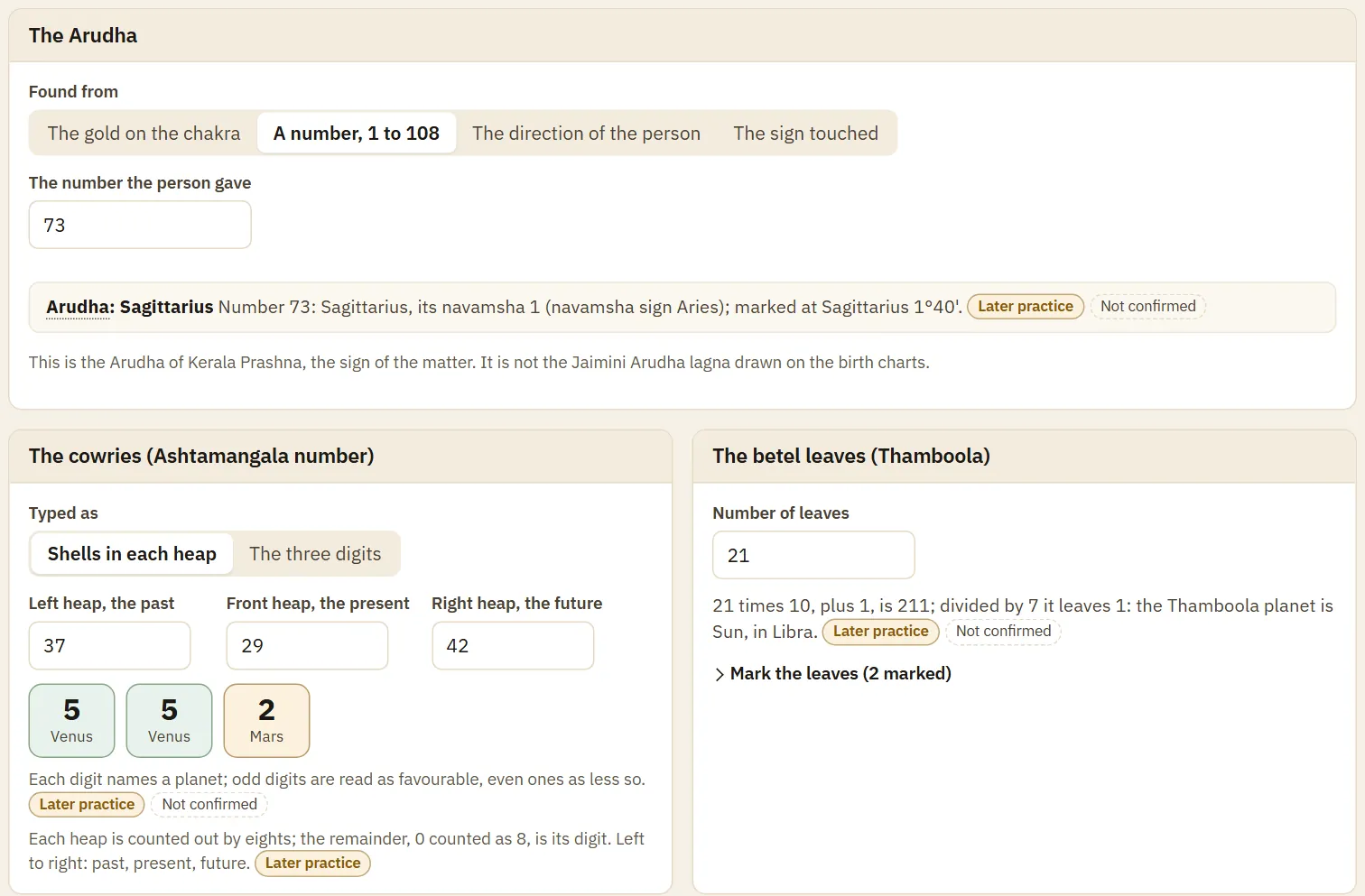
The Arudha and the cowries
The Arudha by number, here 73, with its sign and navamsha, and the three heaps turned into the Ashtamangala number.
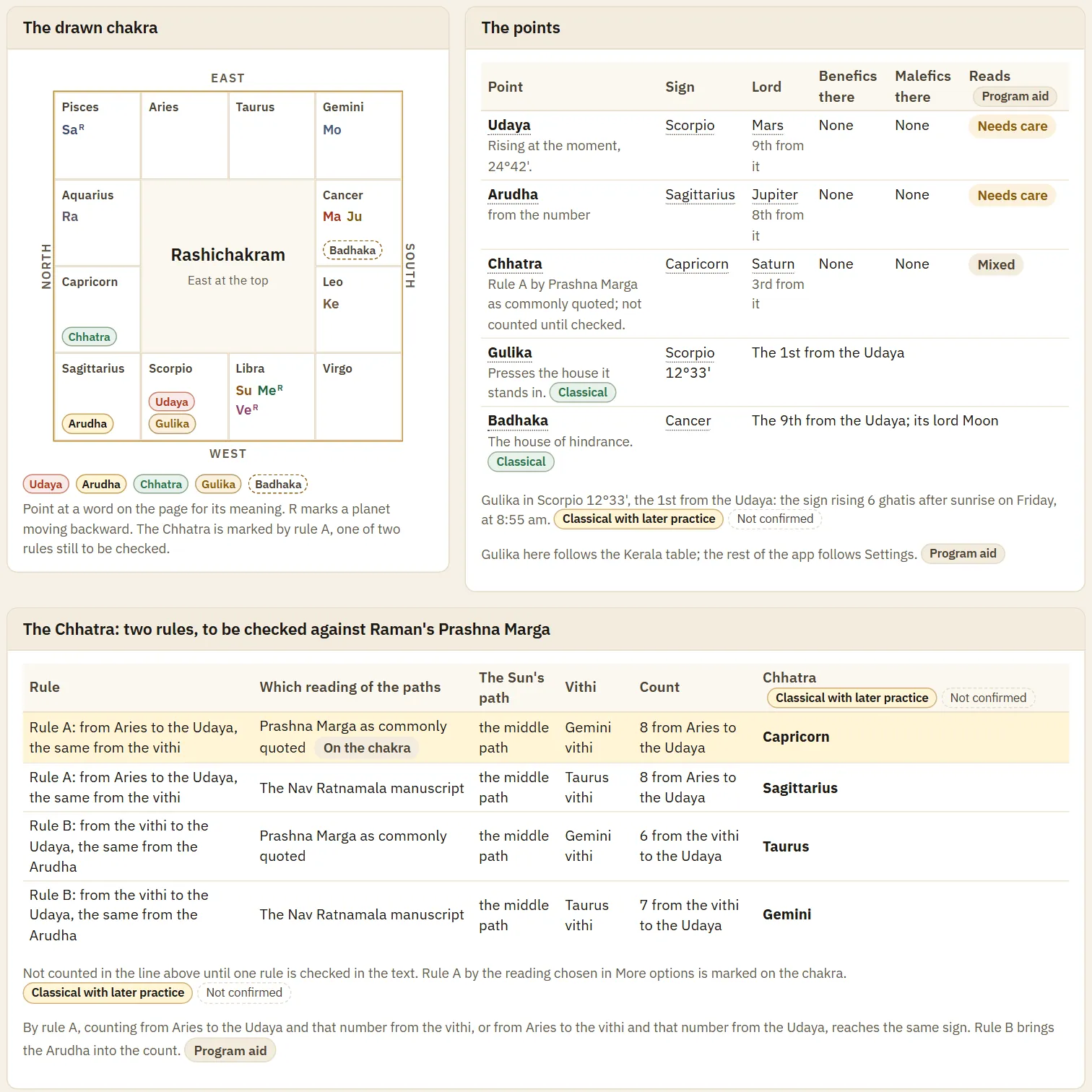
The drawn chakra, the points and the Chhatra
The chakra with east at the top, a table of the points with what stands on each, and the Chhatra by both rules.
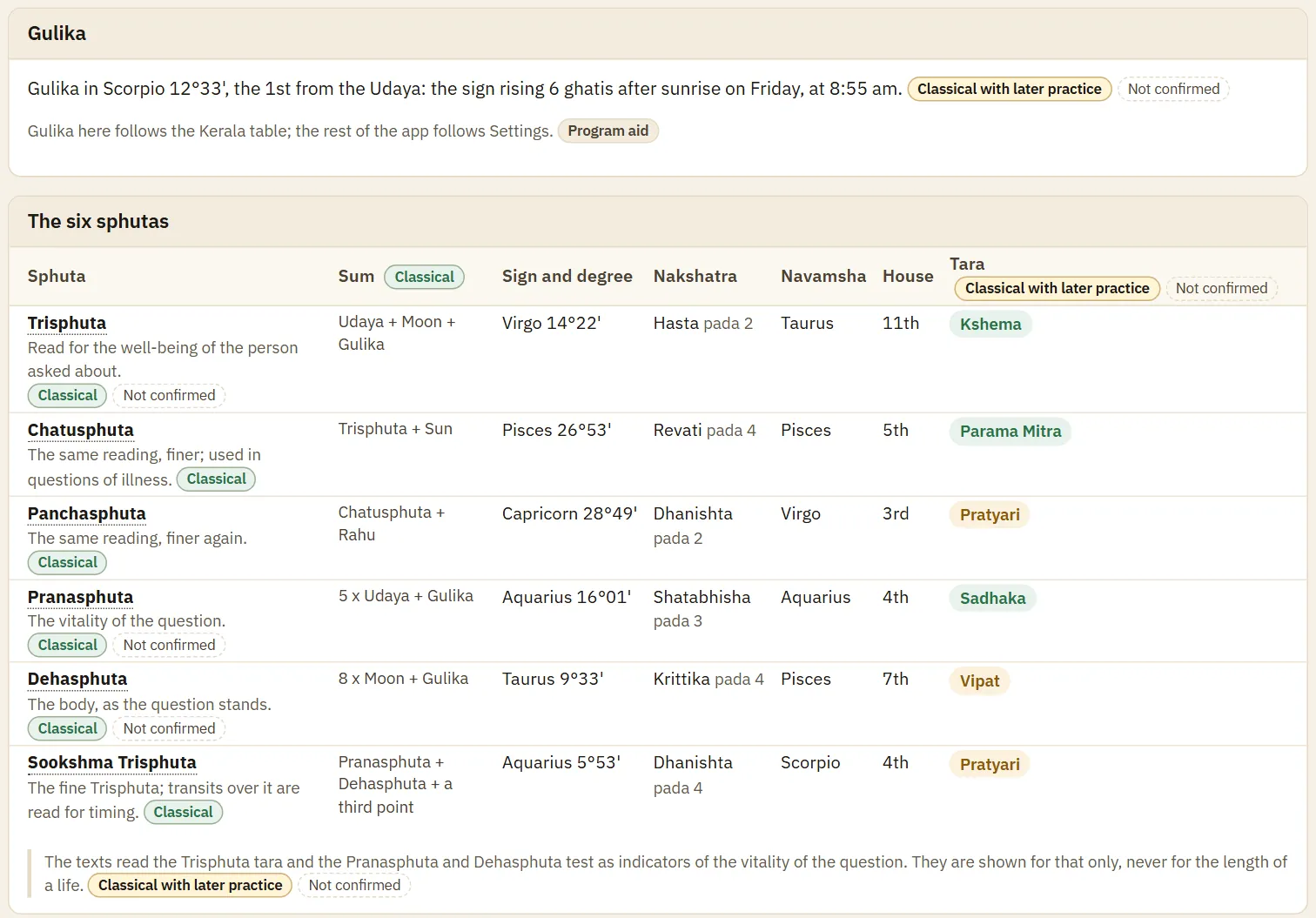
Gulika and the six sphutas
Each sphuta with its sum, sign, nakshatra, navamsha, house and tara from the birth star.
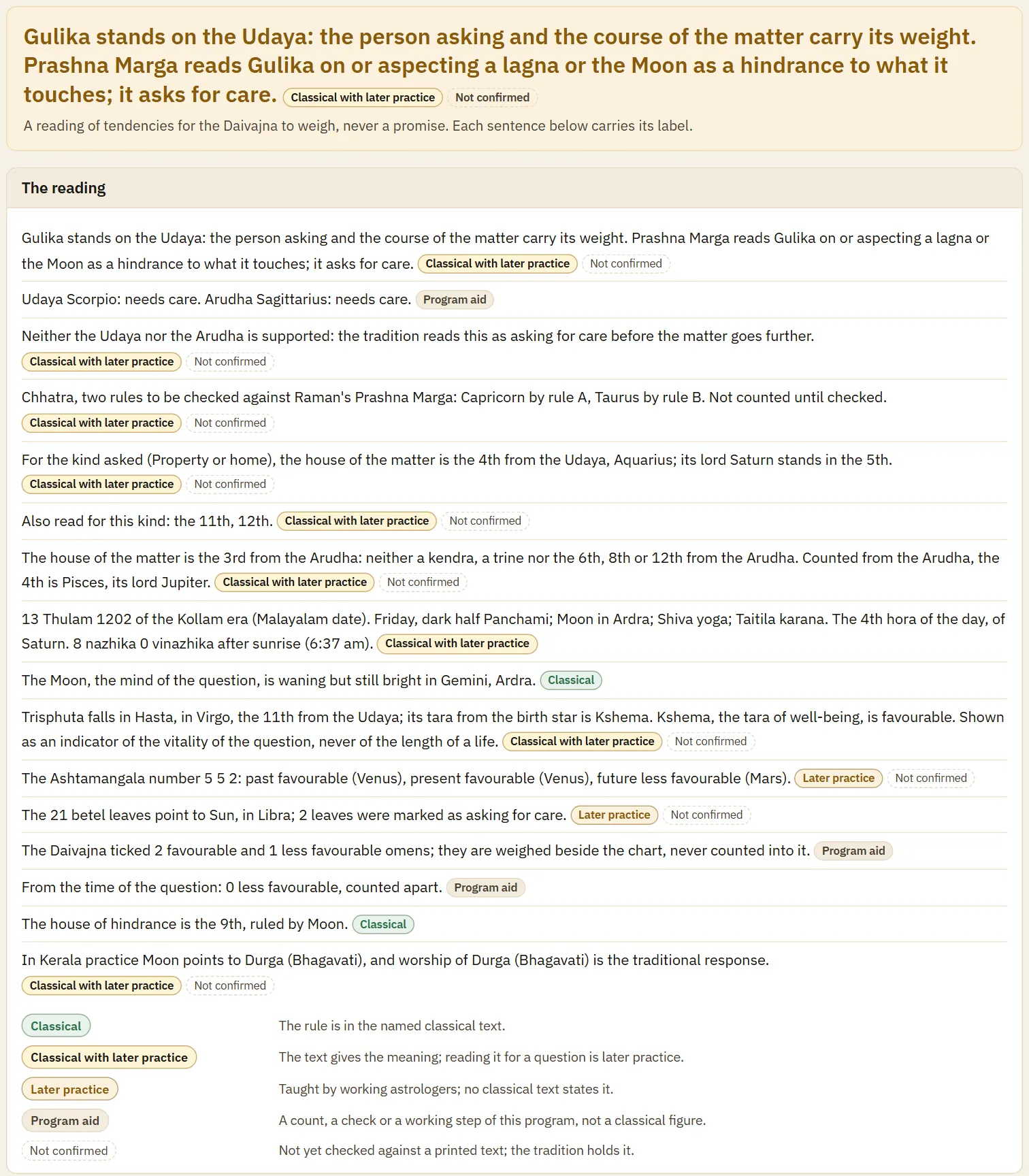
The reading, line by line
One sentence for each part of the rite, each with a label such as Classical or Later practice, ready to weigh and to speak with care.
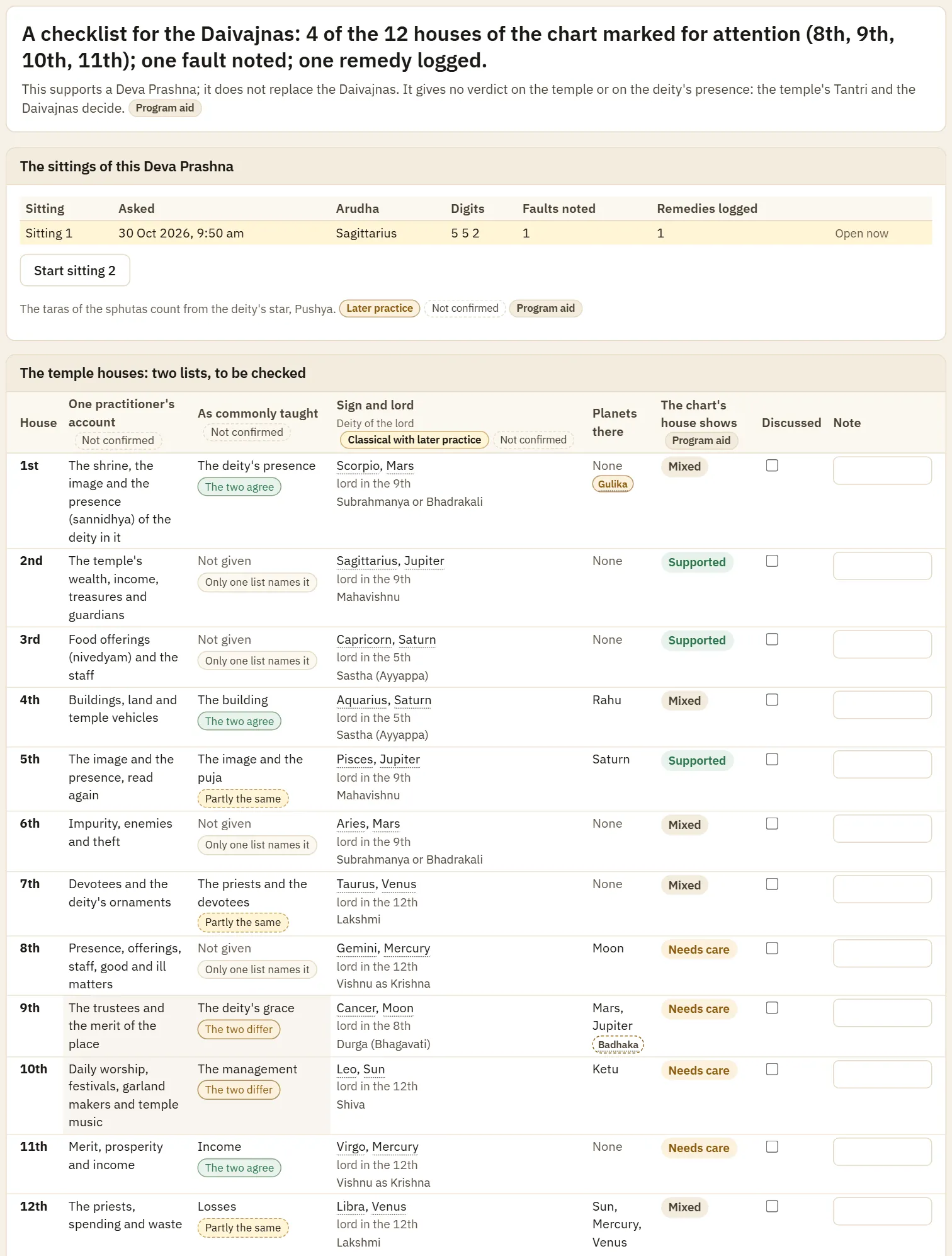
The Deva Prashna checklist
The sittings of one temple kept together, then the twelve temple houses from both lists, with the differences marked, for the Daivajnas to go through together.
How it fits the rite
- Light the lamp and set up as you always do. Note the minute the gold is placed, and set that moment on Question setup.
- Set the Arudha from the square the gold fell on, or from the number, the direction or the sign touched.
- Split the cowries, count each heap out by eights, and type the shells or the digits.
- Count the betel leaves the person brought, and mark any that are withered, torn or holed.
- Tick only the omens you saw for yourself.
- Read the Arudha, Udaya and Chhatra page and the sphutas, then open The reading and add your own notes.
- Save the question, and print the one page sheet if the person wants one.
Method and sources
The chart is cast for the moment the gold is placed, and its rising sign is the Udaya. Positions are drik, with the ayanamsa set in Settings, and sunrise is taken at the upper edge of the Sun. Each of the 47 rules carries a label: 13 classical, 13 classical with later practice, 10 later practice and 11 program aids, and 16 are marked Not confirmed. A line that begins The tradition holds was not checked against a printed text.
- Prashna Marga (Kerala, about 1649), ascribed to Narayanan Nambutiri of Edakkad, translated by B. V. Raman in two parts: the rite, the omens, the three lagnas, Gulika, the sphutas, the house of hindrance
- Prasnanushtana Paddhati: the order of the rite
- Krishneeyam: rules that Prashna Marga quotes
- One practitioner's account of a Deva Prashna: the cowries, the digit key, the Thamboola rule, the temple houses, the faults and remedies
- Kerala teaching as commonly summed up: the second list of temple houses, the deity's star, the Chhatra by rule B
- A 2022 paper on the number method: the rule for 1 to 108
- The Kerala almanac: the Malayalam month and the Kollam year
What it does not do
- It does not perform the rite and cannot see omens. Everything from the rite is what you enter.
- It works from drik positions, not the Vakya panchangam. The two can differ by a fraction of a degree or more, so a sphuta near a border may fall in the next nakshatra in your panchangam.
- Five open rules still wait for a sitting with B. V. Raman's translation. The Chhatra is shown and not counted until then, and chapters are cited by subject until their numbers are checked.
- It gives no verdict on a temple or on the deity's presence. The temple's Tantri and the Daivajnas decide what is done.
- It does not read the length of a life, and the Mrityusphuta is named once and not applied. Matters of serpents, ancestors and unseen causes are not read beyond naming the house of hindrance, its planet and the linked deity.
Questions
Which Gulika does it use?
These pages always work Gulika out by the Kerala table, a set number of ghatis after sunrise or sunset by weekday. The rest of the tool follows its own Gulika setting, which these pages change only when a user in Kerala or Tulu Nadu says yes to the one question asked.
Does it use the Vakya panchangam?
No. It uses drik positions. Many Kerala Daivajnas work from Vakya, so the Sources page asks you to check any reading that turns on a border against the panchangam you follow.
Why is the Chhatra shown in four ways?
Two rules are taught, and two readings swap the names of the middle and southern paths of the Sun. All four are shown, and none is counted in the line that reads the lagnas until one rule is checked in the text.
How are the cowrie digits read?
Each heap is counted out by eights, and the remainder, with 0 counted as 8, is the digit. Left to right they stand for past, present and future. The planet key rests on one practitioner's account, which calls itself simplified, so it carries a label.
Is this the same Arudha as in Jaimini?
No. This is the Arudha of Kerala Prashna, the sign of the matter. It is not the Jaimini Arudha lagna drawn on birth charts.
Can several Daivajnas use the Deva Prashna page together?
The page is one checklist on your device, and it is meant to be gone through together, with a Discussed box for each house. Each sitting is saved as its own question, and the sittings of one temple stay together. Temple names stay on your device.
How does this differ from the Prashna tool?
The Prashna tool reads a question by the Tajik yogas and the Parashari reading. This one follows the Kerala rite. Both share one saved list, and outcomes are recorded on the Prashna page.
Have another question?