Prashna astrology software
When a sincere question reaches you, this tool casts the chart of that moment and gives a lean with its reasons. The sixteen Tajik yogas, a reading of the time and a saved record of what actually happened come with it.
Included in the Vedic plan, Rs 3,001 a month. No card needed. Sign in with Google to start.
Who it is for
Questions often come with no birth details at all. A client asks whether a transfer will come or where the keys went. You type the question, pick its kind, and the chart is cast for that minute at your place or at the person's place.
It also suits an astrologer who wants to learn from their own work. Each question you save keeps its moment, its settings and its lean. When you later record what happened, the tool keeps your own count of how the leans turned out.
What you can do with it
Setting up the question
- 17 kinds of question, from Will it happen to Lost object, Marriage, Lawsuit, Children, Property, Studies and Money lent.
- Work comes in four kinds. A new job, a change of job, a transfer and a promotion.
- Each kind sets the house of the matter, and you can change it. The page says which houses it reads.
- Cast for your own place or the person's place, to the minute.
- The rising sign can come from the moment, from a number from 1 to 108, or from the Arudha.
- Link the question to a saved client, or leave it unlinked.
- With no question typed, the page casts for now, so the chart of the moment is still there to read.
The lean and its reasons
- The Tajik lean comes first. Leans yes, Mixed, Leans no, or Not shown clearly in this chart.
- The words change with the question, such as Leans steadier for illness and Leans toward finding it for a lost thing.
- The three reasons that weigh most, each labelled, and a fold with all reasons and their weights.
- A second reading by Parashari aspects, in the manner of Prashna Marga. When the two differ, both are shown and they are never added together.
- A note before judging, when the rising degree is within 1 degree of a sign edge or in gandanta, or the Moon is afflicted or empty of course.
- The same client's earlier question of the same kind within 30 days, with its lean then and its outcome.
- Illness and dispute readings close with a line that they are not medical or legal advice.
Tajik yogas
- All sixteen yogas of the Tajika Neelakanthi, with a line on why each is or is not present.
- The sixteen are Ikkabala, Induvara, Ithasala, Easarapha, Nakta, Yamaya, Manau, Kamboola, Gairi-Kamboola, Khallasara, Radda, Duhphali-Kuttha, Dutthottha-Davira, Tambira, Kuttha and Duraph.
- The planets, the distance and the joint orb of each yoga, applying or separating.
- Change the two significators by hand. The lagnesh and karyesh are set for you.
- The aspect grid of all 21 pairs of planets, with the gap, the joint orb and the state.
- Real motion decides the faster planet. The fixed order is a switch, and pairs where the two differ are marked.
- A second joining test asks that the gap is also closing by real motion.
- Four yogas carry the mark Definitions differ, where translations define them differently.
The chart of the moment
- The chart with the house of the matter marked and the other houses read tinted.
- The rising points Udaya and Arudha, with what stands on each. The Chhatra is a switch that starts off.
- Each planet with its real speed, direction, dignity, orb and Parashari aspects, so the yogas can be checked by hand.
- Who stands on and aspects the 1st house, the house of the matter and both lords, benefics and malefics apart.
- Every debilitated planet, and whether the debilitation is cancelled and by what.
- The Moon as the mind of the question, with its next aspect.
When, lost objects and numbers
- The sky date, the moment the aspect carrying the matter is exact in the planet tables.
- The classical reading of the time, the degrees still to go counted as days, weeks or months by the sign or the house.
- The rising sign's word on soon, middling or late, and the Moon's path to the karyesh.
- No date ahead is given under Leans no. When the lords have met and separated, the page says when the joining was exact.
- Lost object: near or far, the direction to look first, where it lies from the 4th house, and the reasons for recovery.
- From a number: 1 to 108 sets the rising degree with the working shown, and 1 to 12 names the Arudha sign.
Saved questions
- Each saved question keeps its moment, place, settings, reasons, notes and follow-up date.
- Record what happened as Happened, Partly, Did not happen or Waiting, with the date and a line.
- Your own record, such as how many outcomes matched the lean. It is your record, never a measure of the tool.
- Search and filter by kind, client, outcome and follow-ups due.
- A question recast with today's settings shows both leans if they differ.
- Add a question to the client's consultations in one click.
- Print a one page A4 sheet of the question, with the chart, the lean and its reasons.
See it in the tool
Real screens from the tool, made with sample charts. Select a screen to see it larger.
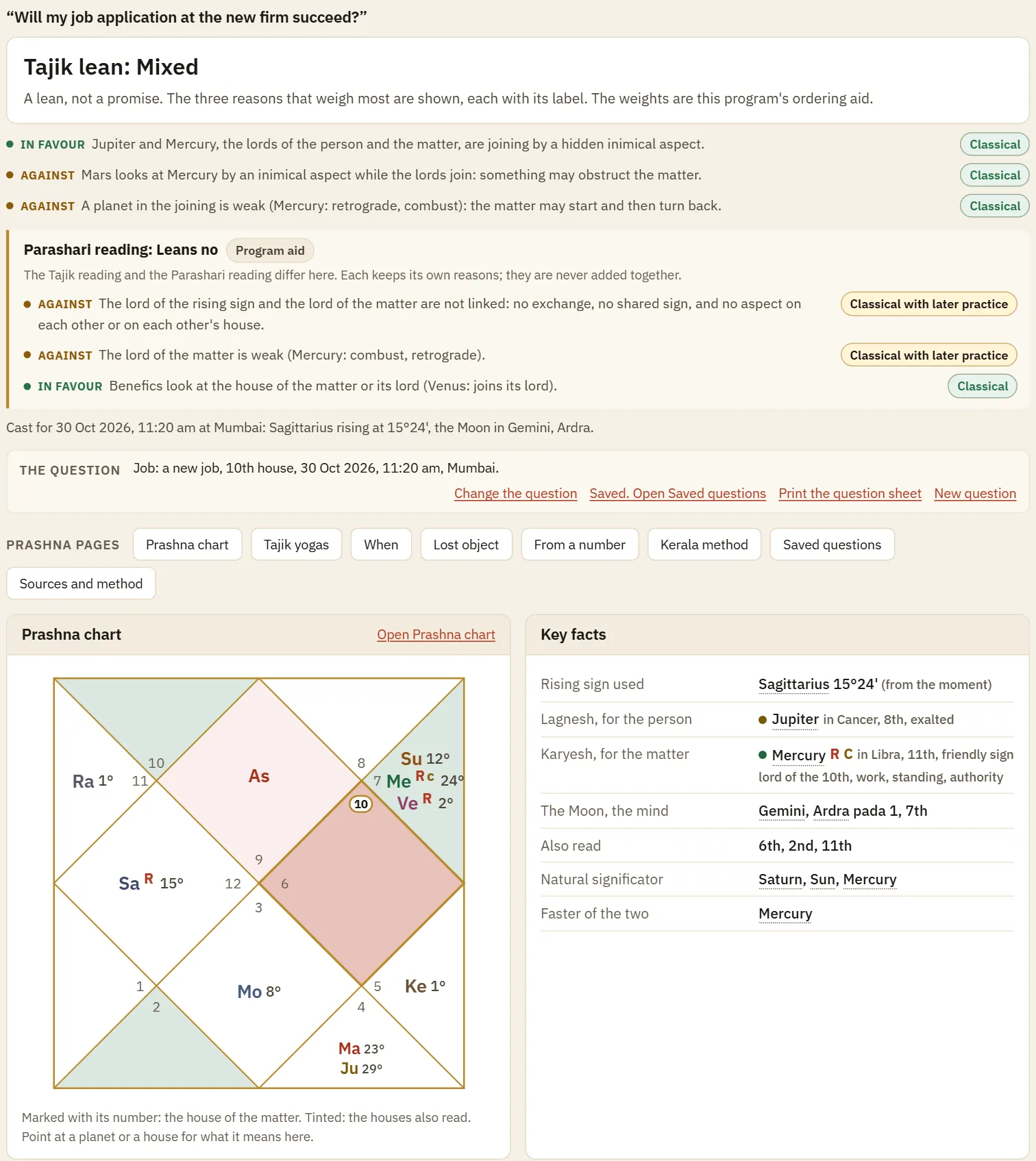
The lean, its reasons and the chart
The question at the top, the lean with its three main reasons, then the chart of the moment and the key facts.
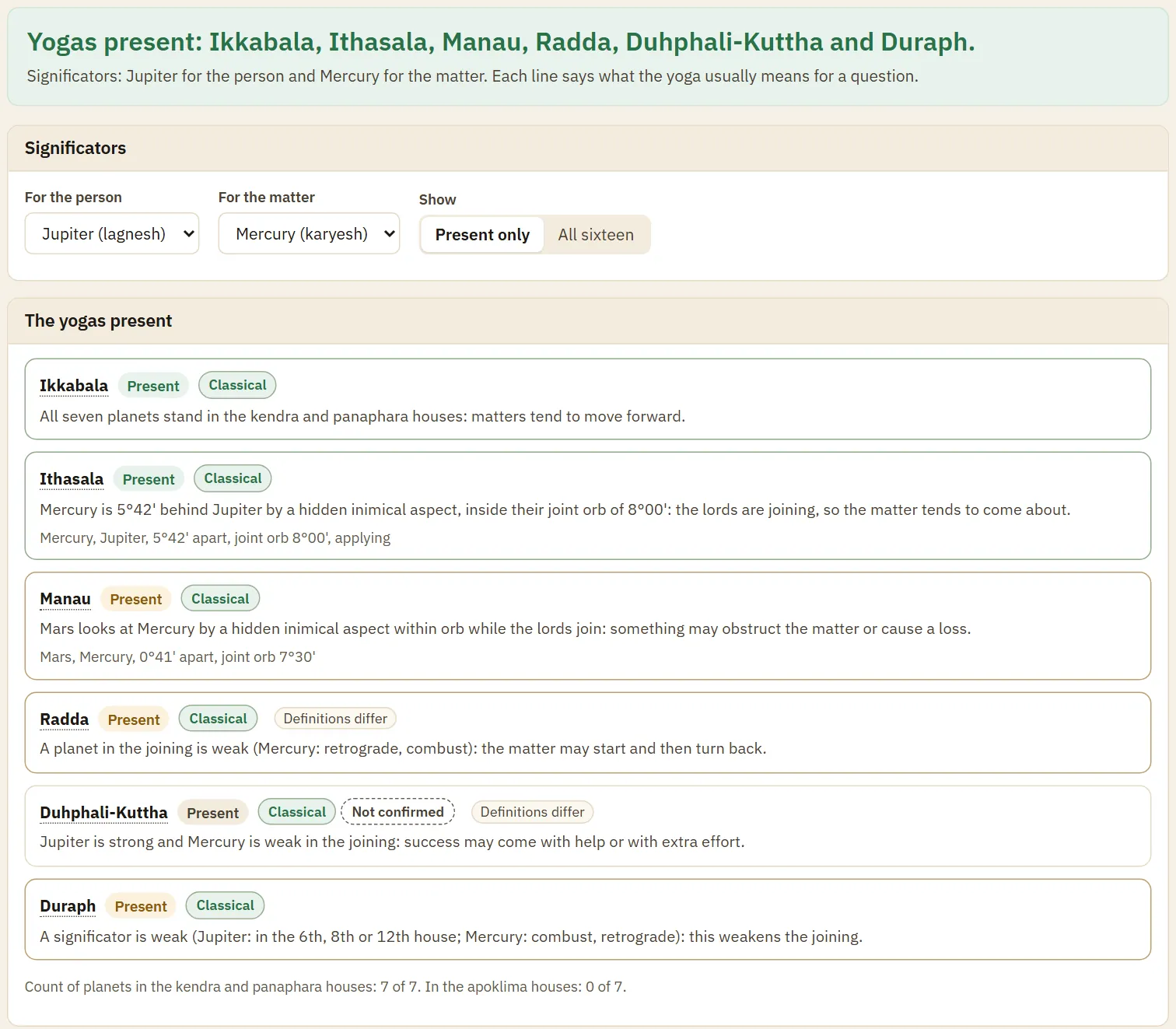
The Tajik yogas present
The significators you can change, then each yoga found, with a plain line, its label, the gap and the joint orb.
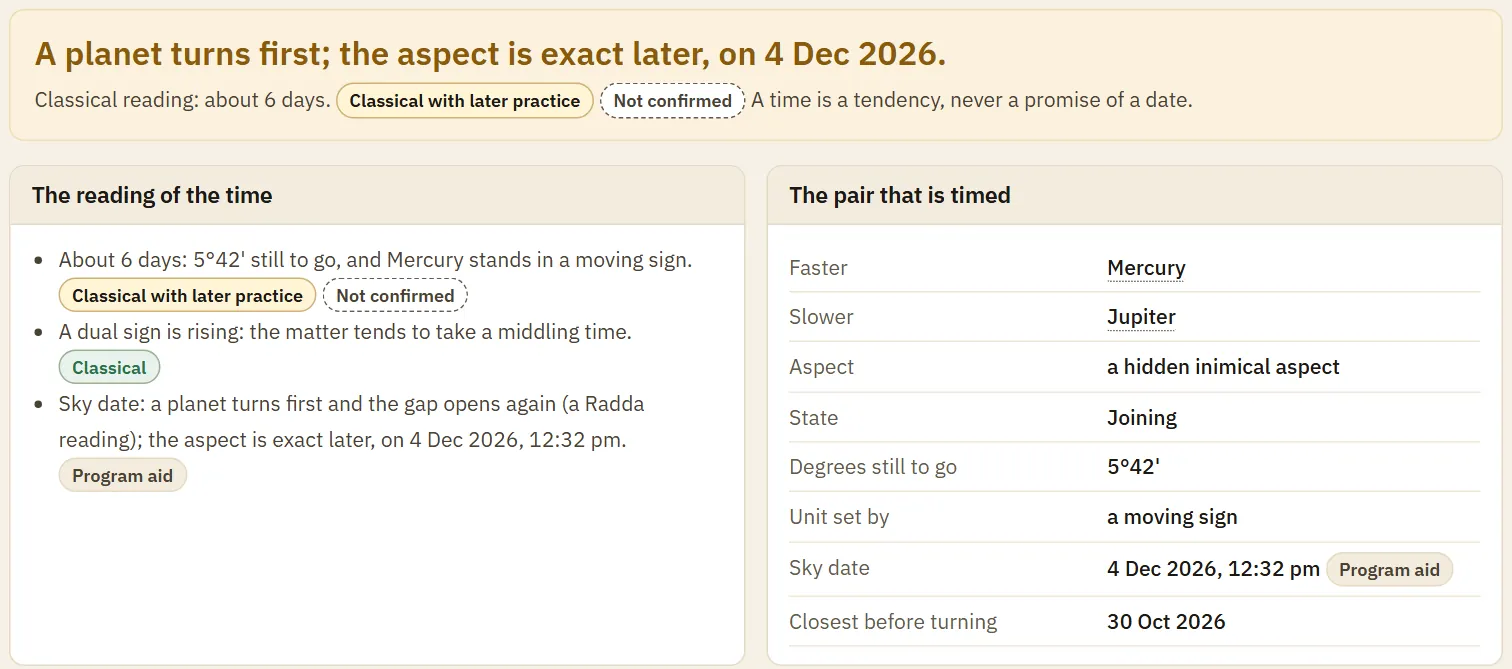
When the matter may move
The sky date beside the classical count of the time, with the pair that is timed.
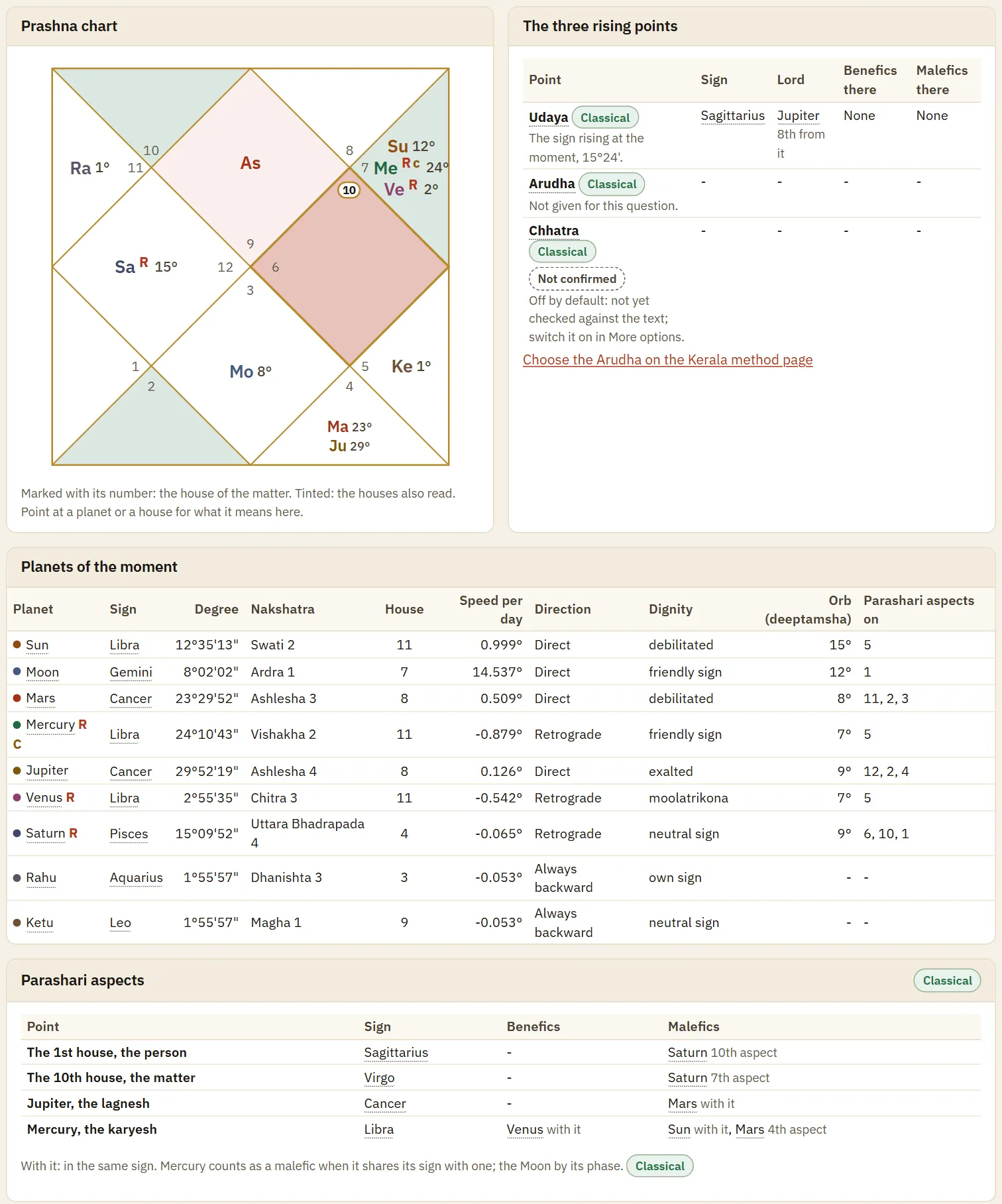
The chart, the rising points and the planets
The chart of the moment, the rising points, and each planet's real speed, dignity, orb and Parashari aspects.
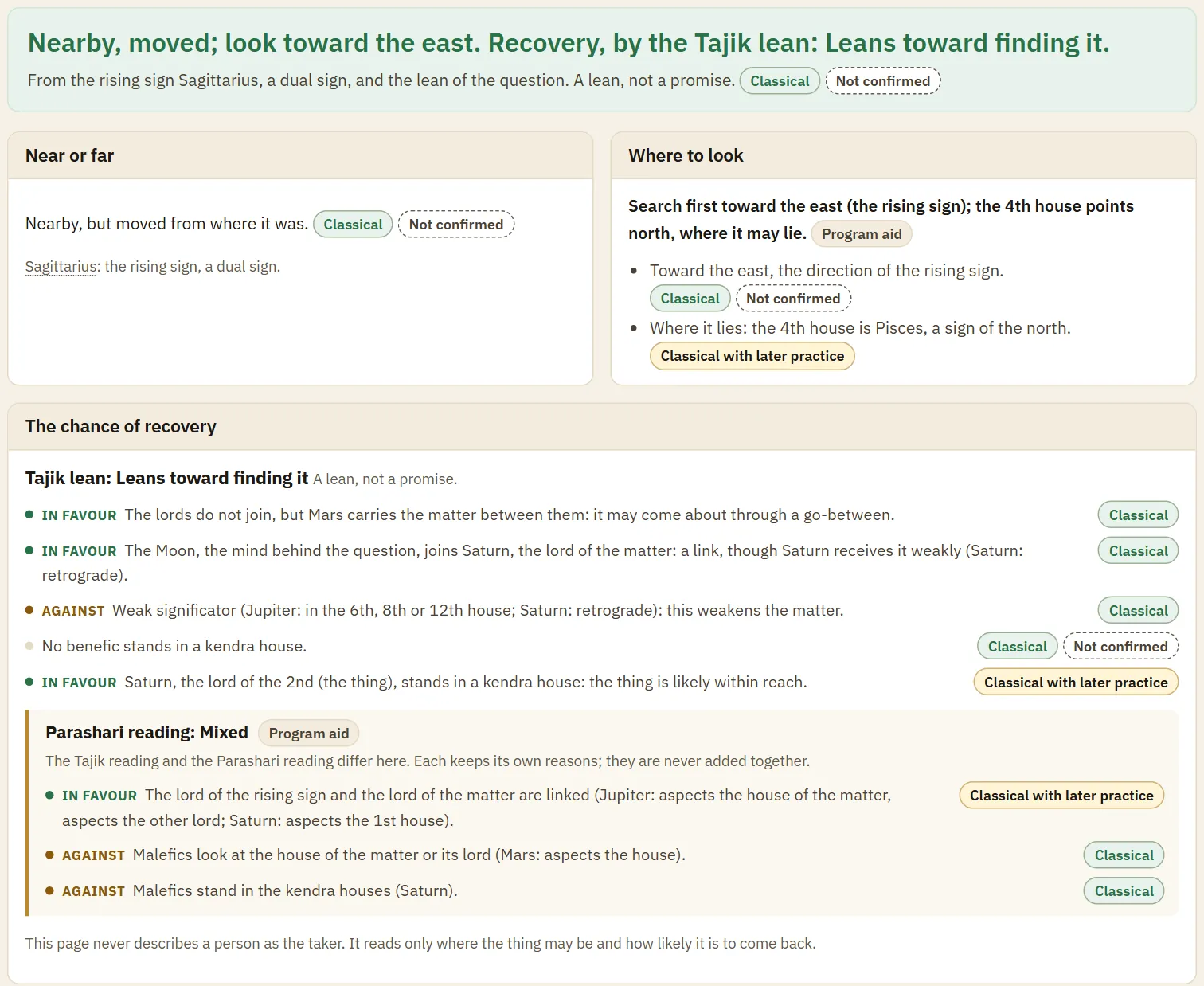
A lost object
Near or far, the direction to look, and the chance of recovery with its reasons. The page never describes a person as the taker.
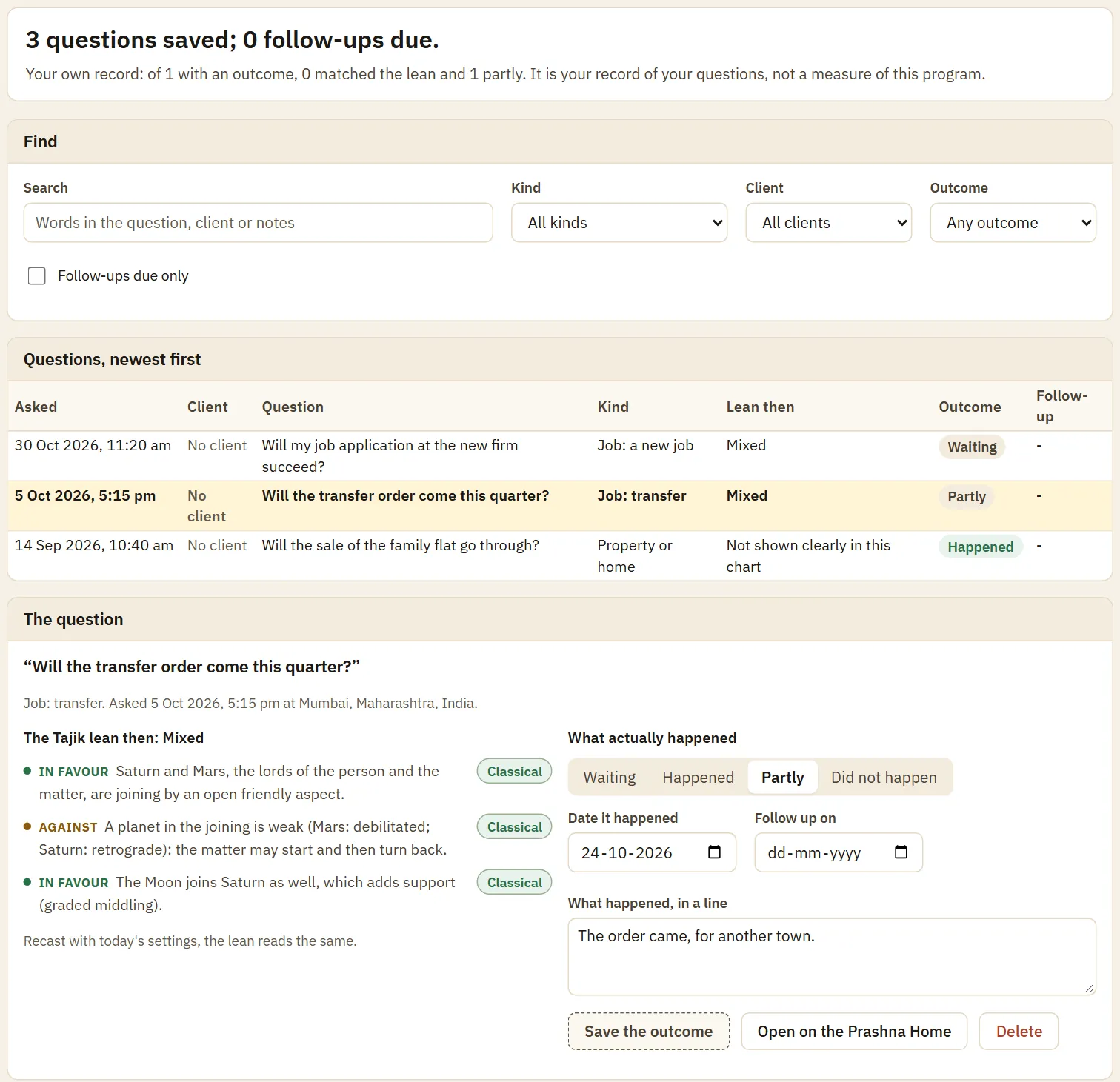
Saved questions and your own record
Each question with its lean then and its outcome. Click one to record what happened.
How it fits a question
- When the person asks, note the minute. Type the question as they said it and pick its kind.
- Choose where to cast it. Your own place is the default, and the person's place is one click away.
- Read any note before judging. A rising degree on a sign edge is a note to check the time, never a block.
- Read the reasons, not only the lean. The joining of the two lords counts most, and the Parashari reading stands beside it when the two differ.
- Give the person a season, not a day, and speak of it as a tendency.
- Save the question, set a follow-up date, and record the outcome when it is known.
Method and sources
The chart is cast for the moment and place of the question. The rising sign is the person, the lord of the house of the matter is what is asked, and the Moon is the mind behind the question. Of the 75 rules, 41 are classical, 11 classical with later practice, 11 later practice and 12 program aids, and 10 are marked Not confirmed. The weights that order the reasons are the program's own aid.
- Prashna Marga, translated by B. V. Raman: the rising points, the omens, the Parashari reading
- Tajika Neelakanthi of Neelakantha Daivajna: the aspects, the orbs and the sixteen yogas
- Prasna Tantra, translated by B. V. Raman: lagnesh and karyesh, the Moon, the chapters on each kind of question
- Shatpanchasika of Prithuyasas, with the commentary of Bhattotpala: journeys, contests, lost things, the nature of the rising sign
- Daivajna Vallabha: a second witness for the rules
- Phaladeepika of Mantreswara: a cancelled debilitation (neecha bhanga)
- Brihat Parashara Hora Shastra: the nature and directions of the signs and planets, the Parashari aspects, vargottama
- A 2022 paper on the number method: the rule for 1 to 108, one written source only
What it does not do
- A lean is a tendency, never a promise. The tool does not tell a person what will happen.
- It does not read the length of a life, whether an unborn child is a boy or a girl, lottery or betting numbers, or who took a lost thing. These questions get a calm line and a nearby question it can read.
- The Prashna Marga sphutas used for the length of life are not offered.
- Omens are recorded and counted only, and they never change the lean.
- The Chhatra is off to start with, because its rule is not yet checked against the translation. Some rules still await a check against a printed edition, and each carries the Not confirmed mark.
Questions
Do I need the client's birth details?
No. A question is read from the chart of the moment. You can link it to a saved client so the record stays together, and the tool then shows that client's earlier question of the same kind.
Which place should I cast for when the person is far away?
Your own place is the default. The question card has a switch for the person's place, and Prashna settings can change the default. The Sources and method page labels this rule as later practice.
Why are there two readings?
The Tajik reading rests on the joining of the two lords. The Parashari reading rests on the lords, the houses and the aspects, as Prashna Marga judges a matter. They are different methods, so each keeps its own reasons, and where they differ you weigh both.
Does it take the KP number from 1 to 249?
That method lives in the KP tool. A number from there can be opened here and read with the Tajik yogas. The 1 to 108 rule here divides the zodiac differently, so the two are not mixed.
Why is there no date under Leans no?
Because a date there would read as a promise of what the chart leans against. The pair and the degrees are still shown, so you can see the working.
Where does the Kerala method fit?
The Kerala page here reads the Arudha beside the rising sign. The full rite, with the cowries, the betel leaves and the sphutas, is the Ashtamangala tool, which shares this saved list.
Where are my saved questions kept?
On your own device. Nothing about a question is sent anywhere.
Have another question?