Gemstone astrology software
A stone finder that checks each planet for the rising sign, stops the stones usually avoided at a gate with the reason, and ranks the rest with every point in view. Wearing details, pair cautions and laboratory advice sit beside it, and none of it promises a result.
Included in the Vedic plan, Rs 3,001 a month. No card needed. Sign in with Google to start.
Who it is for
For the astrologer whose client walks in with a ring on the finger or a stone a shop has suggested, and asks if it suits. You get the chart's answer with house numbers, so you can explain why a stone is considered or held back.
The stance of the module is plain. A stone is a traditional support, considered after the chart is read and after conduct, mantra and giving. It is never dismissed and never oversold, and the reading shows no prices.
What you can do with it
The stone finder
- A gate comes first. The lordship of each planet for the rising sign decides if its stone can be considered at all, and the Brihat Parashara Hora Shastra list for that sign decides where the house rules differ.
- A stone stopped at the gate gets no number, only its reason with the house numbers.
- Six groups: First to consider, Second choice, Also considered, Helpful but low score, Held back, and Usually avoided.
- Points show the sum line by line, from lordship and from need. Need reads Shadbala, dignity, cancelled debilitation, combustion, planetary war and affliction.
- The points are marked as this program's aid. They only put the stones in an order.
- Two schools, one switch. The common school lifts a weak helpful planet, the other goes by lordship alone. Both are labelled later practice.
- Rahu and Ketu have their own group. Hessonite or cat's eye is considered only when all four conditions hold, and each condition is shown.
- Mark the stones a client already wears, and the pair check includes them.
- With no birth time, the finder says the list cannot be worked out and shows a weaker guide from the Moon sign.
- Printing gives a one-page sheet with every reason.
The stone for this period
- The Mahadasha lord's stone is considered only when that lord helps the rising sign.
- A harsh lord's period is met with mantra and giving, not a stone. The page says so.
- A maraka lord that rules no 5th or 9th house is held back in its own period.
- The running Antardasha is shown as a note only, because it changes every few months.
- Change the date to look at any day. A fold lists every Mahadasha of the life with its stone.
Wearing, as later manuals give it
- Metal, finger, hand, day and hora for each of the nine stones, with a note where teachers differ.
- The next wearing windows for your town: the stone's day in the bright fortnight, with no Rikta tithi, Amavasya or eclipse, and every hora of the planet that day.
- The beej mantra with its count of 108, and the opening of the planet's Vedic mantra.
- Weight in carats with the convention named. The trade ratti of 0.91 carat and the older goldsmith ratti of 0.61 carat are never mixed.
- Type a body weight to add the figure by the rule of 1 ratti for every 10 kg, or 12 kg if you prefer.
- The energising custom and the custom of keeping a stone under the pillow first are described, each marked as later practice.
Cautions and pairs
- Choose any two stones and see if they are kept apart, with how each planet counts the other, both ways.
- With a client open, the temporary friendship in their chart is added.
- The friendship table is classical. Keeping stones apart is labelled later practice, because no classical text gives the pair list.
The nine gems and how to test them
- A table of the nine gems with planet, names, mineral, substitutes and whether it comes from an animal.
- A page for each gem with mineral facts, the qualities and flaws the texts name, care, wearing, and what it is for each of the twelve rising signs.
- What a laboratory certificate should say, and the treatments and look-alikes of each gem.
- Heating is noted as widely accepted. Glass filling, dye and diffusion are noted as not.
- The classical tests are given as history only, with the Hindi trade's flaw words beside them.
Jain clients
- The Jain tradition keeps no gemstones. A client marked Jain gets a note in place of the finder, and the Wearing guide opens on an example.
See it in the tool
Real screens from the tool, made with sample charts. Select a screen to see it larger.
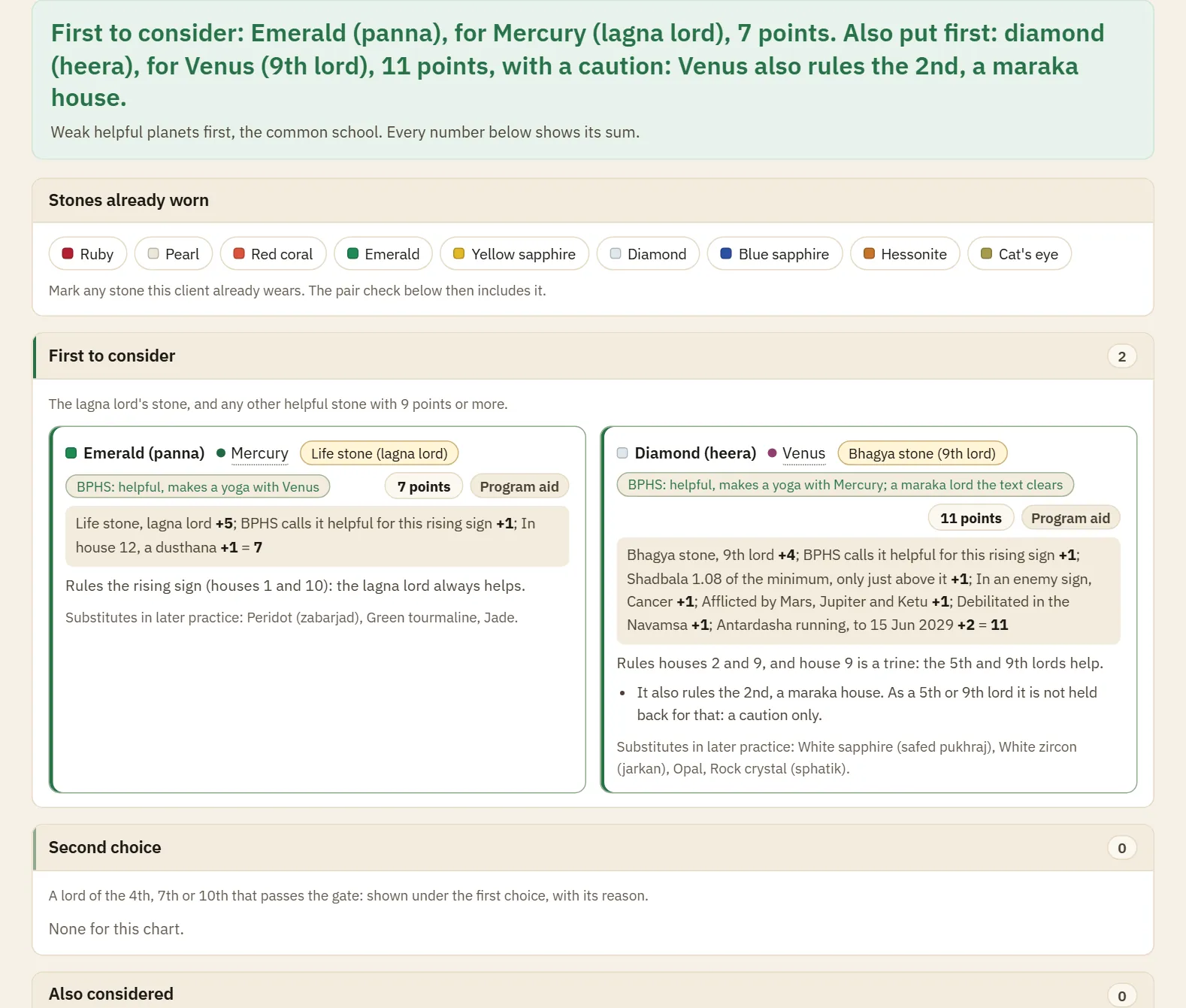
The stone finder
The answer line names the stones to consider first. Each card shows its sum line by line, its word from Brihat Parashara Hora Shastra, and any caution.
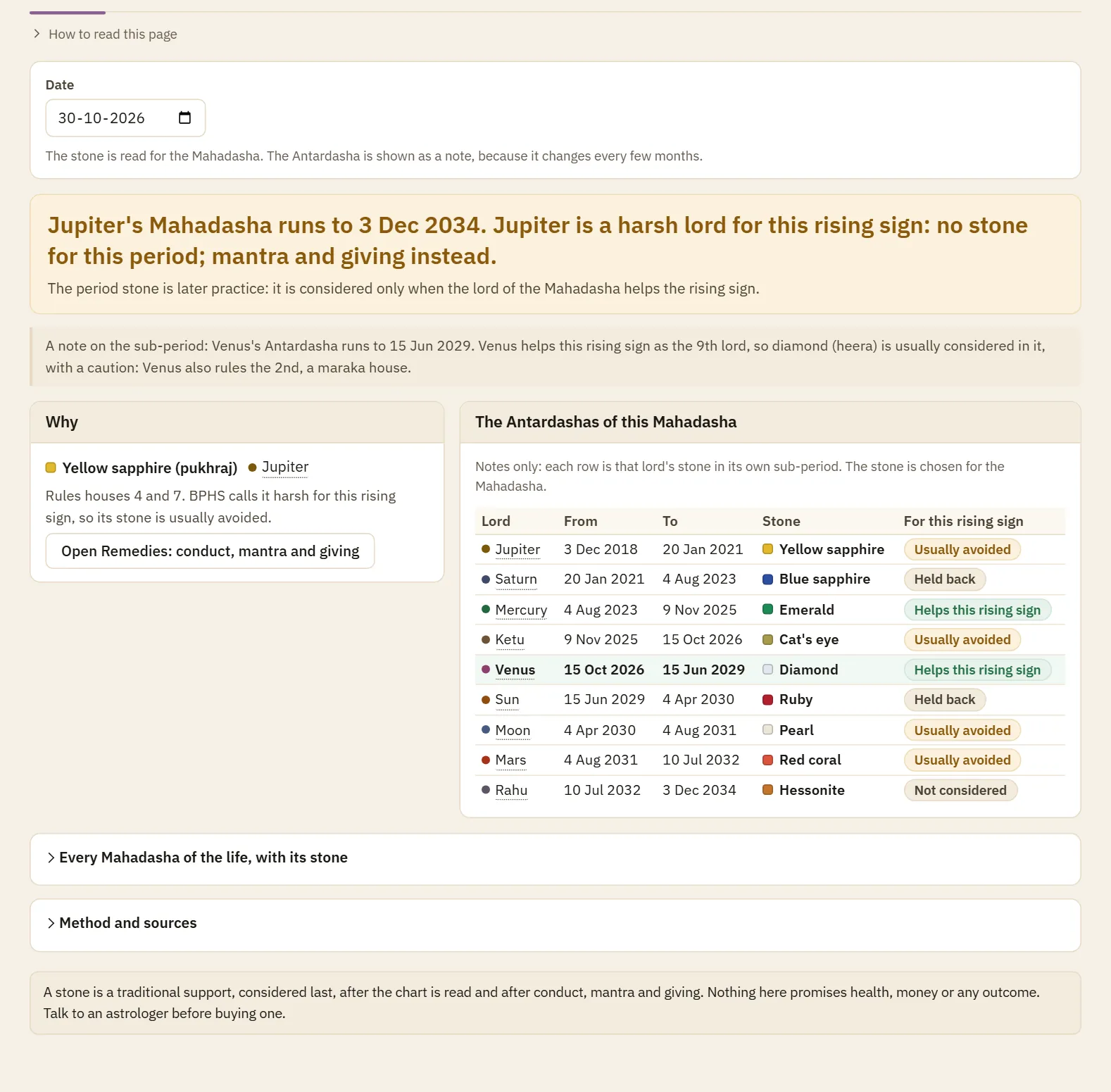
The stone for this period
In this sample the Mahadasha lord is harsh for the rising sign, so the page gives no stone for the period and points to mantra and giving. The sub-periods follow as notes.
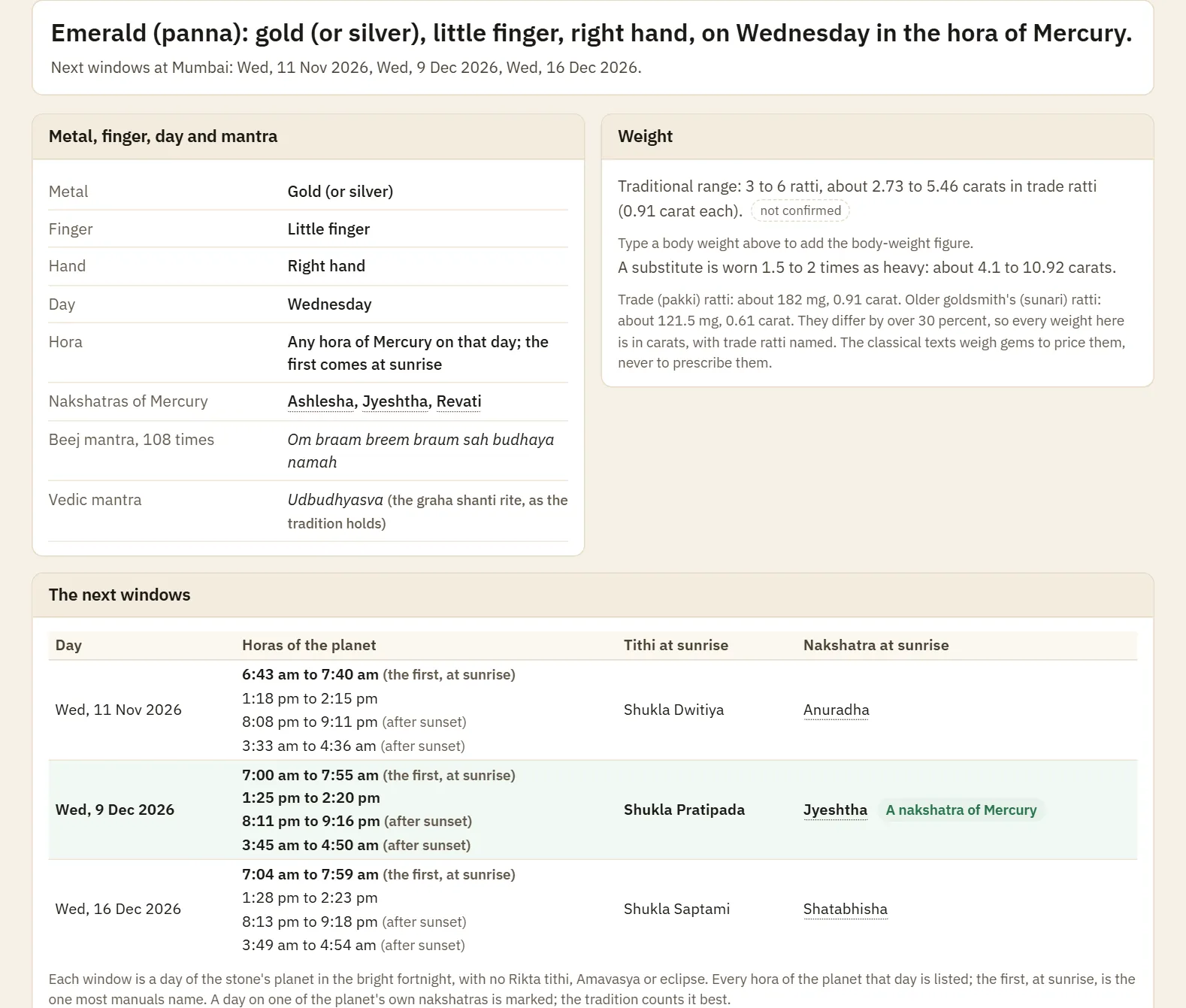
The wearing guide
Metal, finger, hand, day and hora for one stone, as the later manuals give them, with the weight in carats and the next windows at your town.
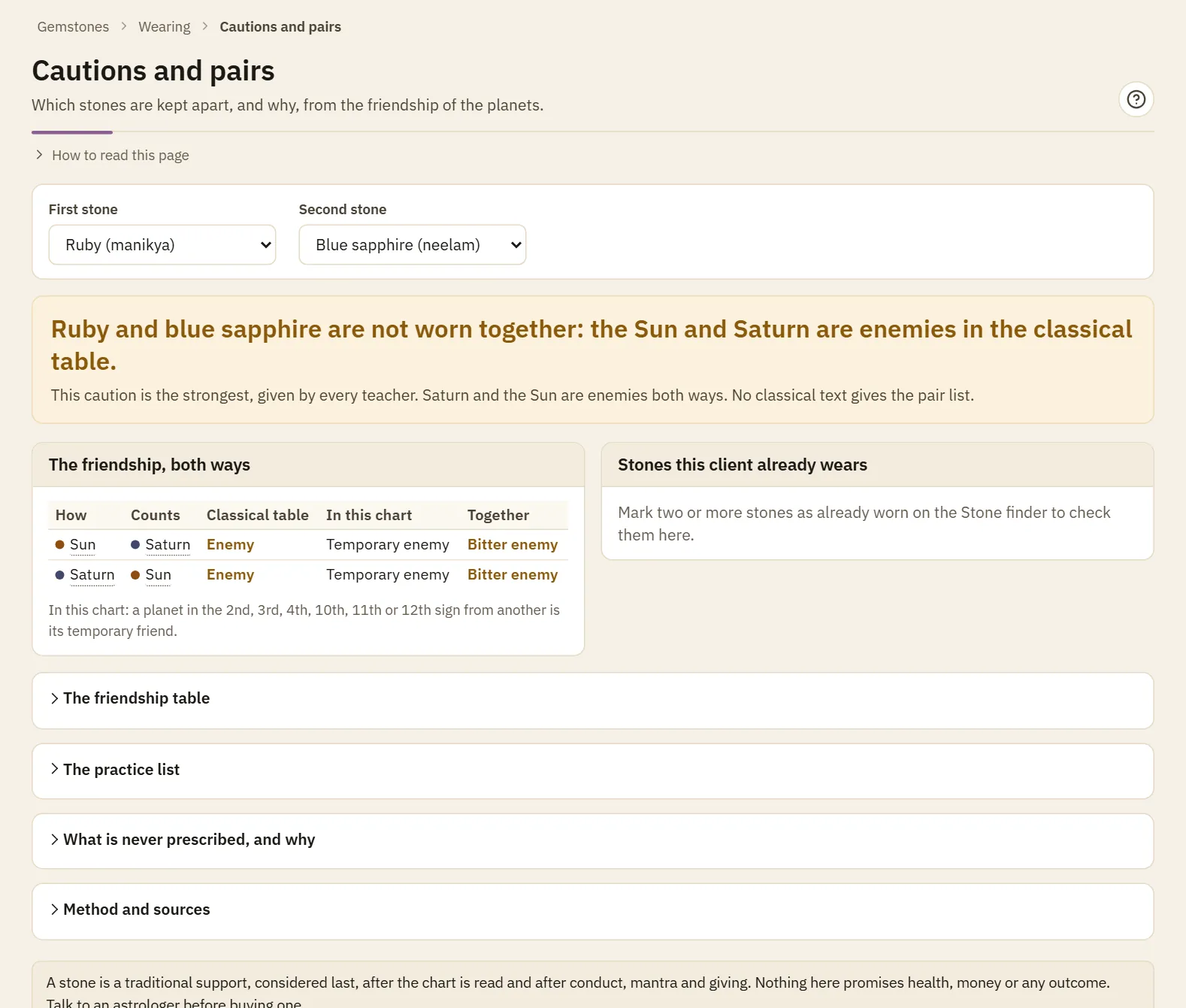
Cautions and pairs
Two stones chosen. The first line says if they are kept apart, and the table shows how each planet counts the other.
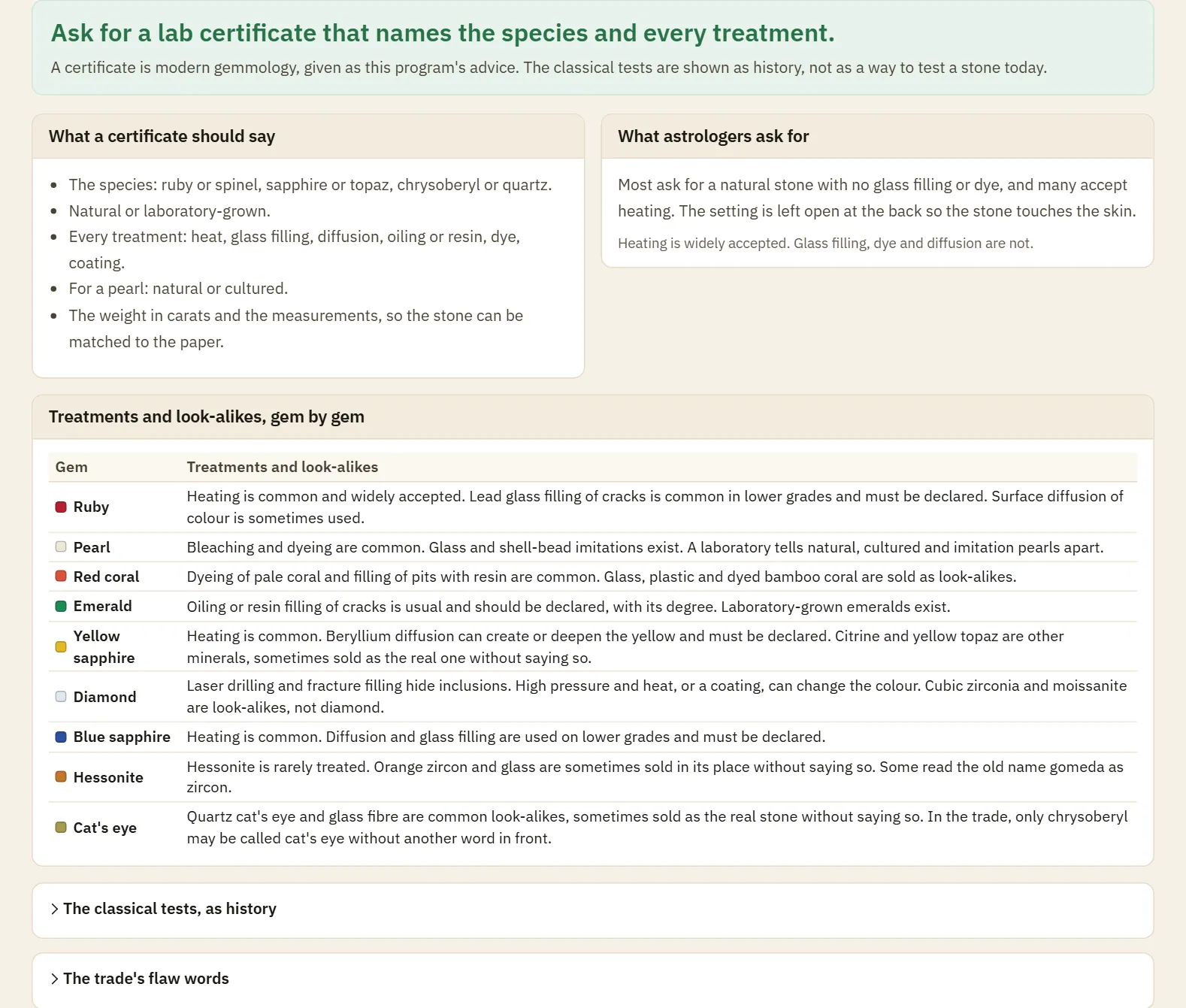
Quality and testing
What to ask a laboratory for, what astrologers usually ask for, and the treatments of each gem. The advice is labelled as modern gemmology.
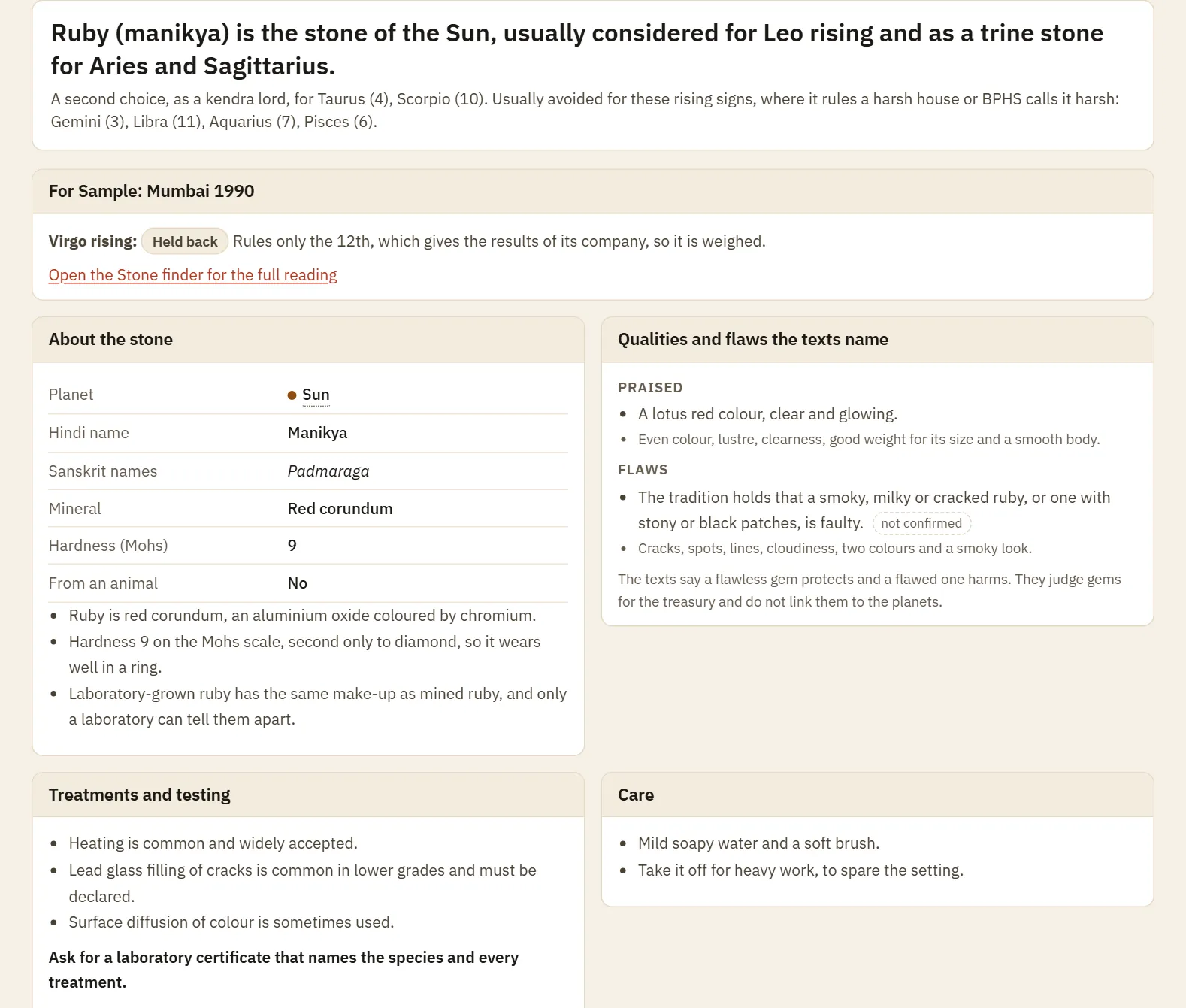
A page for each gem
Ruby, with the rising signs it is usually considered for, what it is for the open client, the mineral facts and the qualities the texts name.
How it fits a sitting
- Read the chart first. The stone comes after that, and after conduct, mantra and giving.
- Open the finder for the client and mark any stone already on the hand.
- Go through the first group and the avoided list, with the house numbers, so the client sees the reason for each.
- Check the period stone if the question is about now, and read the lordship before anything else.
- If a stone is chosen, open the wearing guide for the next window at their town and print the sheet.
- Send the client to a gem laboratory for a certificate before any purchase.
Method and sources
The gate comes from the lordship rules for each rising sign. Points then add suitability and need, and the groups are read from them. Choosing a stone from a birth chart took shape mostly in the 20th century, so the page labels which part is classical and which is later practice.
- Brihat Parashara Hora Shastra, the chapter on the Yogakarakas and the chapter on Shadbala
- Laghu Parashari, on the functional nature of the planets
- Phaladeepika, on the lords of the houses and on neecha bhanga
- Jataka Parijata, for the gem of each planet
- Brihat Samhita, Ratnapariksha of Buddhabhatta and Garuda Purana, for qualities and flaws
- Mani Mala of S. M. Tagore and the 20th century gem manuals, for wearing and weight
- Modern gemmology, for certificates and treatments
What it does not do
- It promises no result from any stone. A stone is shown as a traditional support, and the decision stays with you and your client.
- It does not identify or value a stone. It gives no prices and no shop links in the reading, and it sends you to a laboratory for what a stone is.
- No classical text says to wear the stone of the 5th lord, gives a wearing weight or names a finger. All of that is labelled later practice, and teachers differ.
- The Brihat Parashara Hora Shastra list for nine rising signs is from one edition and is still to be checked in print. Virgo, Scorpio and Pisces were read verse by verse.
Questions
Does the tool say a stone will bring a result?
No. It says which stone is usually considered or usually avoided for a chart and why, and the Home says a stone comes after conduct, mantra and giving.
Does the tool push stones to sell?
The reading has no prices and no shop links, and a plain card on the Gemstones Home says the reading does not depend on buying anything. Whoever you buy from, it says to ask for an independent laboratory certificate.
Why does a stone I expected show as held back?
A rule stopped it, and the card names the rule. It may be mixed lordship, kendradhipati, or a maraka lord in its own period. It is not a ban, and you can read the reason and decide.
Which ratti does it use?
Every weight is printed in carats with the convention named. The trade ratti is about 0.91 carat and the older goldsmith ratti about 0.61 carat, and they differ by over 30 percent.
What about a client who follows the Jain path?
The client gets a note in place of the finder, because the Jain tradition keeps no gemstones. You can mark one client, or set the whole practice to Jain in Settings.
Is there a free stone check on the website?
Yes, the free gemstone suggestion gives a first view, and the guide on how to buy a gemstone covers certificates. The Pro tool adds the gate, the groups, the period stone and the wearing windows.
Have another question?