Jain astrology software
Jain astrology here is a setting inside the Vedic plan, not a separate product. Set Tradition to Jain in Settings and every client is read the Jain way, and the Jain kundli, the Jain day, parvas, pachkhan times and Tirthankaras sit under More systems in the rail.
Included in the Vedic plan, Rs 3,001 a month. No card needed. Sign in with Google to start.
How you reach it
Go to Settings, General, Tradition, and choose Jain. Every client is then read the Jain way: remedies follow the Navkar Mantra, samayik, tapasya and daan, with no stones and no graha worship. If most of your clients are not Jain, leave it on Vedic and write Jain in the group, tags or notes of a single client.
The Jain pages themselves sit under More systems in the left rail. A second setting, Jain calendar, picks the tradition the calendar follows, Murtipujak (Tapagaccha), Sthanakvasi, Terapanth or Digambara, and how the Vikram Samvat is counted. It is made for astrologers who serve Jain families and need the sangh's calendar and wording along with the chart.
What you can do with it
What the Tradition setting changes
- Remedies show the Jain path in place of graha mantras and temple worship, in the Remedies section.
- The Gemstones section shows a note in place of the finder, because the Jain tradition keeps no gemstones.
- The AI reader treats every client as Jain.
- The Naming section has its own Hindu or Jain switch, which uses the Adipurana line and puts Jain names first.
The Jain kundli
- One page with the birth chart, the Navamsa, the checks and the practices, with today's tithi, parva, Tara Bala and Chandra Bala on a strip above.
- The tithi is written the Gujarati way, Sud 7, Vad 8, Punam or Amas.
- Jain checks of doshas and yogas. Each row opens to the rule that fired and the cancellations that were tested.
- A dosha is read as weather, not a verdict. The planets indicate karma, and they do not cause anything.
- Pitru Dosha is reworded, because in Jain teaching karma is one's own and nothing passes down from the ancestors.
- Kaal Sarp is marked as later practice. Balarishta shows only on a child's chart and is never counted.
- The Tirthankara of the birth star, with a Shvetambara, Digambara or both reading, and the Tirthankara of the dasha lord.
The Jain day
- The Jain tithi at sunrise for any date and place, with what is kept that day and why.
- The pachkhan table for your town, with sunrise, Navkarsi, Porisi, Sadh-Porisi, Purimaddh, Avaddh and Chauvihar. The next time to come is marked.
- Vira Nirvana Samvat, Vikram Samvat in the count you chose, and the month in purnimanta and Gujarati amanta names.
- The five limbs of the day, and Tara Bala and Chandra Bala from the open chart or a star you pick.
The Jain year
- Parvas and festivals of any year from 1900 to 2073, among them Paryushan, Das Lakshana, the Ayambil Oli, Ashtahnika, Chaumasa, Gyan Panchami and Diwali.
- A parva tithi at no sunrise is kept on the day before, and one at two sunrises on the second. The row says which and why.
- A switch adds the days other traditions keep, each marked with who keeps it.
- All 120 kalyanakas of the 24 Tirthankaras, in purnimanta and Gujarati month names, with the date in the year you pick.
- A note appears when a yearly day does not fall in the year shown, with the dates it falls on.
Jain tools
- Jain Muhurta ranks 7 to 60 days from any start date for six purposes, from a business opening to a vrata, with favourable choghadiya windows. It never calls a day bad.
- A worldly purpose counts a parva day as an objection, and a vrata prefers it.
- Jain Matching gives the 36 point Guna Milan, four Dashakoota factors, the classical exceptions to Nadi and Bhakoot, and a Mangal comparison.
- The 24 Tirthankaras in one table with symbol, birth star, rashi, birthplace and nirvana place, each opening to a life and its five kalyanaka dates.
- Notes on eight Jain tirths, from Palitana and Girnar to Sammed Shikharji.
Two Vedic tools kept here
- Conditional Dashas shows Vimshottari and eight conditional systems, with a tag for whether each one's condition holds for the chart.
- Reduced Ashtakavarga gives the tables before and after reduction, with the Kakshya table.
- Both are named as Vedic tools. Nothing in their method is Jain.
See it in the tool
Real screens from the tool, made with sample charts. Select a screen to see it larger.
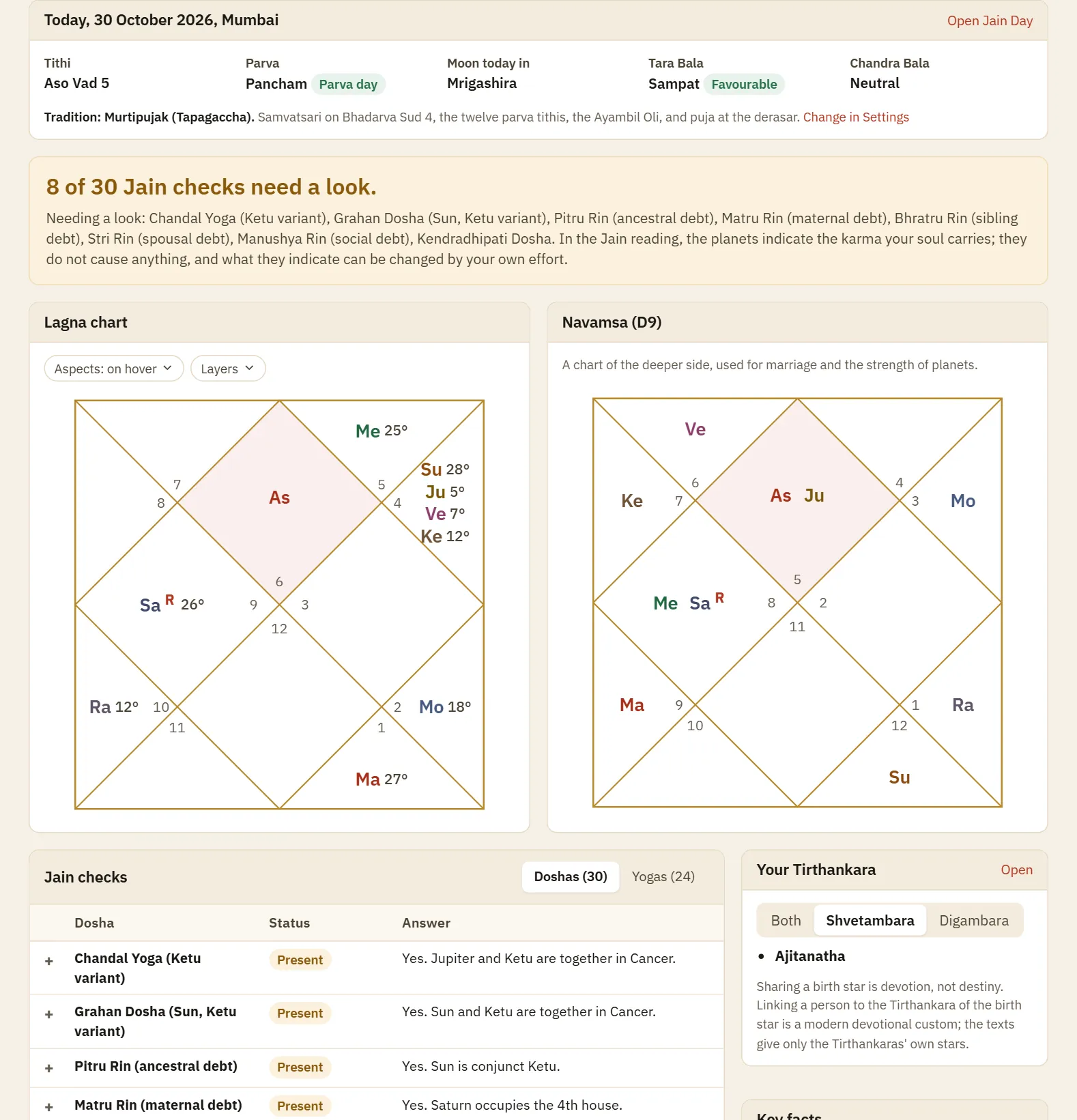
The Jain kundli
Today's tithi, parva, Tara Bala and Chandra Bala on a strip, then the count of checks that need a look, with the birth chart and the Navamsa under them.
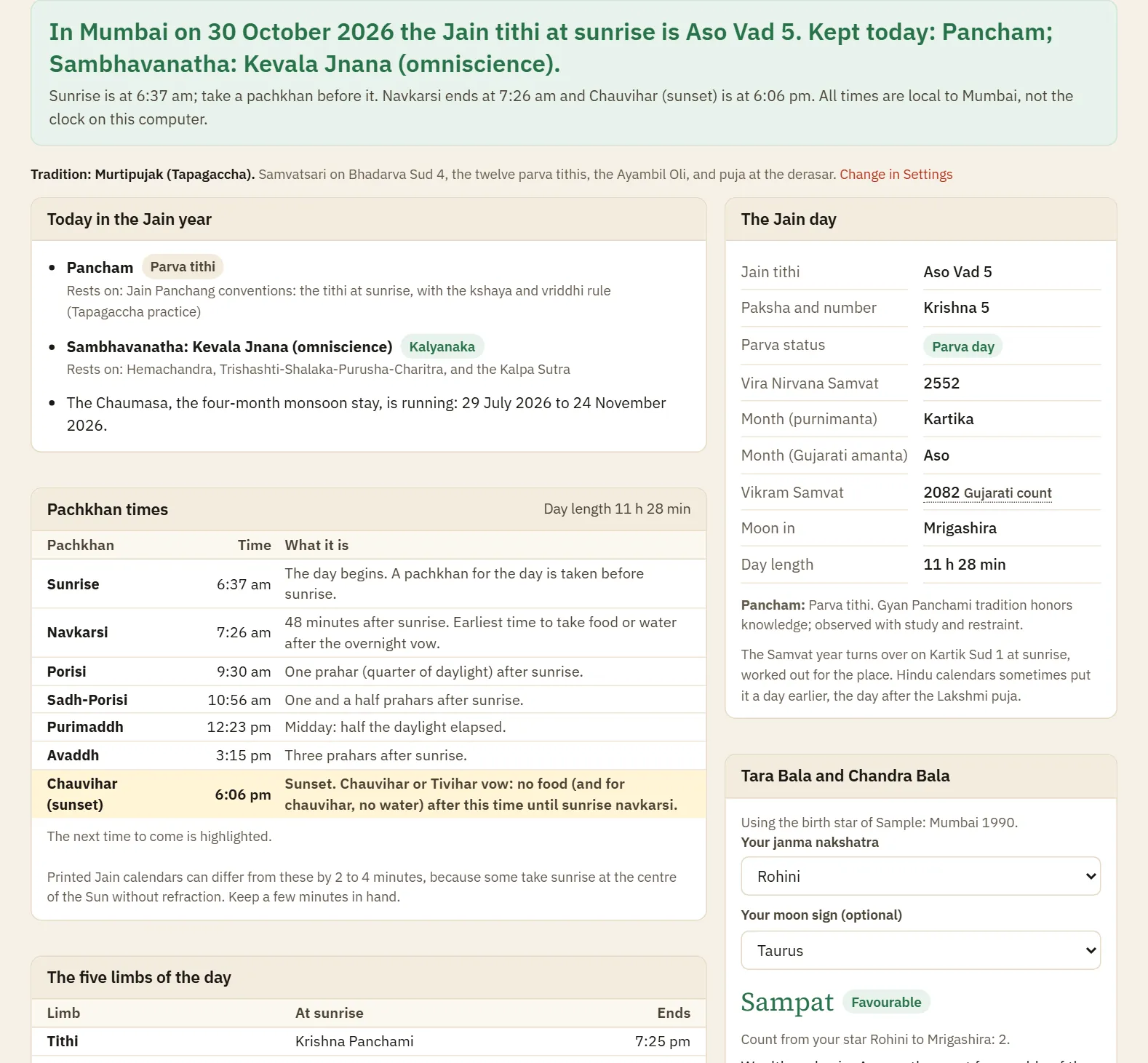
The Jain day and pachkhan times
What is kept today and why, with the pachkhan table for the chosen town and the Jain day facts beside it.
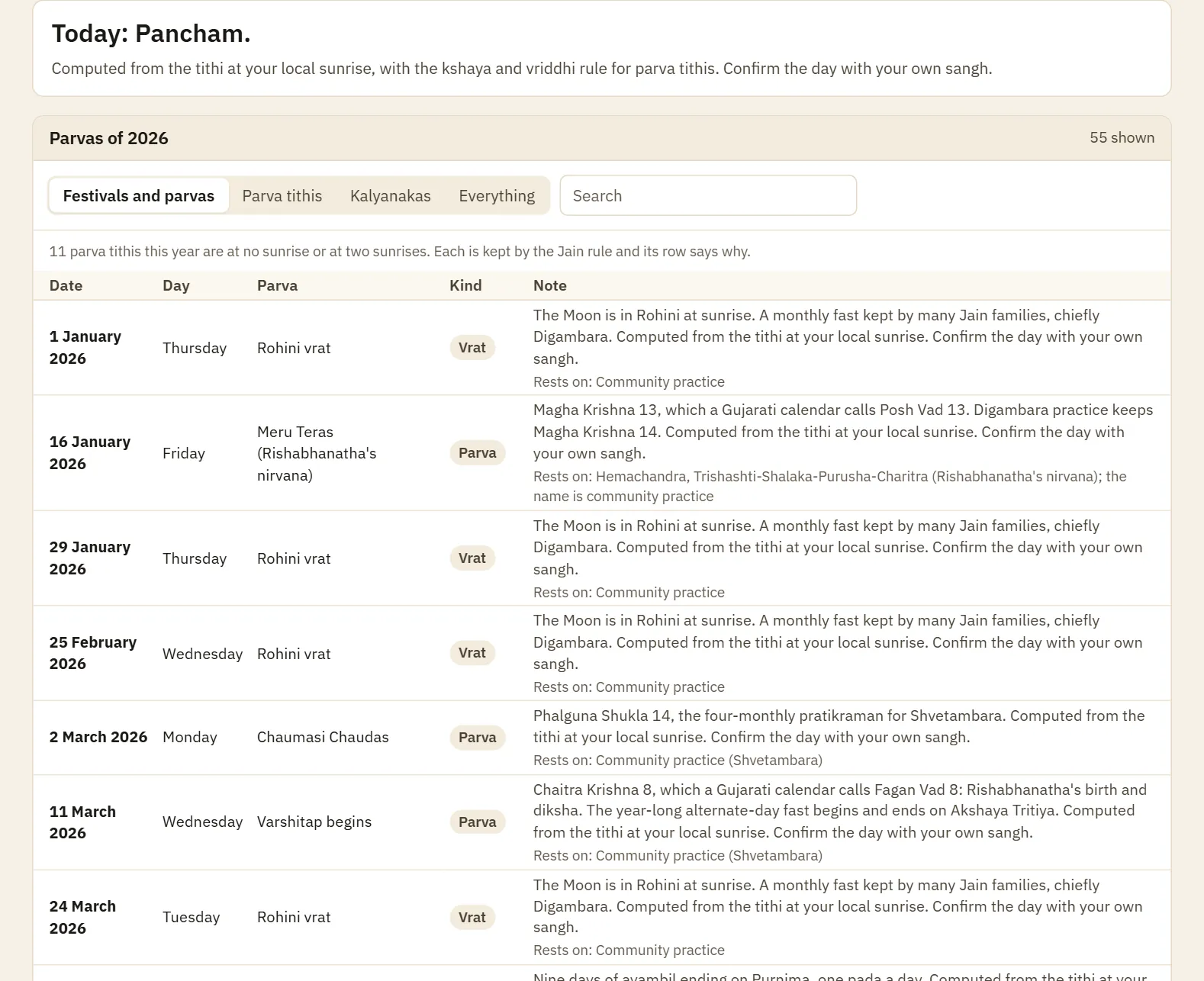
Parvas of a year
Festivals and parvas in date order, for the tradition chosen in Settings. Each row says why it falls on its day.
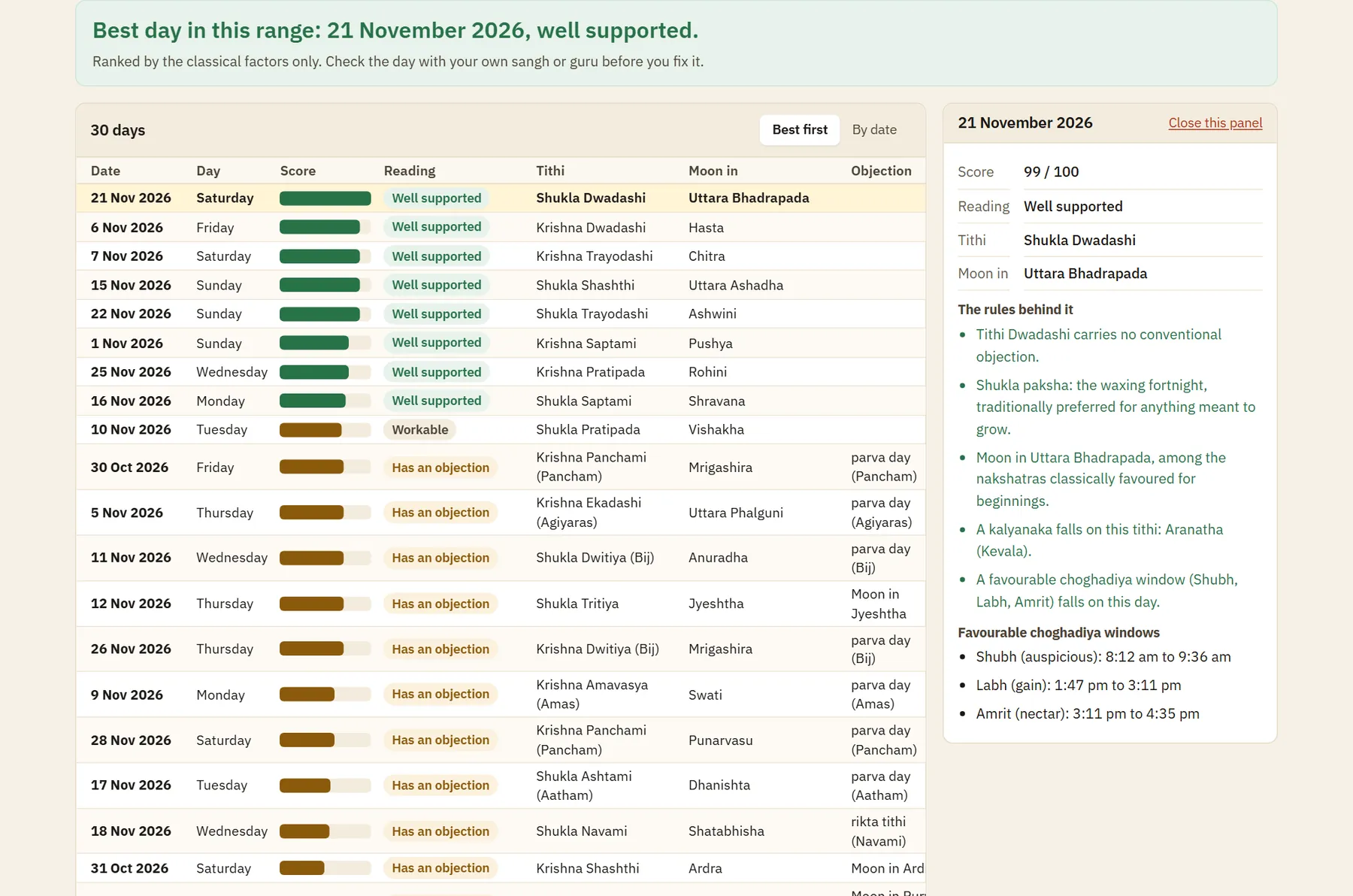
Jain Muhurta
The days ranked for one purpose, with the rules behind the chosen day and its favourable choghadiya windows in the side panel.
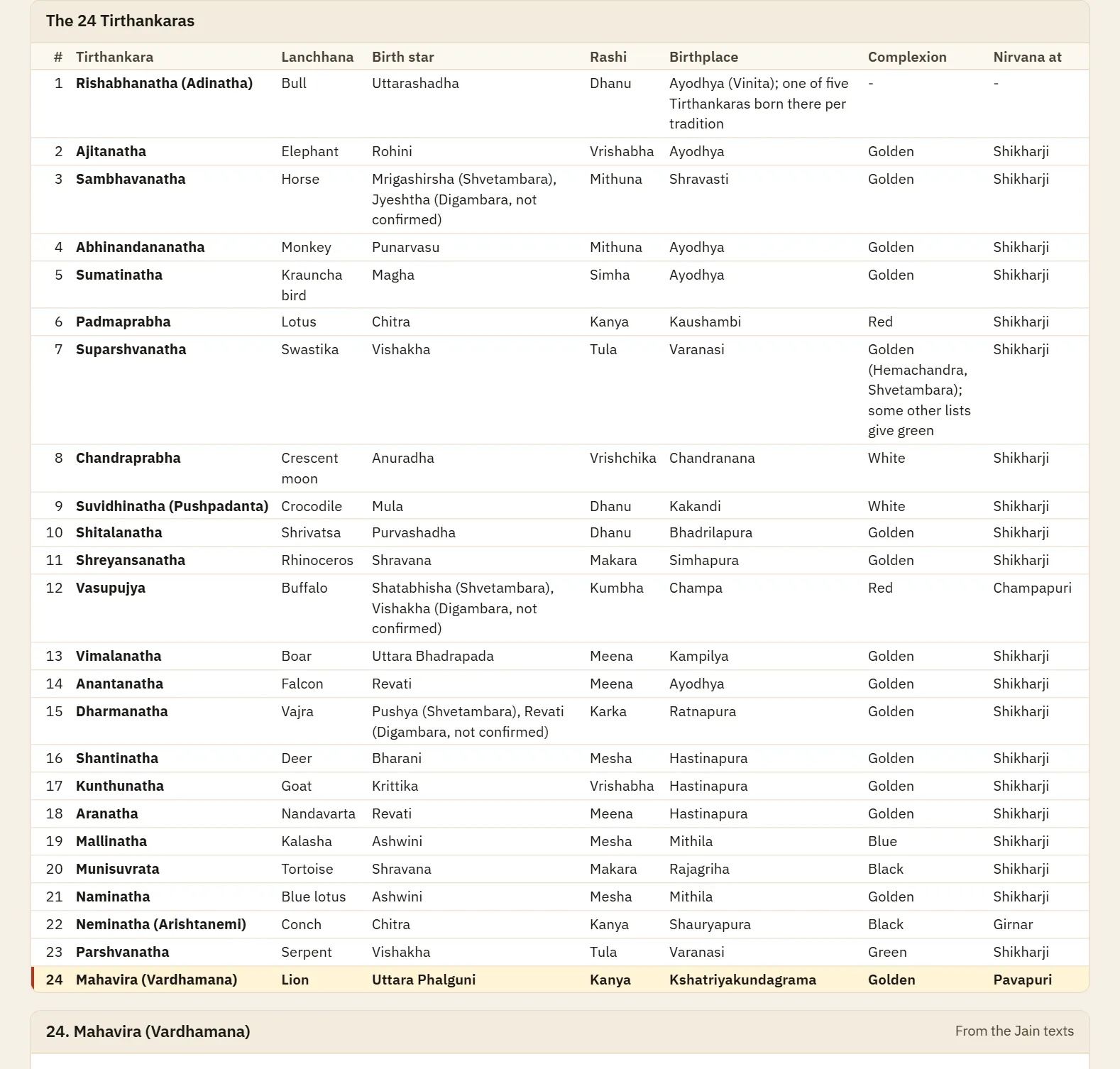
The 24 Tirthankaras
Symbol, birth star, rashi, birthplace and nirvana place in one table. Both readings are shown where they differ.
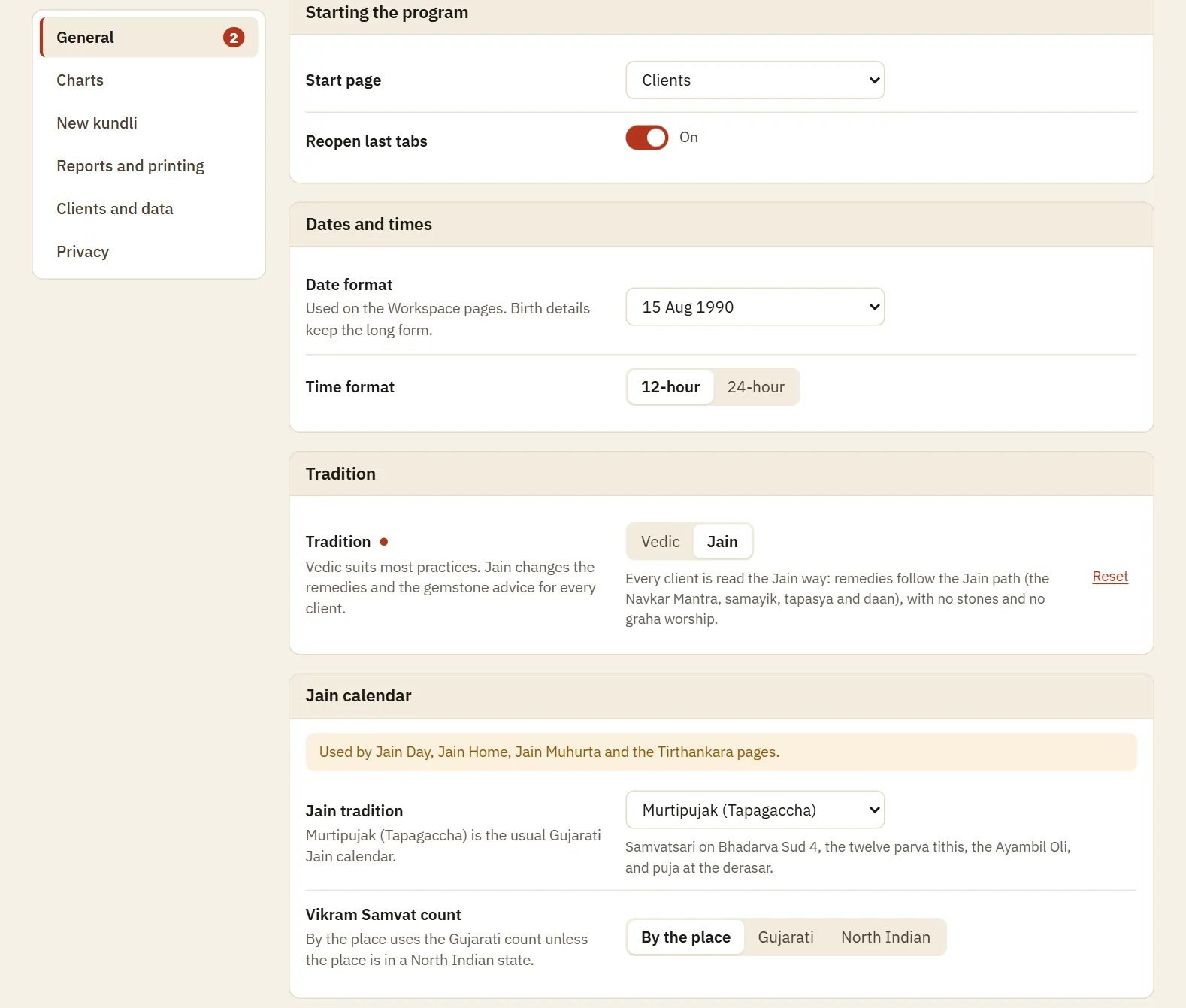
The Tradition setting
Settings, General. Choose Vedic or Jain for the whole practice, and the line under it says what changes. The Jain calendar choices sit just below.
How it fits a sitting
- Choose the setting once, Jain for the whole practice or a Jain mark on one client, and set the Jain calendar to the family's tradition.
- Open the Jain kundli and start with the sentence under the strip, which says how many checks need a look.
- Open a row to read the reasons and whether another planet softens it.
- Talk through the practices, which are simple acts such as Navkar, samayik, fasting and giving. Nothing here is bought.
- For a date, use Jain Day or Jain Muhurta, then ask the family to confirm with their own sangh or guru.
Method and sources
The Jain tithi is the one running at local sunrise, with the kshaya and vriddhi rule for parva tithis as Tapagaccha calendars apply it. Sunrise and the pachkhan times come from the shared engine for the place you set. Charts, dashas and doshas use the shared Vedic rules, read in Jain wording.
- Hemachandra, Trishashti-Shalaka-Purusha-Charitra, for the lives and the kalyanaka dates
- Kalpasutra, for birth, diksha and nirvana details and Samvatsari
- Tiloya Pannatti, for the Digambara line of the Tirthankara facts
- Umasvati, Tattvartha Sutra, for the ten dharmas of Das Lakshana
- Avashyaka Sutra and Uttaradhyayana Sutra, for the pachkhan and Porisi
- Jain Panchang conventions, for which day keeps a tithi
- Brihat Parashara Hora Shastra, for the conditional dashas, doshas and yogas
What it does not do
- The kalyanaka dates follow Hemachandra, the Shvetambara line. Digambara texts give some of them differently, and those are not in the tool yet.
- Three Digambara birth stars are not yet checked against the Tiloya Pannatti, and they are marked not confirmed.
- The Jain Muhurta scoring is a convention stated rule by rule. It is not yet checked against the Arambhasiddhi, the Jain muhurta text.
- Sanghs differ, and the page says so. Pachkhan times can differ from printed calendars by 2 to 4 minutes, and the 36 point match is the standard Ashtakoota used by Jain families.
Questions
Is Jain astrology a separate plan?
No. It is part of the Vedic plan. Choose Jain under Settings, General, Tradition, or leave Vedic on and mark a single client Jain in their group, tags or notes.
Do the Jain pages open only with the Jain setting?
No. The pages under More systems stay open on the Vedic plan with either setting. The Tradition setting changes how remedies and gemstones treat your clients, and the AI reader with them.
My clients are Digambara. Does it follow their calendar?
Choose Digambara under Jain calendar in Settings, and the pages use Das Lakshana, Ashtami and Chaturdashi and the Digambara reading of the Tirthankaras. The kalyanaka dates are still Hemachandra's for now, and the page says so.
Are stones or graha worship suggested?
No. With the Jain reading, stones are left out, and each sentence that names one is removed from a remedy line. The practices are the Navkar Mantra, samayik, tapasya and daan.
Why are the conditional dashas listed if they are not Jain?
They are Vedic tools kept in the Jain menu because Jain astrologers use the shared chart rules. The page names them as Vedic so nobody takes them as Jain doctrine.
Have another question?