Varshaphal software
The Tajika annual chart for any year of life, cast for the moment the Sun returns to its birth longitude. You get the year lord with every step of its choice, the Muntha, sahams, Tajik yogas, two period systems and twelve month charts.
Included in the Vedic plan, Rs 3,001 a month. No card needed. Sign in with Google to start.
Who it is for
Many clients come back once a year, near the birthday. This tool is for the astrologer who reads that year by the Tajika method and wants the working on screen, so a claim about the year lord or the Muntha can be checked by hand.
It reads the year against the birth chart and its running Vimshottari dasha. The birth chart stays the base, and the year chart shows how that dasha plays out over these twelve months.
What you can do with it
The year at a glance
- One line on how the year looks, easier, mixed or asking for patience, with its easier and harder stretches and the points behind that call.
- Tiles for the year lord, the Muntha, the strongest clean yoga, the periods running today, the next month chart and when the year begins.
- Pick any year, find the year that holds a date, or change the place of the chart.
- The birth-chart Vimshottari dasha running through the year.
- The year chart beside the birth chart, with the start given to the minute. A year lagna within 1 degree of a sign edge is flagged.
- The return uses the ayanamsa and node of the kundli.
Year lord and Muntha
- The five claimants, Muntha lord, year lagna lord, Tri-rashi lord, day-night lord and birth lagna lord, with the office each planet holds.
- The aspect of each claimant on the year lagna, its strength, and a numbered list of every step of the choice.
- Choose what happens when no claimant looks at the year lagna, by the Hayanaratna and the other readings, and which friendship table to use.
- A close call line when two claimants are within 0.5 of 20, saying who the other friendship table would name. A note when the Moon wins or the lord is very weak.
- The Muntha by sign or by degree, its house in the year chart and the birth chart, and the place, strength and marks of its lord.
- The Muntha month by month, one sign a month and 2.5 degrees a month, side by side.
Strength, sahams and yogas
- Panchavargeeya bala and Harsha bala out of 20, part by part, and a count of the twelve divisions in own or friendly signs.
- 51 sahams with day and night formulas. Punya comes first, then the eight lit up this year, drawn on the year chart.
- A note on each saham where other readings use another formula. Sahams named for hardship are folded away.
- The 16 Tajik yogas, from Ikkabala and Induvara to Ithasala, Easarapha, Kamboola, Radda and Duraph, read between the significators of the year.
- Each yoga with its gap and orb, a Why that goes step by step, and a mark when a joining is weakened.
- Add the lord of any house to the significators for a question about that part of life. The aspect of every pair of planets is in a fold.
Periods and months
- Mudda and Patyayini periods on one timeline with today marked, each with its dates and a line on what it brings into focus.
- Each Mudda period graded easier, steady or asks for care. Rahu and Ketu stay ungraded.
- The Patyayini working table, degrees, patyamsha, share of the year and days. Sub-periods can be shown too.
- Twelve month charts with the date each begins, the month lagna, month lord and Muntha. Day charts open under a month, marked as later practice.
Print and sources
- A year sheet of at most three A4 pages, in your colours, with the answer, both charts, the lord, the Muntha, the yogas, sahams, periods and month dates.
- A Sources page with 49 rules you can search. Each carries a label, Classical (27), Classical with later practice (4), Later practice (8) or Program aid (10).
- 8 of those rules are marked Not confirmed, and the page says what is still open.
See it in the tool
Real screens from the tool, made with sample charts. Select a screen to see it larger.
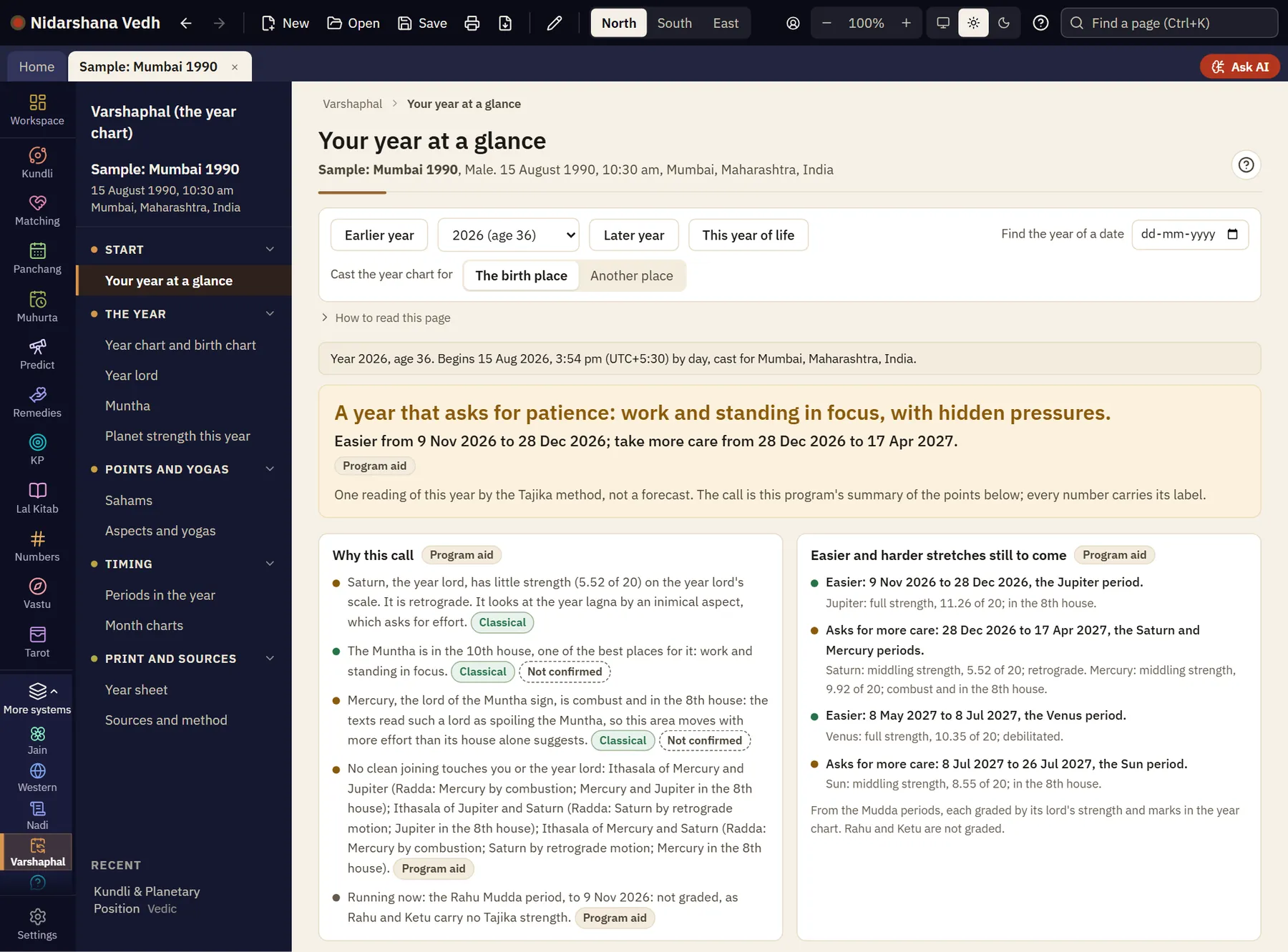
Your year at a glance
The call on the year comes first, with the points behind it. Each tile opens its own page with the full working.
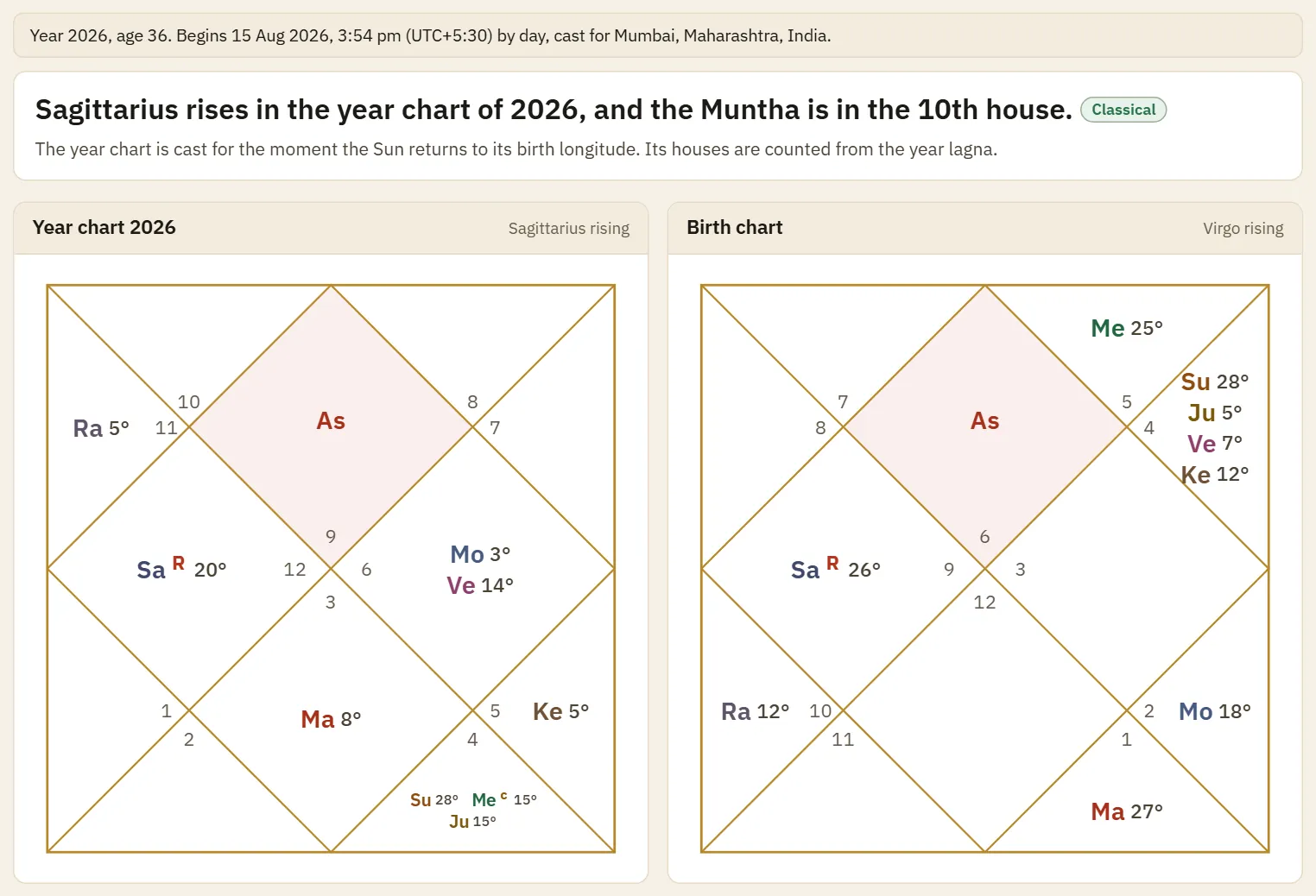
Year chart and birth chart
The two charts side by side, with when the year begins and where the chart is cast. Compare where each planet falls this year with where it was at birth.
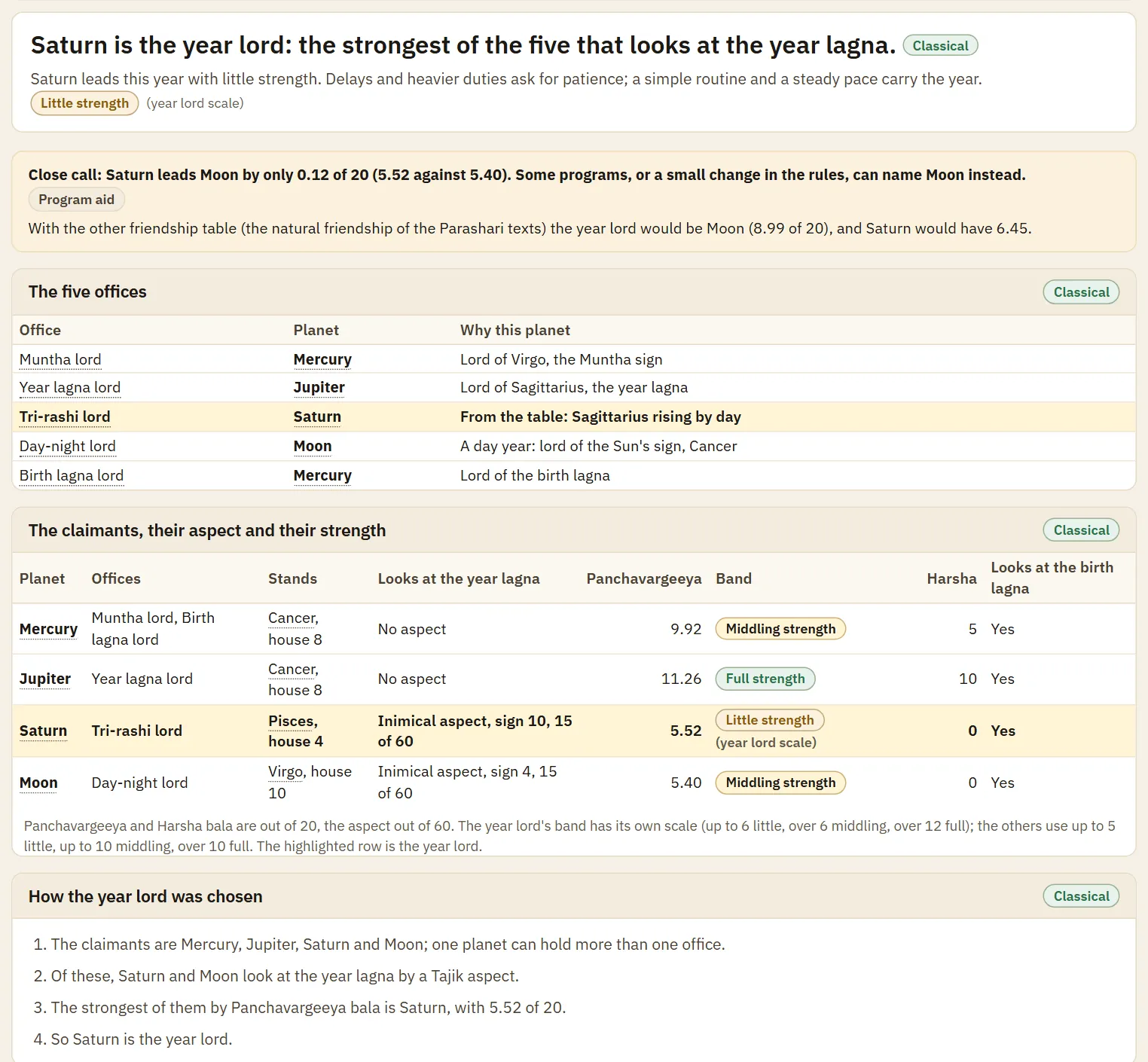
How the year lord was chosen
The five offices, each claimant's aspect and strength, then the numbered steps. A close call is stated, with the planet the other friendship table would name.
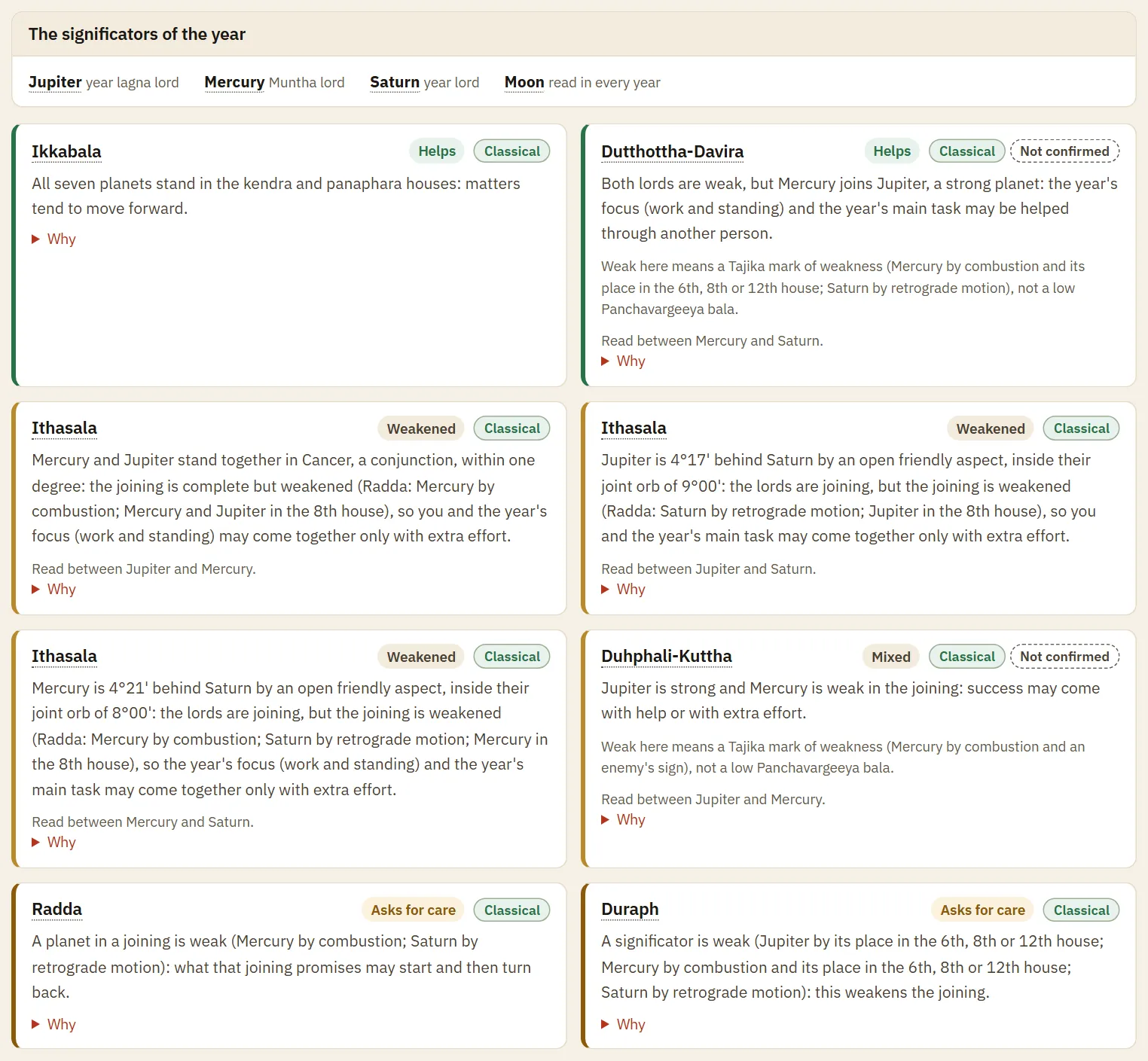
Tajik yogas of the year
The significators are listed first. Each yoga then gets a sentence with its gap and orb, and a Why for the conditions step by step.
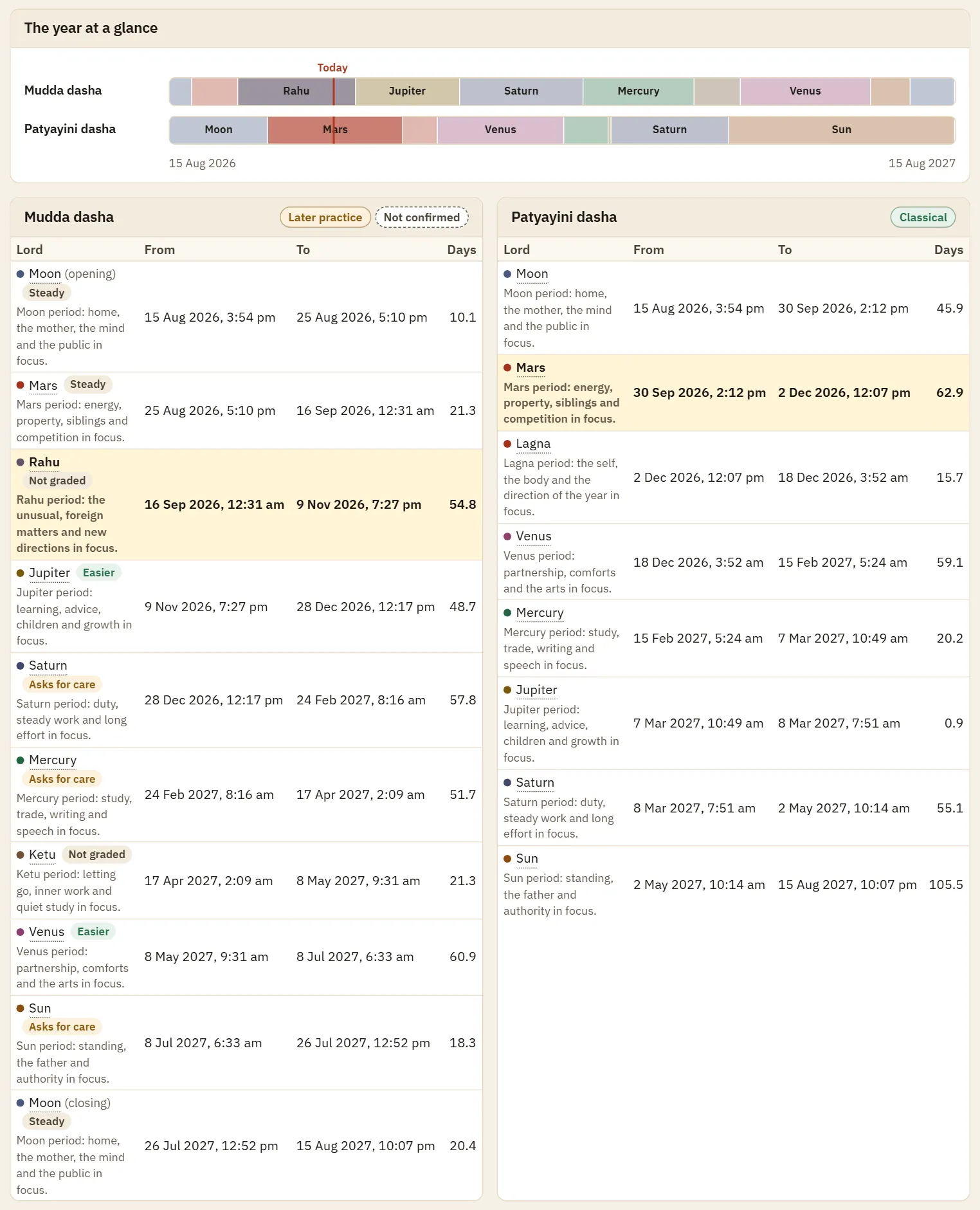
Periods in the year
Mudda and Patyayini on one timeline with today marked, then a table of each with dates and what each period brings into focus.
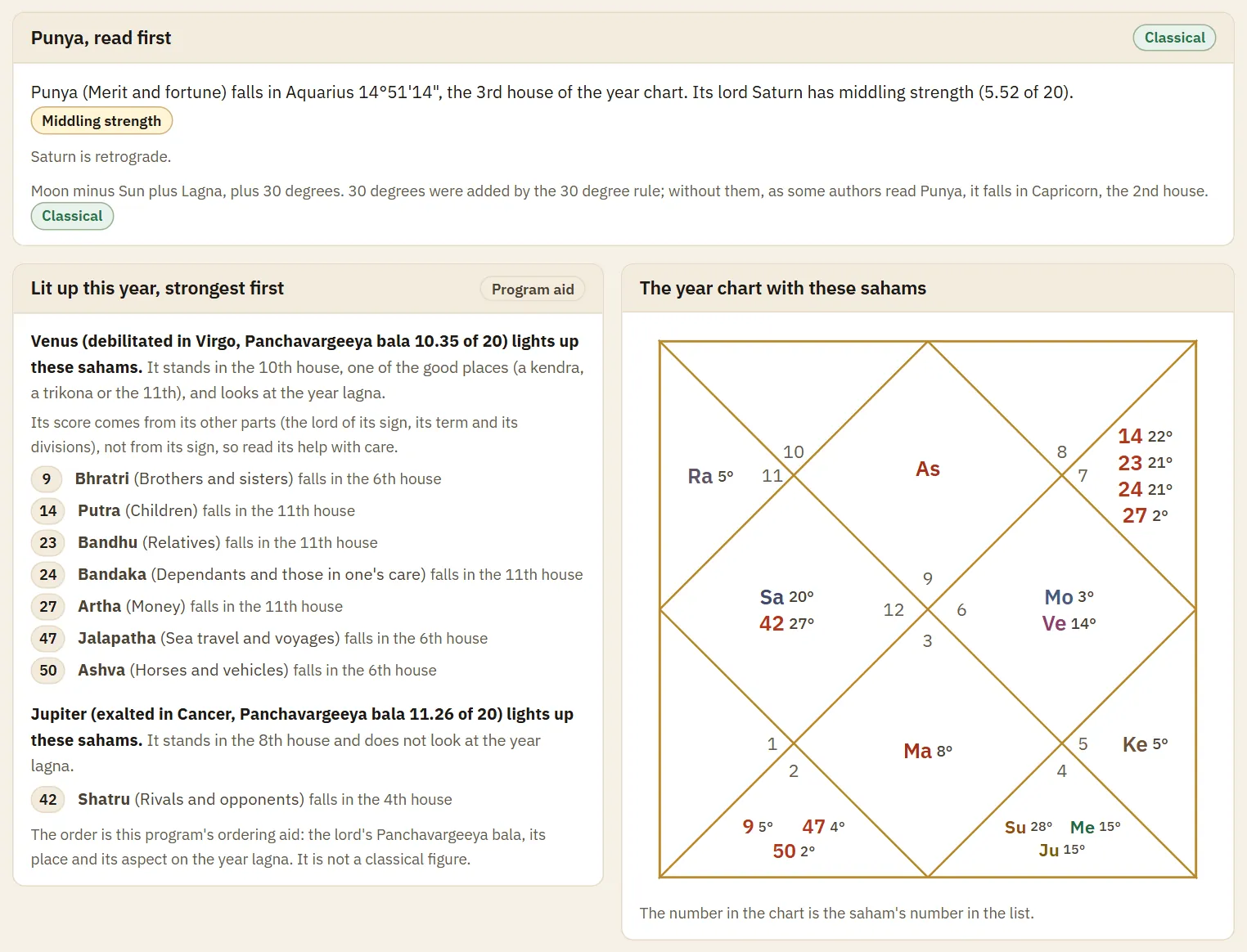
Sahams
Punya with its house, lord and formula, then the sahams lit up this year in plain words. The full list of 51 is in a fold.
How it fits a yearly sitting
- Open the client's kundli and the year. Change the place if the client now lives elsewhere and you prefer that chart.
- Read the call and the year lord. Open How it was chosen if the client's chart gives a close result.
- Read the Muntha house and its lord for where the year's attention goes.
- Go through the Mudda periods for the easier and harder stretches. Use the month chart of the month in question.
- Print the year sheet and talk it through with the client.
Method and sources
The year begins when the Sun returns to its exact birth longitude, in the kundli's own ayanamsa, and the chart is cast for the birth place unless you change it. The year lord is the strongest of the five claimants that aspect the year lagna. Where texts differ, the rule says which reading is used.
- Tajika Neelakanthi of Neelakantha (1587), the Samjna Tantra and the Varsha Tantra
- Hayanaratna of Balabhadra, in Martin Gansten's edition (Brill, 2020)
- Tajikashastra of Samarasimha, through its quotations in the Hayanaratna, and the Tri-rashi table of Manittha
- B. V. Raman, Varshaphal or the Hindu Progressed Horoscope, and K. S. Charak, A Textbook of Varshaphala, for later practice
What it does not do
- It reads the tone of a year and where attention goes. It does not forecast events, illness or loss.
- It needs a birth time. The year chart counts houses from a rising sign, so a kundli without a time cannot be read here.
- The Tripataki chakra and the sixty-hour charts are not included yet. Each waits on a printed text for its rules.
- The start of the year is shown to the minute. A birth time a few minutes off moves it by about as many minutes.
Questions
Which place is the year chart cast for?
The birth place by default. Many teachers use the place where the person lives at the start of the year, and you can change it in the top bar. The moment stays the same, and the rising sign and houses change.
Does it use the fixed year length of the texts?
No. It solves for the true return of the Sun. The texts add a fixed year, which runs about 3.4 minutes long and drifts later with age. The Sources page explains this.
Why do Mudda and Patyayini both appear?
Mudda is what most programs show. Patyayini is the period system of the Tajika texts. Both are shown with their label, and you can choose which comes first.
How far can I trust a given rule?
Each rule on the page has a label beside it, Classical, Classical with later practice, Later practice or Program aid. A Program aid only puts things in order and is never a classical figure.
Can I try a Varshaphal without this tool?
Yes. This website has a free Varshphal calculator. This tool adds the working, the month charts, the sahams and the year sheet.
Have another question?